
Summary of Simple circuit indicates health of lithium-ion batteries
### Summary This article describes a simple circuit designed to test the health of lithium-ion batteries by indicating whether the voltage is safe for recharging. The circuit uses two LEDs and a transistor to signal if the supply voltage is below 2.6V (unsafe) or above it (safe). Component values, such as LED forward voltages and diode types, depend on the specific LEDs chosen, with red LEDs being standard in this design.
Parts used in the Lithium-ion Battery Tester:
- Transistor
- LED1
- LED2
- Red LEDs
- Schottky diode
- 1N4148 diode
Lithium-ion batteries are sensitive to bad treatment. Fire, explosions, and other hazardous condition may occur when you charge the cell below the margin that the manufacturer defines. Modern battery chargers can manage the hazardous conditions and deny operation when illegal situations occur. This fact doesn’t mean, however, that all cells are bad. In most cases, you can replace the discharged battery and increase your device’s lifetime. Figure 1 shows the circuit for testing battery packs.
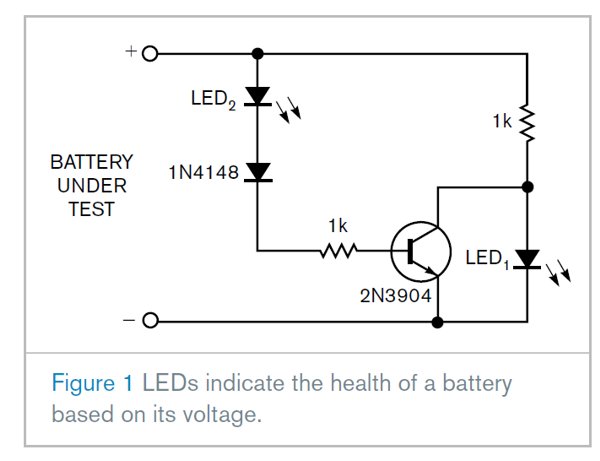
When the supply voltage is lower than 2.6V, no current drives the base of the transistor. LED1 lights up, and LED2 is off. When the voltage exceeds 2.6V, the transistor begins to short LED1, turning it off and lighting LED2. This condition indicates that the battery is below the allowed limit for recharging. The voltage margins highly depend on the type or color of the chosen LEDs. A standard red LED has a forward voltage of 1.7V; a green LED, about 2.1 or 2.2V. The circuit in this design uses red LEDs with forward voltages of approximately 1.6V at 2 mA. Other LEDs may require a simple redesign, mostly resulting in the requirement for a Schottky diode instead of the 1N4148 in this circuit. Even white or blue LEDs with 3V or more forward voltage make sense for certain applications.
For more detail:Simple circuit indicates health of lithium-ion batteries
- What happens when the supply voltage is lower than 2.6V?
No current drives the base of the transistor, causing LED1 to light up while LED2 remains off. - How does the circuit indicate that the battery is unsafe for recharging?
The condition where LED1 lights up and LED2 is off indicates the voltage is below the allowed limit. - Does the voltage margin depend on the type of LED used?
Yes, the voltage margins highly depend on the type or color of the chosen LEDs. - What is the forward voltage of a standard red LED mentioned in the text?
A standard red LED has a forward voltage of approximately 1.7V, or about 1.6V at 2 mA in this design. - Can white or blue LEDs be used in this circuit?
Yes, white or blue LEDs with 3V or more forward voltage make sense for certain applications. - What component change might be required if using different LEDs?
Other LEDs may require a redesign, mostly resulting in the requirement for a Schottky diode instead of the 1N4148. - Why are modern battery chargers mentioned in the context of this project?
They are mentioned to explain how they manage hazardous conditions and deny operation when illegal situations occur.
