
Summary of DIY OPA2134 RIAA Phono Preamplifier
This article describes a high-performance solid-state phono preamplifier designed for both moving magnet (MM) and low-output moving coil (LOMC) cartridges. The author prioritizes low noise and ease of construction, utilizing an operational amplifier (op-amp) based circuit. Key design choices include precise RIAA equalization calculations followed by manual tweaking with test equipment to optimize performance. A notable feature is the use of a Meanwell DCW03A-12 DC to DC converter to generate symmetrical +/- 12V power rails from a single input source, simplifying the power supply architecture compared to traditional methods.
Parts used in the DIY OPA2134 RIAA Phono Preamplifier:
- Operational amplifier (op-amp)
- Moving magnet (MM) cartridge
- Low output moving coil (LOMC) cartridge
- Quality components
- Solid state DC to DC converter (Meanwell DCW03A-12)
This project is a departure from that of my normal sort. It is based around an operational amplifier (op-amp)… Yup I’ve transgressed to the dark side. Actually I have nothing against integrated circuits (IC) or solid state devices and in fact use a number of solid state components in my designs. This project is for a relatively simple high performance phono preamplifier that can handle both moving magnet (MM) and low output moving coil (LOMC) cartridges.
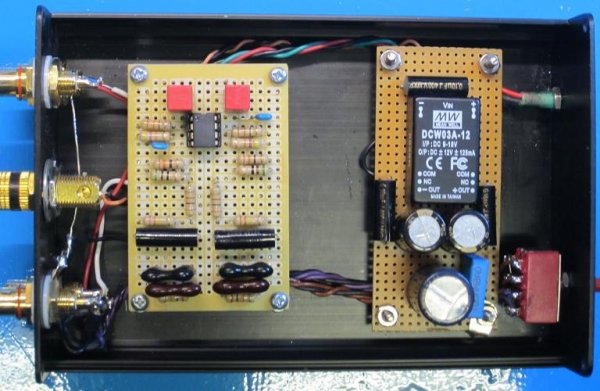
The basis for the project was a temporary need to have a LOMC preamp in addition to the valve (vacuum tube) ones I have to study low noise performance. Without trying to start any arguments, I have found that it is a lot easier to make a low noise high gain solid state circuit than it is to do the same for valve circuit of similar capabilities. The circuit I came up with is pretty much like many common op-amp based phono preamplifier circuits. I did go through the process of doing the RIAA calculations and then some final tweaking with both my test equipment and use in my reference system.
The values were initially fairly close, but tweaking made the performance significantly better. I used quality components throughout the build. I have always sought ways to do things better and easier so the power supply is a great example of this concept. I won’t say I cheated, but I did use a solid state DC to DC converter to get the symmetrical voltages needed (available from Jameco for $10.95 each). For those of you unfamiliar with the Meanwell DCW03A-12 converter – (PDF 78kB) it is about the size of an ice cube and takes anything from about 9 volts to 18 volts DC as input and puts out symmetrical regulated dual supply at plus and negative 12 volts DC. This particular one is limited in current to about 125 mA on each rail.
Other members of the family can deliver more and there are numerous voltage combinations available. Another one I like can take 120 or 240 volts AC input and deliver a regulated 12 volts DC at nearly half an amp. It is not much bigger in size. Line to load isolation is excellent. Since the output from the converter is regulated and symmetrical around “zero” volts there is no provision for restricting DC gain or offset. None was needed as constructed. Note however that DC offset adjustment might be necessary if you use a different method for the power supply.
For more detail: DIY OPA2134 RIAA Phono Preamplifier
- What type of cartridges does this preamplifier support?
The project handles both moving magnet (MM) and low output moving coil (LOMC) cartridges. - How was the circuit optimized for performance?
The values were initially set close via RIAA calculations and then significantly improved through final tweaking with test equipment and use in a reference system. - Can I build a low noise circuit using solid state devices?
Yes, the author found it easier to make a low noise high gain solid state circuit than to achieve similar capabilities with valve circuits. - What specific DC to DC converter is recommended for the power supply?
The article recommends the Meanwell DCW03A-12 converter available from Jameco. - What input voltage range does the Meanwell DCW03A-12 accept?
The converter takes anything from about 9 volts to 18 volts DC as input. - Does the described power supply require DC offset adjustment?
No, since the output from the converter is regulated and symmetrical around zero volts, no provision for restricting DC gain or offset was needed as constructed. - Is line to load isolation good in the recommended power supply?
Yes, the article states that line to load isolation is excellent for the Meanwell converter. - What is the current limit on each rail for the Meanwell DCW03A-12?
This particular converter is limited in current to about 125 mA on each rail.
