
Summary of Inexpensive power switch includes submicrosecond circuit breaker
This article describes a high-voltage power switch circuit that functions as a submicrosecond circuit breaker. It uses a low-voltage control signal to activate a P-channel MOSFET, sourcing current through a sense resistor. If the load current exceeds safe limits, the voltage across the sense resistor triggers a latching transistor pair (Q1 and Q2) that cuts off the MOSFET, protecting the power source. The system resets by lowering the control signal or cycling power, with component values scalable for various voltage ranges.
Parts used in the High-Voltage Power Switch:
- Transistor Q3
- P-channel MOSFET Q4
- Resistor R6
- Resistor R7
- Sense resistor R3
- Transistor Q1
- Transistor Q2
- Resistor R4
- Diode D2
- Resistor R1
- Resistor R5
The circuit in Figure 1 lets you switch high-voltage power to a grounded load with a low-voltage control signal. The circuit also functions as a submicrosecond circuit breaker that protects the power source against load faults. Power switches to the load when you apply a logic-level signal to the output control terminal.
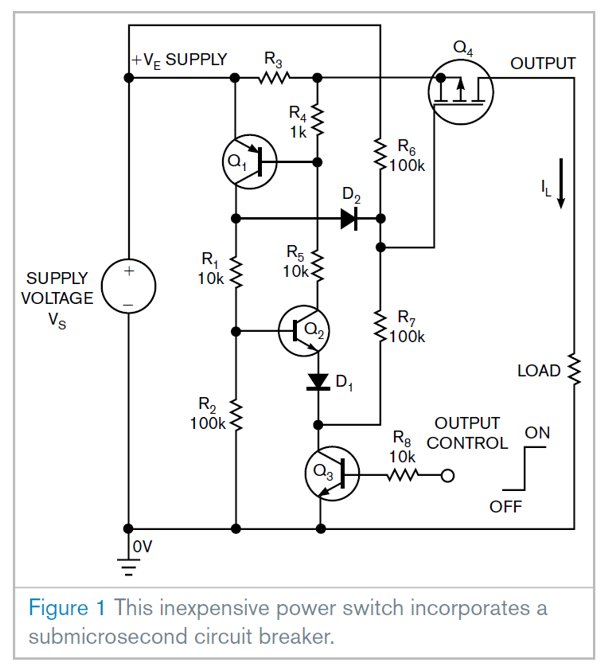
circuitWhen the signal is lower than 0.7V, transistor Q3 is off and the gate of P-channel MOSFET Q4 pulls up to the positive supply through R6, thus holding Q4 off. During this off condition, the circuit’s quiescent-current drain is 0A.
A 3 to 5V signal at the control terminal turns on Q3, which pulls R7 to 0V, providing gate drive for Q4. The MOSFET now turns on and sources the load current, IL, through sense resistor R3 to the load. If R3’s and Q4’s on-resistances are smaller than the load resistance, the magnitude of the supply voltage, VS, and the load resistance mainly determine the load current.
Under normal load conditions, the sense voltage developed across R3 is too small to bias Q1 on; thus, Q1 and Q2 are both off. If, however, the load current increases, the voltage across R3 may become large enough to turn on Q1. At that point, base current flows through R4 to Q1, and Q1’s collector current in turn provides base current for Q2. As Q2 turns on, it provides extra base drive for Q1, and the two transistors rapidly latch in the on-state.
With Q1 saturated, its collector pulls D2’s anode to the positive supply, which clamps Q4’s gate voltage to a diode drop below VS. Without gate drive, the MOSFET turns off, and IL falls to 0A. With Q1 and Q2 both latched on, Q4 remains off, which protects the power source from excessive load currents. You can reset the circuit breaker simply by taking the control signal low or by cycling the power. The resistance values in Figure 1 are suitable for operation at supply voltages of 20 to 30V. Assuming that the transistors are suitably rated, the circuit can operate at much higher voltages, but you must scale the resistor values accordingly. Operation at a voltage as low as approximately 5V is also possible, but you may need to reduce the values of R1 and R5 to ensure proper drive for Q1 and Q2. Resistors R6 and R7 form a potential divider, which sets Q4’s gate-to-source voltage, VGS, to a value large enough to enhance the MOSFET fully when Q3 is turned on.
For more detail: Inexpensive power switch includes submicrosecond circuit breaker
- How does the circuit turn on the power switch?
A 3 to 5V signal at the control terminal turns on Q3, which pulls R7 to 0V and provides gate drive for Q4. - What happens when the control signal is lower than 0.7V?
Transistor Q3 turns off, causing the gate of Q4 to pull up to the positive supply through R6, holding Q4 off. - How does the circuit detect an overload condition?
An increase in load current creates a large enough voltage across R3 to turn on Q1. - What mechanism protects the power source from excessive currents?
Q1 and Q2 latch in the on-state, clamping Q4's gate voltage via D2 and turning the MOSFET off. - How can you reset the circuit breaker?
You can reset it by taking the control signal low or by cycling the power. - What determines the load current under normal conditions?
The magnitude of the supply voltage and the load resistance mainly determine the current if resistances are small. - Can this circuit operate at voltages other than 20 to 30V?
Yes, it can operate at higher voltages with scaled resistors or as low as approximately 5V. - Why are R6 and R7 important in the design?
They form a potential divider that sets the VGS value to fully enhance the MOSFET when Q3 is on.
