
Summary of Make a proper PCB exposer out of a cheap UV nail curing lamp
This article details a low-cost DIY method for building a UV light source to expose PCB materials like dry film photoresist and UV curable soldermask. The project modifies a cheap UV nail curing lamp to solve issues of collimation, uniform illumination, and exposure time, achieving results in under two minutes for approximately $20.
Parts used in the DIY PCB Exposer:
- UV nail curing lamp
- Reflector design
- Dry film photoresist
- UV curable soldermask
This instructable is about how to use such a device to build a low cost light source, suitable for exposing the various UV sensitive materials encountered in printed circuit board production, like dry film photoresist and UV curable soldermask.

As well as being very low cost (around $20 for all required materials), this build addresses a few issues I’ve seen on other devices on the intertubes:
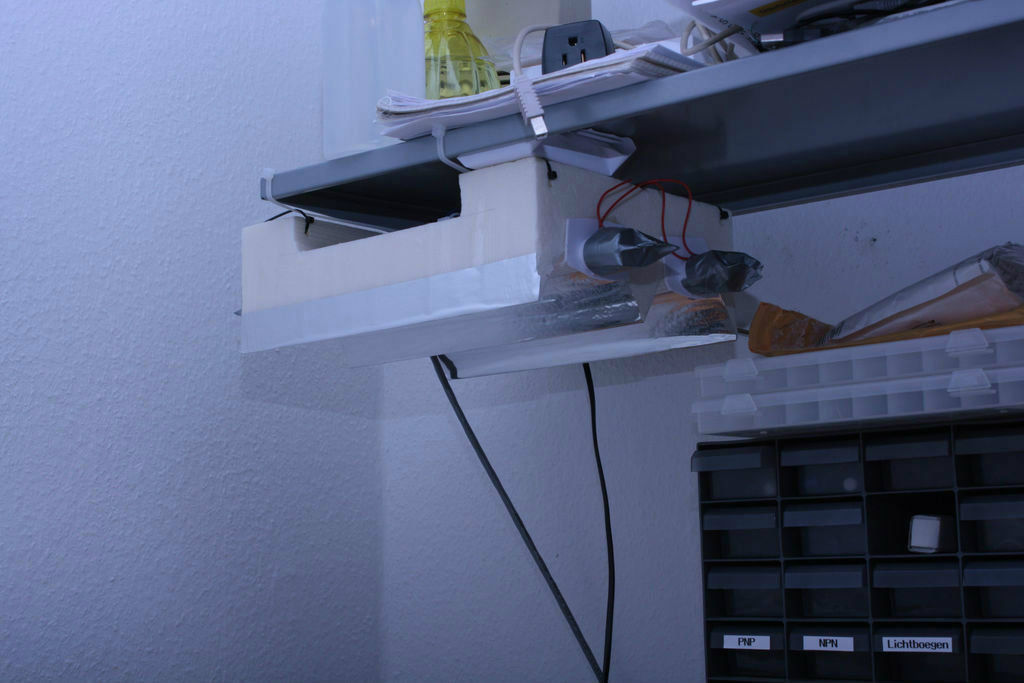
As well as being very low cost (around $20 for all required materials), this build addresses a few issues I’ve seen on other devices on the intertubes:
- Collimation: To simply expose a board with fairly coarse features, you wouldn’t need to do any of this. You could just use the nail dryer as is and call it a day. But to be able to expose small features (down to 5mil, according to this site), you have to make sure all your UV rays come from the same direction, which is exactly perpendicular to the board you are exposing.
- Uniformity of illumination across the whole exposure plane. Imagine you want to expose a really big board, e.g. A4 or letter sized. You’d want the same amount of energy over the whole board, without hot or dark spots. For this, the energy source has to have a certain distance from the exposure plane and you need either a very tightly packed array of UV sources (like UV-LEDs, which can be rather pricey), or an effective reflector design for the UV sources you have at hand, which is what I came up with.
- Exposure time: I have no idea how fast this source is with pre-sensitized positive copper clad material, as I’ve never used that stuff, but with dry film photoresist it feels really fast. Like under two minutes fast. The thing is, I’m not really qualified to properly interpret the results, so I have to gather a few more opinions on this one.
For more detail: Make a proper PCB exposer out of a cheap UV nail curing lamp
- What is the primary purpose of this device?
To build a low cost light source suitable for exposing UV sensitive materials in printed circuit board production. - How can you expose small features down to 5mil?
You must ensure all UV rays come from the same direction which is exactly perpendicular to the board. - How do you achieve uniformity of illumination across a large board?
The energy source needs a certain distance from the plane or an effective reflector design must be used. - What is the estimated cost of this build?
The total cost is around $20 for all required materials. - Does this device work with pre-sensitized positive copper clad material?
The author has no idea how fast it is with that specific material as they have never used it. - How long does the exposure take with dry film photoresist?
The exposure feels really fast, taking under two minutes. - Why is a reflector design necessary instead of just using the lamp as is?
A simple nail dryer lacks the collimation needed for fine features and uniformity for large boards.
