
Summary of MPPT solar charger
This article details a prototype MPPT solar charger featuring ultra-low standby power consumption (approx. 13–14 µA) using a Texas TPS62120 buck converter. The system employs a PIC18F26J50 microcontroller capable of switching between 8MHz, 48MHz, and 32.768kHz clock sources for general operation and real-time clock functions. While USB support is pending, core software functionality is operational, though the design retains some flaws requiring future improvement.
Parts used in the MPPT Solar Charger:
- Texas TPS62120 low-power buck converter
- PIC18F26J50 microcontroller
- 8MHz primary crystal oscillator
- 32.768kHz secondary oscillator
- Voltage divider circuit
In a previous post I have presented a design for an MPPT Solar Charger. In the mean time I have built a prototype and also wrote some software for it. So today I’ll go through my findings of what works well and what needs to be improved. And yes, there are some flaws in the design…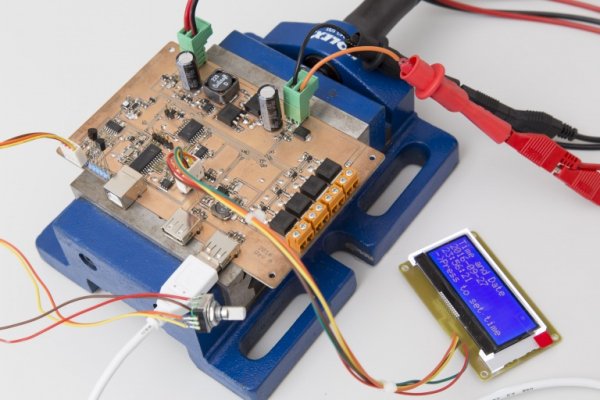
The software is far from final but with the notable exception of USB all the basic functionality has been implemented.
Power Supply
One of my main goals with this design is to archieve very low standby current, somewhere in the tens of microamps. The basis for this is a low-power buck on the basis of a Texas TPS62120 where the microcontroller can switch the output voltage between 2.2 and 3.3 volts nominally. This works as intended. With no load and the output voltage low, the supply consumes 12.9 microamps at 12V input voltage. With the high output voltage the idle current goes up to 14.3uA. Quite a bit of that current is due to the voltage divider that sets the output voltage. The regulator itself consumes about 9uA in both cases.
Microcontroller
The PIC18F26J50 starts up using the primary oscillator’s 8MHz crystal with the internal PLL disabled. It can then switch to 48MHz operation by enabling the PLL or to the secondary oscillator running at 32.768kHz. The latter is always running since it also serves as the clock source to the real-time clock and calender (RTCC). Switching between clock sources as well as the RTCC have been implemented in software and work fine.
For more detail: MPPT solar charger
- What is the target standby current for this design?
The goal is to achieve very low standby current, specifically somewhere in the tens of microamps. - How does the microcontroller start up initially?
The PIC18F26J50 starts up using the primary oscillator's 8MHz crystal with the internal PLL disabled. - Does the secondary oscillator run continuously?
Yes, the 32.768kHz secondary oscillator is always running as it serves as the clock source for the real-time clock and calendar. - Can the output voltage be switched by the microcontroller?
Yes, the microcontroller can switch the output voltage between 2.2 and 3.3 volts nominally. - What is the idle current consumption at high output voltage?
With the high output voltage, the idle current goes up to 14.3uA. - Is the USB functionality fully implemented?
No, with the notable exception of USB, all basic functionality has been implemented, but the software is far from final. - What is the regulator's own power consumption?
The regulator itself consumes about 9uA in both low and high output voltage cases. - Can the system switch between different clock sources?
Yes, switching between clock sources as well as the RTCC have been implemented in software and work fine.
