
Summary of Withings Body Cardio Teardown
The Withings Body Cardio is a smart scale measuring weight, body composition, hydration, heart rate, and Pulse Wave Velocity. This teardown reveals its internal architecture, highlighting the challenge of disassembly due to adhesive usage. The device employs four load cells arranged in Wheatstone bridges for accurate weighing and off-center detection. Key internal components include the main PCB, a rechargeable LiPo battery, and an LCD display, all connected via 3-wire systems to a central controller unit.
Parts used in the Withings Body Cardio:
- Four Torx screws
- Double-sided adhesive cushions
- Four 3-wire load cells
- Two Wheatstone bridges
- Two separate amplifiers
- Main PCB
- Rechargeable LiPo battery
- LCD display
- Controller unit
The Withings Body Cardio is the latest in the brand’s range of smart health-centered devices, and the second Withings product we’ve tackled in this series!
It’s a smart scale with a pretty impressive set of metrics. It detects weight; fat, muscle and bone mass; hydration level; heart rate; PWV (Pulse Wave Velocity); and it shows your daily step count (if you use the app) and today’s weather.
Of course, this data collection was exactly what we were interested in: how does the scale measure these different factors?
We gathered our tools and found out…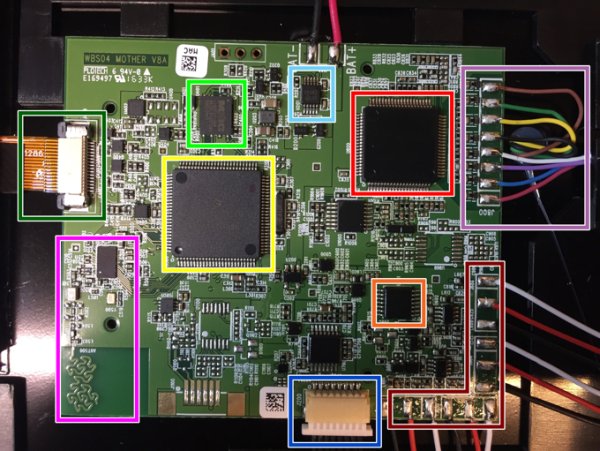
Taking it apart
Opening up the scale was not an easy task – there was a lot of double-sided tape involved. There was also a pretty serious risk of breaking the scale while trying… So you can be extra glad we already did the hard work for you 😉
The back of the scale is fastened with four Torx screws – easy enough. The entire backplate, however, is glued to the front with double-sided adhesive cushions. Removing it simply involved pulling it firmly enough to break the adhesive, but not so hard as to break the connectors.
With the backplate removed, you can immediately spot 4 loads cells, one in each corner. According to a patent they issued last year they arrange the load cells in such way that only two Wheatstone bridges are used. This arrangement provides two outputs being amplified by two separate amplifiers which are fed to the controller unit. Also, having two outputs gives the scale the possibility to compare the two (left and right) and detect when the user stands off-center on the scale which is indicated on the display.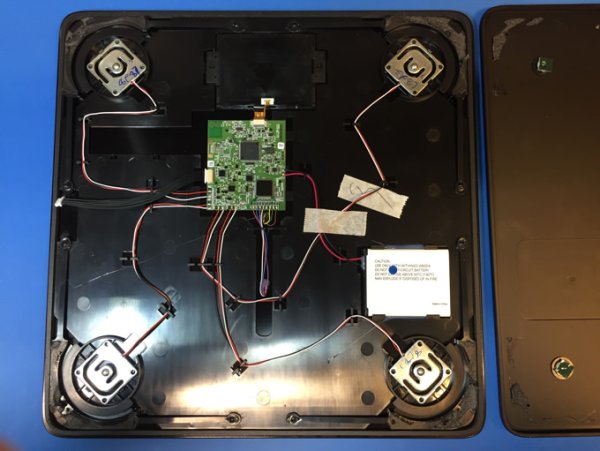
Having four 3-wire load cells and some kind of Wheatstone bridge configuration is one of the most common ways to design a weighing scale: open up your regular kitchen scale and you’ll probably find the same setup.
Apart from the four 3-wire load cells in the corners, you can see the main components: the main PCB in the middle, a rechargeable LiPo battery on the right, and the display on the top.
For more detail: Withings Body Cardio Teardown
- How does the scale detect off-center standing?
The scale compares two outputs from the load cell arrangement to detect when a user stands off-center. - What metrics does the Withings Body Cardio measure?
It measures weight, fat, muscle, bone mass, hydration level, heart rate, PWV, step count, and weather. - Why was opening the scale difficult?
Opening was hard because the backplate was glued to the front with double-sided adhesive cushions. - How many load cells are inside the scale?
There are four 3-wire load cells located in each corner of the scale. - What configuration do the load cells use?
The load cells are arranged so that only two Wheatstone bridges are used. - Where is the battery located inside the device?
The rechargeable LiPo battery is located on the right side of the internal layout. - What secures the backplate to the scale frame?
The backplate is secured by four Torx screws and double-sided adhesive. - Can the scale show daily step counts without the app?
The article states it shows daily step count if you use the app.
