
Summary of 3 MilliWatt-Consumption Data Glasses
This article describes low-power data glasses developed by the Fraunhofer Institute FEP. Using OLEDs on silicon semiconductors, these glasses display images via radio links while preserving hands-free operation and environmental light perception. A key innovation is a chip that updates only changing parts of the video stream rather than refreshing the entire screen, reducing power consumption to just 2–3 milliWatts compared to standard displays' 200 milliWatts.
Parts used in the Data Glasses:
- OLEDs embedded in silicon semiconductor
- Silicon semiconductor controlling individual pixels
- Radio link receiver
- Chip for partial image updating
Data glasses display information to the eye without interfering with the wearer‘s vision but they run energy down very quickly due to the consumption of electronics while processing video images and data. Researchers at Fraunhofer Institute for Organic Electronics, Electron Beam and Plasma Technology FEP had developed a new data glass that has low-power consumption. Received using a radio link, the glasses is able to display images to the wearer while his/her hands are free.
These glasses also goes bright even the power is somehow low thanks to the OLEDs embedded to a silicon semiconductor which controls the individual pixels. Plus, they have the ability to perceive light from the environment around not only emit it.
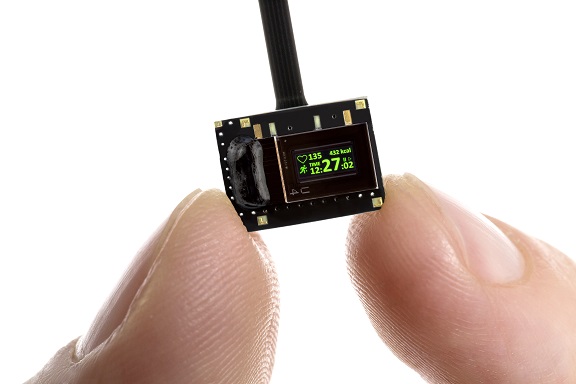
Another reason to high power consumption in data glasses is loading the data stream, but FEP researchers have came up with a new way to reduce it by changing only objects that are changed and keep the constant ones,
“We now control the chip so that the entire video image is not constantly renewed, rather only that part of the display in which something changes.” – Project manager Philipp Wartenberg “For example, if an actor runs through a room in a movie, only his position changes, not the background. In applications such as a navigation system for cyclists, in which only arrows or metre information is displayed, it is unnecessary in any case to constantly renew the whole picture, to put it simply, we have now adapted the circuit so that it only lets through that portion of the data stream which changes.”
FEP data glasses requires an output of 2-3 milliWatts, a fraction of the output need for ordinary displays – around 200 milliWatts.
For more detail: 3 MilliWatt-Consumption Data Glasses
- How do these glasses save energy?
The chip updates only the changing parts of the video image instead of constantly renewing the entire display. - What technology allows them to work with low power?
OLEDs are embedded into a silicon semiconductor which controls individual pixels. - Can the glasses perceive environmental light?
Yes, they have the ability to perceive light from the environment around them in addition to emitting it. - How much power do these glasses require?
They require an output of 2-3 milliWatts. - How does this compare to ordinary displays?
Ordinary displays need around 200 milliWatts, whereas these glasses use a fraction of that amount. - How is the data stream managed to reduce consumption?
Researchers changed the circuit to let through only the portion of the data stream where objects change. - Do the glasses keep the wearer's hands free?
Yes, received via a radio link, the glasses allow the wearer to see images while their hands remain free. - Why do traditional data glasses run out of energy quickly?
Traditional glasses consume high energy due to electronics processing video images and data streams.
