
Summary of New PWM controller IC By Microchip Charges Batteries of Any Chemistry
Nanotechnology is revolutionizing battery chemistry, creating diverse types like Li-ion and supercapacitors. To address the challenge of needing specific chargers for each type, Microchip introduced the MCP19124/5 hybrid PWM controller. This device integrates an 8-bit PIC microcontroller with an analog PWM controller to support universal charging across various chemistries. It features dual control loops for current and voltage regulation, allowing dynamic profile adjustments via I2C or GPIOs. The chip supports multiple topologies including Boost and Flyback, operating within a 4.5-42V range with minimal external components required.
Parts used in the Universal Battery Charger Project:
- MCP19124 PWM Controller IC
- MCP19125 PWM Controller IC
- 8-bit PIC Microcontroller (Integrated)
- Analog PWM Controller (Integrated)
- I2C Communication Interface
- GPIO Pins (9 for MCP19124, 12 for MCP19125)
- High Voltage Linear Regulator (Integrated)
- Temperature Sense Diode (Integrated)
- 10-bit A/D Converter (Integrated)
- External Feedback Networks
Battery technologies of all chemistry are experiencing revolutionary changes nowadays. Nanotechnology is leading this revolution by yielding new battery technologies including but not limited to Tiny Supercapacitors and Li-ion batteries that never explode at any condition. But, it’s bothersome to make different chargers for different types of batteries. So, Microchip solved this problem by introducing a new hybrid PWM controller, MCP19124/5, that charges batteries of any chemistry.
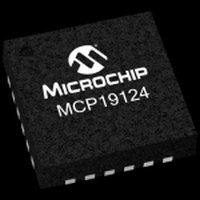
The power of this charging device lies in the combination of an 8-bit PIC microcontroller and an analog PWM controller in one package. This mixed signal low-side PWM controller features individual analog PWM control loops for both current regulation and voltage regulation. It can be configured with separate feedback networks and reference voltages. Any voltage, current, temperature, or duration can be used to trigger a transition to a different charging profile.
Various types of batteries require different charging profile. So, the only way to charge all kinds of batteries with a single device is to simulate all the charging profiles. A user can set his/her desired profile with the help of two independent current and voltage control loops, along with variable reference voltage. Now let’s get to know more details about this versatile PWM controller IC.
MCP19124/5 :
The MCP19124/5 is a mid-voltage (4.5-42V) analog-based PWM controller with an integrated 8-bit PIC Microcontroller. There are two devices, the MCP19124 and MCP19125, where the last one has four I/O pins more than the first one. MPC19124 and MPC19125 are packaged in 24-lead QFN package and 28-lead QFN package respectively. It has following features:
- Smooth, dynamic transitions from constant-current to constant-voltage operation
- Dynamically adjustable output current and output voltage over a wide operating range
- Wide operating voltage range: 4.5-42V
- Analog peak-current mode Pulse-Width Modulation (PWM) control
- Available fixed frequency (31 kHz to 2 MHz)
- I2C communication interface
- 9 GPIO for MCP 19124 and 12 GPIO for MCP19125
- Integrated high voltage linear regulator, with external output
- Integrated temperatures sense diode
- Integrated 10 bit A/D converter
- Minimal external components needed
- Custom algorithm support
- Topologies supported include Boost, SEPIC, Flyback, and Cuk
In fact, the above list is just a brief overview. The controller is so complicated that user must read all 236 pages of the datasheet to gain sufficient knowledge.
Now, the question is, how can we use this IC to design an efficient battery charger?
To find the answer, one must read the datasheet thoroughly. At the same time, in-depth knowledge about the target battery is also required. However, Microchip provided a few schematics (as references) in the datasheet based on different applications. The circuit on battery charger is given below:
For more detail: New PWM controller IC By Microchip Charges Batteries of Any Chemistry
- How does the MCP19124/5 charge different battery chemistries?
It combines an 8-bit PIC microcontroller and an analog PWM controller to simulate various charging profiles using independent current and voltage loops. - What is the operating voltage range of the MCP19124/5?
The device operates within a wide voltage range of 4.5 to 42 volts. - Can the output current be adjusted dynamically?
Yes, the output current and output voltage are dynamically adjustable over a wide operating range. - What communication interface does the controller use?
The controller features an I2C communication interface. - Which power supply topologies are supported by this IC?
Supported topologies include Boost, SEPIC, Flyback, and Cuk. - How many GPIO pins does the MCP19125 have compared to the MCP19124?
The MCP19125 has 12 GPIO pins, while the MCP19124 has 9 GPIO pins. - Does the chip require many external components?
No, it requires minimal external components due to its integrated features. - What internal sensors are included in the MCP19124/5?
It includes an integrated temperature sense diode and a 10-bit A/D converter.
