
Summary of PIR motion sensor interface with AVR-microcontroller ATMEGA32
This article explains interfacing a Passive Infrared (PIR) motion sensor with an ATmega32 AVR microcontroller. The system detects moving living objects and controls an LED based on motion presence. When motion is detected, the PIR output goes high, turning the LED on; otherwise, it remains off. Common applications include automated doors, lifts, garden lights, and parking area monitoring.
Parts used in the PIR Motion Sensor Interface Project:
- Passive Infrared (PIR) sensor
- Atmega32 AVR microcontroller
- LED
- PortC.0 pin
- PORTB.0 pin
Passive Infra red sensor also known as PIR sensors is capable of detecting motion or movement within a certain range. These type of sensors have wide range of applications in our daily life and it is essential to learn the interfacing method. This article is going to demonstrate the PIR motion sensor interface with AVR microcontroller.
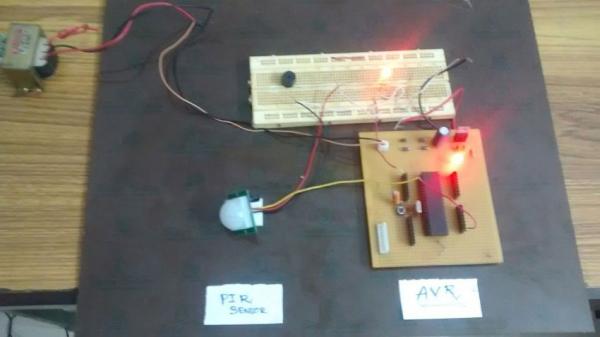
APPLICATIONS OF PIR SENSOR:
Lets see some of the common applications of PIR sensor for better understanding.
- Automated doors in shopping malls.
- Lifts
- Garden lights
- Parking areas.
PIR SENSOR:
The PIR sensor detect only bodies (hot materials and living objects) in motions not the static ones. This sensor uses Infra red beam to detect the motion and only covers a certain space based on the sensor model, i advise you to go through the manufacturer datasheet to know about the range. This sensor module gives only two output states that is logic High 1 which is equivalent to 3.3 V and logic low 0 equivalent to 0 V.
WORKING:
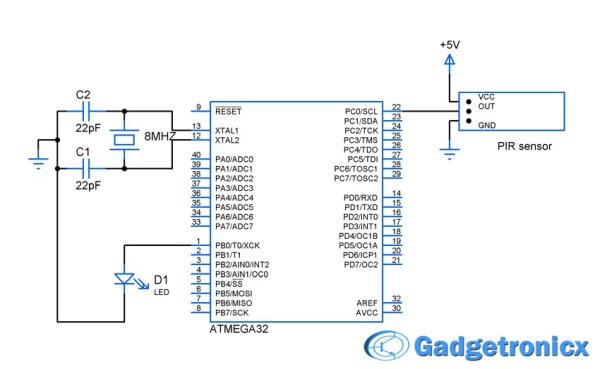
The PIR sensor is interfaced with Atmega32 AVR microcontroller to detect the motion around the environment. Atmega32 considers any voltage between 2V to 5V as logic high. Hence PIR sensor is directly interfaced to the input pin of the controller.
The circuit shown above will read the status of the output of the PIR sensor and switch ON the LED when there is a motion detected and switch OFF the LED when there is nothing. Output pin of the PIR sensor is connected to PortC.0 pin of the atmega32. LED is connected through PORTB.0 of the microcontroller.
Read More: PIR motion sensor interface with AVR-microcontroller ATMEGA32
- What does a PIR sensor detect?
A PIR sensor detects bodies, hot materials, and living objects in motion, but not static ones. - How does the PIR sensor indicate motion?
The sensor provides two output states: logic High 1 equivalent to 3.3 V for motion and logic low 0 equivalent to 0 V for no motion. - Can the PIR sensor be directly connected to the Atmega32?
Yes, because the Atmega32 considers voltages between 2V to 5V as logic high, matching the PIR sensor's output levels. - Which pins are used for connecting the PIR sensor and LED?
The PIR sensor output connects to PortC.0, while the LED connects through PORTB.0 of the microcontroller. - What happens to the LED when motion is detected?
The circuit switches ON the LED when motion is detected by reading the PIR sensor status. - What happens to the LED when there is no motion?
The circuit switches OFF the LED when there is nothing detected by the sensor. - Are there specific range limits for PIR sensors?
Yes, each sensor model covers a certain space, so checking the manufacturer datasheet is advised for range details. - What are some common applications of PIR sensors mentioned?
Common applications include automated doors in shopping malls, lifts, garden lights, and parking areas.
