
Summary of Interrupt in AVR Atmega32A Microcontroller
This tutorial explains using interrupts on the AVR Atmega32A microcontroller, focusing on software interrupts and a simple example with Timer/Counter1. It describes how interrupts temporarily suspend normal program flow to run an ISR, then resume execution. The project toggles a green LED on PB0 each second using the 16-bit Timer/Counter1 to generate interrupts. External interrupts INT0/INT1/INT2 and 21 interrupt vectors are mentioned; the tutorial centers on timer-driven software interrupt implementation and wiring a 330 Ω resistor to PB0 with a green LED.
Parts used in the Timer/Counter1 LED Toggle Project:
- AVR Atmega32A microcontroller
- Green LED
- 330Ω current limiting resistor
- Connection wires
- Power supply for microcontroller
- Programmer or development board to upload code
This tutorial is about how to use interrupt in AVR Atmega32A microcontroller. Interrupt enhances a use of microcontroller in many different ways. Interrupt is exactly the same as it means in English. Normally we expect a program to keep on executing sequentially in the way we have defined. When interrupt occurs the normal flow of instruction is temporarily suspended and interrupts service routine (ISR) related function or event is executed by program so basically whenever interrupt occurs in our program, we stop current task and handle the event then resume program flow back where we left off.
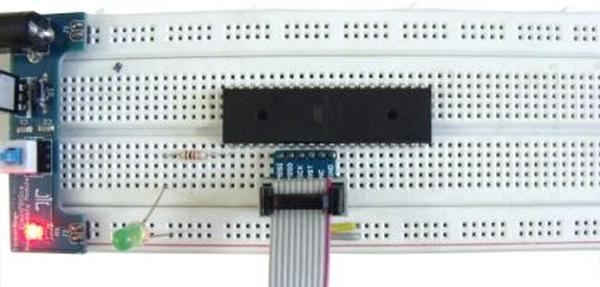
Interrupt in AVR Atmega32A Microcontroller is either software or hardware. There are in total 21 different interrupt vectors available (for more detail about their address and definition please follow datasheet page no: 43). External interrupts are triggered by INT0, INT1, INT2 pins. In this tutorial will be covering software interrupt. As in our previous post, we have seen timer and counter so let’s write interrupt driven program. In which we will be using 16-bit Timer/Counter1 register.
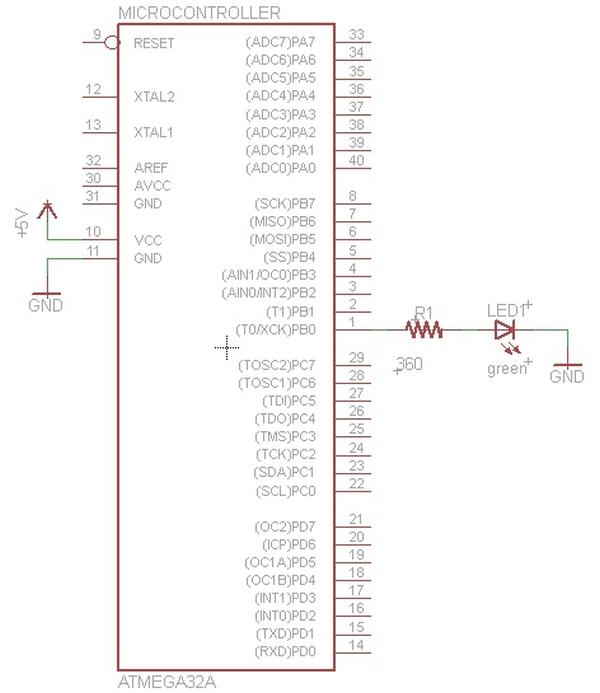
This is one of classic example to keep tutorial short and simple. Let’s hook up green LED and a current limiting resistor of 330Ω to PB0 pin of microcontroller. In this example, we will generate interrupt to toggle LED after every second. Please follow video for more detail about code.
Read More: Interrupt in AVR Atmega32A Microcontroller
- What is an interrupt in AVR Atmega32A?
An interrupt temporarily suspends normal program flow to execute an interrupt service routine and then resumes the program. - How many interrupt vectors are available in Atmega32A?
There are 21 different interrupt vectors available. - Which pins trigger external interrupts?
External interrupts are triggered by INT0, INT1, and INT2 pins. - Which timer is used in this tutorial for software interrupt?
The tutorial uses the 16-bit Timer/Counter1 register. - What does the example project do with the LED?
The project toggles a green LED on PB0 every second using a timer-generated interrupt. - What resistor value is used with the LED on PB0?
A 330Ω current limiting resistor is used with the green LED on PB0. - Is this tutorial covering hardware or software interrupts?
This tutorial covers software interrupts using Timer/Counter1. - Where can I find more details about interrupt vectors and addresses?
More details are available in the Atmega32A datasheet (referenced page 43 in the article).
