
Summary of FTDI LAUNCHES DUAL & QUAD CHANNEL USB-TO-UART/MPSSE BRIDGE ICS WITH BUILT-IN TYPE-C/PD CONTROLLERS
FTDI Chip introduces new multi-channel USB interface ICs (FT2233HP and FT4233HP) featuring built-in Type-C/PD controllers supporting up to 100W power delivery. These Hi-Speed devices offer serial UART and MPSSE interfacing, managing power negotiation internally via a 32-bit RISC core without requiring custom firmware or driver development for Windows, Linux, Mac, or Android.
Parts used in the FTDI Multi-Channel USB Interface IC Project:
- FT2233HP 2-channel Hi-Speed device
- FT4233HP 4-channel Hi-Speed device
- Type-C/PD controller
- Serial UART interfaces (RS232, RS422, RS485)
- MPSSE interfaces (JTAG, I2C, SPI, Bit-Bang)
- 32-bit RISC processor core
- 8kB data RAM
- 48kB code ROM
- PD Policy Engine
- USB drivers for Windows, Linux, Mac, and Android
Always at the forefront of embedded connectivity innovations, FTDI Chip’s latest series of multi-channel USB interface ICs. These have the capacity to deal with next generation power requirements, as larger items of hardware start to make use of the protocol.
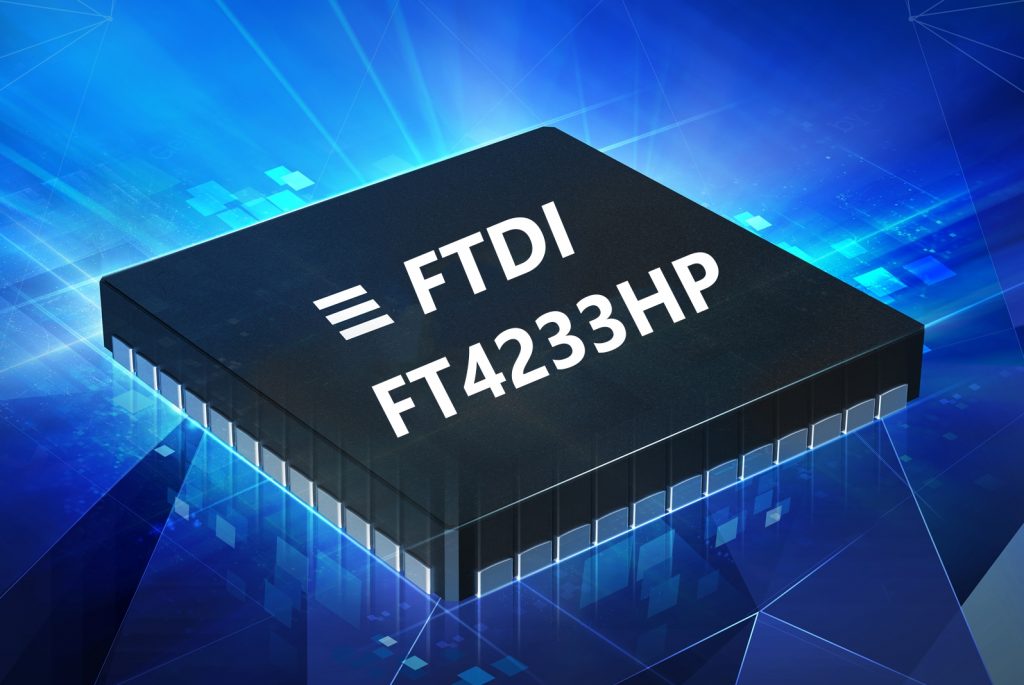
Available in both 2-channel (FT2233HP) and 4-channel (FT4233HP) versions, the new Hi-Speed (480Mbits/s) devices have serial UART (RS232, RS422 or RS485) and MPSSE (JTAG, I2C, SPI or Bit-Bang) interfacing capabilities. Furthermore, they are fully compliant with Rev 3.0 of the USB power delivery (PD) specification. Each features a Type-C/PD controller for taking care of all negotiation and power gauging, then deciding on the appropriate course of action (thereby offloading work that the system microcontroller would otherwise have to perform). This will enable any equipment that these ICs are integrated into to either draw or provide power as the situation dictates – with power levels of up to 100W being supported.
Based on a 32-bit RISC processor core, with 8kB of data RAM and 48kB of code ROM embedded, the PD Policy Engine manages the respective PD ports. The PD1 port can act as either a power sink or power source, while the PD2 port only acts as a power sink. Since all USB protocol handling can be accomplished directly on chip, there is no need for USB specific firmware programming to be embarked upon – which significantly streamlines the whole implementation process. Furthermore, access to FTDI’s royalty-free USB drivers (for Windows, Linux, Mac and Android) negates the need for engineers to create their own drivers from scratch.
Read more: FTDI LAUNCHES DUAL & QUAD CHANNEL USB-TO-UART/MPSSE BRIDGE ICS WITH BUILT-IN TYPE-C/PD CONTROLLERS
-
What are the available versions of the new FTDI Hi-Speed devices?
The devices are available in 2-channel (FT2233HP) and 4-channel (FT4233HP) versions. -
Does the project support next generation power requirements?
Yes, the devices are fully compliant with Rev 3.0 of the USB power delivery specification and support power levels up to 100W. -
Can the PD1 port act as both a power sink and source?
Yes, the PD1 port can act as either a power sink or power source. -
How does the chip handle USB protocol tasks?
All USB protocol handling is accomplished directly on the chip using a 32-bit RISC processor core. -
Is custom firmware programming required for these ICs?
No, there is no need for USB specific firmware programming because all protocol handling is done on-chip. -
Which operating systems are supported by the included drivers?
The royalty-free USB drivers support Windows, Linux, Mac, and Android.
