
Summary of FORLINX FETMX8MM-C SOM FOR OPTIMIZED AUDIO PERFORMANCE
The Forlinx FETMX8MM-C is a compact System on Module (SoM) based on the NXP i.MX8M Mini, designed primarily for digital audio processing. It supports Android 9.0 and Linux 4.14 with Qt 5.10. The module features a quad-core Cortex-A53 processor, 2GB DDR4 RAM, and 8GB eMMC storage. Its extensive I/O capabilities include MIPI interfaces, multiple audio protocols, Gigabit Ethernet, USB, PCIe, and various serial connections, making it suitable for applications like facial recognition, video intercoms, and medical devices.
Parts used in the Forlinx FETMX8MM-C SoM:
- NXP i.MX8M Mini processor
- Quad-core Cortex-A53 CPU at 1.8GHz
- Cortex-M4 MCU at 400MHz
- GCNanoUltra 3D graphics core
- GC320 2D graphics core
- 2GB DDR4 RAM
- 8GB eMMC storage
- H.265 and VP9 decoders
- Gigabit Ethernet controller
- MIPI-DSI and CSI interfaces
- I2S, AC97, TDM, PDM, SPDIF, and SAI audio interfaces
- USB 2.0 OTG and micro USB connector
- PCIe, SD/SDIO, UART, I2C, PWM, eCCPI, FlexSPI, and JTAG ports
Forlinx’s SoM FETMX8MM-C contributes to the ever-growing list of tiny, Linux-friendly modules built around NXP’s i.MX8M Mini. This new board focuses on a variety of digital audio processing interfaces. Recent same form factor boards include MYIR’s MYC-C8MMX and Innocomm’s WB15. This new 56 x 36mm SoM FETMX8MM-C module runs Android 9.0 or Linux 4.14 on i.MX8M Mini. It has 2GB DDR4, 8GB eMMC, up to -40 to 75℃ support.
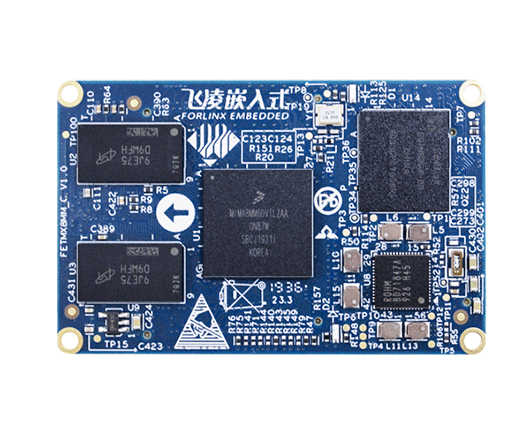
The new SoM FETMX8MM-C centers around the i.MX8M Mini’s specialty at digital audio processing. Other applications with this board may include facial recognition, video intercom, medical, and PDA. This board is powered by Android 9.0 or Linux 4.14 with Qt 5.10.
The SoM FETMX8MM-C is powered by the quad-core Cortex-A53 clocked at 1.8GHz. It also has 400MHz Cortex-M4 MCU and GCNanoUltra (for 3D) and GC320 (for 2D) graphics cores. Forlinx has mentioned that there are H.265 and VP9 decoders that can support 1080P@ 60Hz, which is 50% more efficient but bandwidth and capacity are only 50% of H.264.
The module primarily comes with 2GB DDR4 RAM and 8GB eMMC storage. Media I/O options are 4-lane MIPI-DSI and CSI Audio interfaces include I2S, AC97, TDM, PDM, SPDIF, and 4x SAI, as well as support for FLAC7.1 sound channel output and ring audio input.
The new SoM FETMX8MM-C has support for the Gigabit Ethernet controller and PHY support for 2x USB 2.0. It also includes a standard micro USB connector and USB 2.0 OTG (up to 480 Mbps). Other misc I/O includes PCIe, 2x SD/SDIO, 4x UART, 4x I2C, 4x PWM, 3x eCCPI, FlexSPI, and JTAG.
Read more: FORLINX FETMX8MM-C SOM FOR OPTIMIZED AUDIO PERFORMANCE
-
What operating systems does the FETMX8MM-C support?
The module runs Android 9.0 or Linux 4.14 with Qt 5.10. -
How much RAM and storage does this SoM have?
It comes equipped with 2GB of DDR4 RAM and 8GB of eMMC storage. -
What are the primary application areas for this board?
Primary uses include digital audio processing, facial recognition, video intercoms, medical devices, and PDAs. -
Does the module support high-resolution video decoding?
Yes, it includes H.265 and VP9 decoders capable of supporting 1080P@60Hz output. -
Which audio interfaces are available on this module?
Audio options include I2S, AC97, TDM, PDM, SPDIF, 4x SAI, FLAC7.1 sound channel output, and ring audio input. -
What connectivity options are provided besides Ethernet?
It offers 2x USB 2.0, USB 2.0 OTG, PCIe, 2x SD/SDIO, and 4x UART ports. -
What is the temperature range supported by this module?
The module supports an operating temperature range from -40 to 75℃. -
What graphics cores are integrated into the SoM?
It features GCNanoUltra for 3D rendering and GC320 for 2D rendering.
