
Summary of QUANTUM DOTS IN MEDICAL SCIENCE AS CANCER TRACER
Quantum dots (QDs), semiconductor nanocrystals, represent a significant advancement in personalized medicine for treating diseases like cancer and neurological disorders. Their unique photophysical properties, including high brightness, long lifetime, and size-tunable emission spectra, make them superior to organic dyes for fluorescence imaging. QDs enable deep-tissue imaging using near-infrared light, facilitate early tumor detection, and serve as nano-carriers for targeted drug delivery, enhancing diagnostic precision and therapeutic outcomes.
Parts used in the Quantum Dots Medical Project:
- Quantum dots (QDs)
- Semiconductor nanocrystals
- Ultraviolet rays
- Near-infrared emissions
- Biomolecules
- Tumor cells
- Lymph nodes
- Drug delivery nano-carriers
A huge leap in personalized medicine may come from the use of Quantum dots (QDs) to combat and identify several hard to cure diseases, such as cancer, immunodeficiencies, and neurological disorders. Quantum dots (QDs) are semiconductor nanocrystals with unique photophysical properties. Their excellent optical properties are a promising alternative to organic dyes for fluorescence biomedical applications.
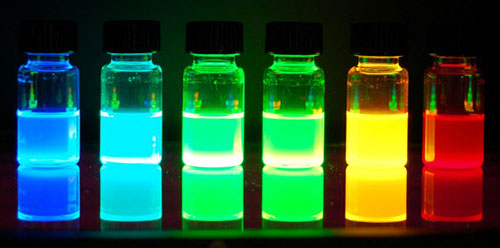
In the biomedical sciences, fluorescence is used as a powerful tool for labeling, imaging, and tracking certain molecules or cells. QDs are a new class of fluorophores that offer several improvements over conventional fluorophores. These particles have large absorption and narrow emission spectra, high quantum yield (efficiency of photon emission), long life-time, and high brightness.
When ultraviolet rays hit these dots, they can emit light of different colors based on their size. QDs have useful as fluorescent properties suitable for dyes in the field of deep-tissue imaging. These techniques are typically used in animal models since most organic dyes are not capable of operating in near-infrared (NIR) emissions. The visible wavelength range of about 400-700nm is not suitable for the transmission through biological tissues.
Specific targeted therapy is delivered to a patient based on particular targeted diagnostic images and tests. Here comes the perfect use for QDs as they can behave as nano-carriers for drug delivery or fluorescent labels. Fluorescent labeling can be explained as the detection involve binding fluorescent dyes to biomolecules to visualize them through fluorescence imaging, such as lymph nodes. This technique makes a great deal in detecting target biomolecules like tumor cells for early diagnosis of cancer, tracking the progress of tumor elimination.
Read more: QUANTUM DOTS IN MEDICAL SCIENCE AS CANCER TRACER
- How do quantum dots emit different colors?
They emit light of different colors based on their size when hit by ultraviolet rays. - What are the main advantages of quantum dots over conventional fluorophores?
They offer large absorption, narrow emission spectra, high quantum yield, long life-time, and high brightness. - Why are quantum dots suitable for deep-tissue imaging?
Their near-infrared emissions can transmit through biological tissues where visible wavelengths cannot. - Can quantum dots be used for drug delivery?
Yes, they can behave as nano-carriers for targeted drug delivery. - What diseases can quantum dots help combat?
They are used to combat hard-to-cure diseases such as cancer, immunodeficiencies, and neurological disorders. - How does fluorescent labeling help in cancer diagnosis?
It allows for the detection of target biomolecules like tumor cells for early diagnosis and tracking tumor elimination. - What is the visible wavelength range that is not suitable for transmission through biological tissues?
The visible wavelength range of about 400-700nm is not suitable for transmission through biological tissues. - Are quantum dots primarily used in human patients or animal models currently?
These techniques are typically used in animal models since most organic dyes are not capable of operating in near-infrared emissions.
