
Summary of MERCURY 2 – BREADBOARD-FRIENDLY FPGA DEVELOPMENT BOARD
The Mercury 2 is a breadboard-friendly development board featuring the Xilinx Artix-7 FPGA in a compact 3x1-inch DIP package. Designed for rapid prototyping and DSP applications, it includes onboard power management, SRAM, Ethernet, USB 2.0, and integrated ADC/DAC converters. Its small form factor makes it ideal for projects requiring programmable logic in tight spaces while supporting the Xilinx Vivado design suite.
Parts used in the Mercury 2:
- Xilinx Artix-7A FPGA
- 512K x 8-bit asynchronous SRAM
- 1.8 Mbits of fast block RAM
- 32 Mbit SPI Flash
- Microchip LAN8720A 10/100M Ethernet PHY
- Dual-channel High Speed USB 2.0 port
- Microchip MCP4812 2-channel D/A Converter
- Microchip MCP3008 8-channel A/D Converter
- Dual-channel internal ADC
- FTDI chip for micro USB debugging
- 3x User LEDs
- 6-pin Expansion header for JTAG
FPGAs are great and there are a number of cool things you can do with them. But as we come across more and more FPGA development boards, we realize that only a few of them are actually designed to be inserted into a breadboard.
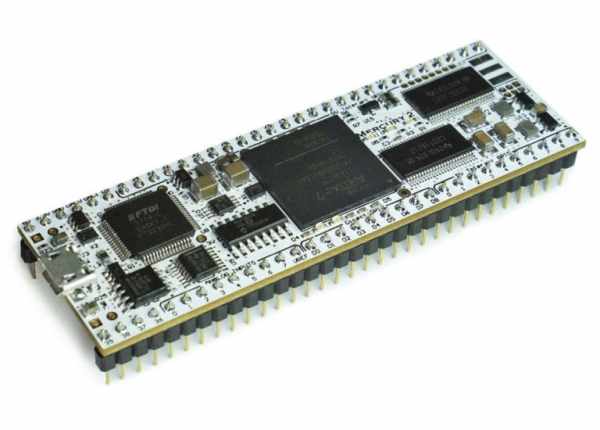
The new Mercury 2 development board by MicroNova is a breadboard-friendly Xilinx Artix-7 FPGA board packaged in a 3 x 1-inch 64-pin DIP (dual in-line) format.
It is a complete FPGA solution with onboard power management, I/O circuitry, SRAM and ADC/DAC. “We’ve included an on-board 8-channel SPI ADC (10 bit, 200 Ksps) and SPI DAC (10-bit, 225 MHz). It also has a dedicated input for the XADC included on the Artix-7A FPGA with the ability to expand into 16 available auxiliary inputs (12 bit, 20 Msps).
This makes the Mercury 2 ideal for DSP designs
says MicroNova.
Key Features and Specifications include:
- Xilinx Artix-7A FPGA with 33,280 logic cells
- 512K x 8-bit asynchronous SRAM with dedicated FPGA I/O interface
- 1.8 Mbits of fast block RAM
- 32 Mbit SPI Flash
- Microchip LAN8720A 10/100M Ethernet PHY
- Dual-channel High Speed USB 2.0 port
- Microchip MCP4812 2-channel, 225 KHz, 10-bit D/A Converter
- Microchip MCP3008 8-channel, 200 KSPS, 10-bit A/D Converter
- Dual-channel, 1 MSPS internal ADC
- 40 x 5V-tolerant digital I/O
- 10 x FPGA-direct high speed IO pins
- 6-pin Expansion header for JTAG
- FTDI chip for micro USB debugging/programming
- 3x User LEDs
- 5V power supply from the micro USB or external 4.5V – 5.5V power source, and,
- Can be programmed with the Xilinx Vivado design suite.
- Dimensions: 76.2 x 25.4 mm
Mercury 2 is perfect for rapid prototyping, and it’s incredibly small form-factor makes it an ideal FPGA board for tighter spaces in projects that need more programmable logic space and/or processing power.
Read more: MERCURY 2 – BREADBOARD-FRIENDLY FPGA DEVELOPMENT BOARD
- What is the primary advantage of the Mercury 2 board?
It is designed to be inserted directly into a breadboard. - How can you program this FPGA board?
You can use the Xilinx Vivado design suite. - Does the board support Ethernet connectivity?
Yes, it features a Microchip LAN8720A 10/100M Ethernet PHY. - Can the Mercury 2 be powered via USB?
Yes, it supports a 5V power supply from the micro USB port. - What type of ADC does the board include?
It has an 8-channel SPI ADC with 10-bit resolution and 200 Ksps speed. - Is there a DAC included on the board?
Yes, it includes a Microchip MCP4812 2-channel, 10-bit D/A Converter. - What are the physical dimensions of the board?
The dimensions are 76.2 x 25.4 mm. - Which FPGA family does the Mercury 2 utilize?
It uses the Xilinx Artix-7A FPGA.
