
Summary of ATmega-32 Pinout
Atmega32 AVR pinout explained: describes functions of all I/O ports, power, crystal, ADC, AREF, AVCC, SPI, UART, TWI, JTAG, timers, interrupts, and reset pins for the ATmega32 microcontroller, including alternate pin functions and voltage ranges for ATmega32 and ATmega32L.
Parts used in the Atmega32 AVR Pinout Guide:
- ATmega32 / ATmega32L microcontroller
- VCC (power supply)
- GND (ground)
- RESET pin
- XTAL1 (external crystal pin 1)
- XTAL2 (external crystal pin 2)
- AVCC (analog power supply)
- AREF (ADC reference voltage pin)
- Port A pins PA0 to PA7 (GPIO / ADC channels 0–7)
- Port B pins PB0 to PB7 (T0, T1, AIN0, AIN1, SS, MOSI, MISO, SCK)
- Port C pins PC0 to PC7 (SCL, SDA, TCK, TMS, TDO, TDI, TOSC1, TOSC2)
- Port D pins PD0 to PD7 (RXD, TXD, INT0, INT1, OC1B, OC1A, ICP, OC2)
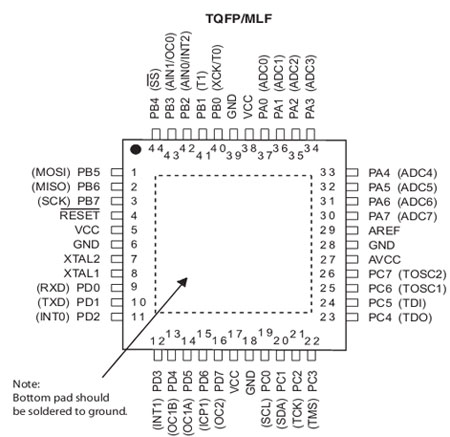
Pinout Diagram for Atmega32 AVR
Complete guide and explanation for atmega avr pinout. Atmega32 is built on CMOS (Complementary metal–oxide–semiconductor) technology which has high speed, low power consumption and enhanced anti-static effects. Pin counts are different for different packages but with almost same characteristics.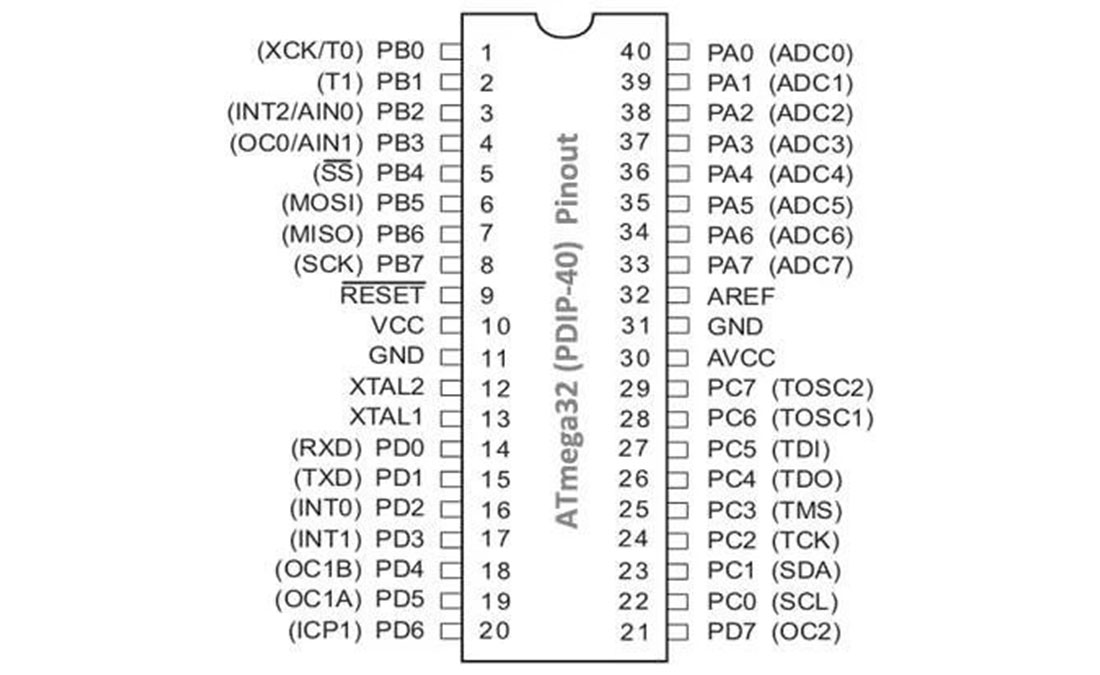
- PB-0: T0 (Timer/Counter External Counter Input ) can also be used as XCK (USART (also known as serial port) External Clock Input/Output)
- PB-1: T1 (Timer/Counter1 External Counter Input) can also be used as INT2 (External Interrupt 2 Input)
- PB-2: AIN0 (Analog Comparator +(Positive) Input) can also be used as INT2(Interrupt) (External Interrupt 2 Input)
- PB-3: AIN1 (Analog Comparator -(Negative) Input) can also be used as OC0 (Timer/Counter0 Output Compare Match Output)
- PB-4: SS (SPI Slave Select Input Pin)
- PB-5: MOSI (SPI Bus Master Output/Slave Input Pin)
- PB-6: MISO (SPI Bus Master Input/Slave Output Pin)
- PB-7: SCK (SPI Bus Serial Clock Pin)
- RESET: Master Device Reset this pin is active low
- VCC: Power Supply Pin Voltage input range is 2.7V – 5.5V for ATmega32L and 4.5V – 5.5V for ATmega32
- GND: Power Supply Ground Reference 0v
- XTAL2: External Crystal Pin 2
- XTAL1: External Crystal Pin 1
- PD-0: RXD (UART Input Pin)
- PD-1: TXD (UART Output Pin)
- PD-2: INT0 (External Interrupt 0 Input Pin)
- PD-3: INT1 (External Interrupt 1 Input Pin)
- PD-4: OC1B (Timer/Counter1 Output CompareB Match Output Pin)
- PD-5: OC1A (Timer/Counter1 Output CompareA Match Output Pin)
- PD-6: ICP (Timer/Counter1 Input Capture Pin)
- PD-7: OC2 (Timer/Counter2 Output Compare Match Output Pin)
- PC-0: SCL ( 2-wire Serial Bus Clock Line Pin)
- PC-1: SDA ( 2-wire Serial Bus Data Input/Output Line Pin)
- PC-2: TCK ( JTAG Test Clock Pin)
- PC-3: TMS ( JTAG Test Mode Select Pin)
- PC-4: TDO ( JTAG Test Data Out Pin)
- PC-5: TDI ( JTAG Test Data In Pin)
- PC-6: TOSC1 ( Timer Oscillator Pin 1 )
- PC-7: TOSC2 ( Timer Oscillator Pin 2 )
- AVCC: This is power supply source for port A, It must be connected with Vcc if not using ADC, It has also another feature for ADC i.e. noise reduction through low pass filter supply from vcc.
- GND: Power Supply Ground Reference 0v
- AREF: Reference Voltage pin for Analogue to digital converter(ADC)
- PA-7: General Purpose Digital Input/Output and can also be used as ADC(Analog to Digital Convertor) input channel 7
- PA-6: General Purpose Digital Input/Output and can also be used as ADC(Analog to Digital Convertor) input channel 6
- PA-5: General Purpose Digital Input/Output and can also be used as ADC(Analog to Digital Convertor) input channel 5
- PA-4: General Purpose Digital Input/Output and can also be used as ADC(Analog to Digital Convertor) input channel 4
- PA-3: General Purpose Digital Input/Output and can also be used as ADC(Analog to Digital Convertor) input channel 3
- PA-2: General Purpose Digital Input/Output and can also be used as ADC(Analog to Digital Convertor) input channel 2
- PA-1: General Purpose Digital Input/Output and can also be used as ADC(Analog to Digital Convertor) input channel 1
- PA-0:General Purpose Digital Input/Output and can also be used as ADC(Analog to Digital Convertor) input channel

- What is the voltage input range for VCC on ATmega32 and ATmega32L?
ATmega32L: 2.7V to 5.5V; ATmega32: 4.5V to 5.5V. - Which pins provide SPI functionality?
PB4 is SS, PB5 is MOSI, PB6 is MISO, and PB7 is SCK. - Which pins are used for UART RX and TX?
PD0 is RXD (UART input) and PD1 is TXD (UART output). - Which pins serve as ADC inputs?
PA0 through PA7 are general purpose I/O and can be used as ADC input channels 0 through 7. - What is the purpose of AVCC and should it be connected?
AVCC is the power supply for Port A and must be connected to VCC if not using ADC; it also supplies a low-pass filtered source for ADC noise reduction. - Which pins are related to the crystal oscillator?
XTAL1 and XTAL2 are the external crystal pins; PC6 is TOSC1 and PC7 is TOSC2 for the timer oscillator. - Which pins are used for external interrupts?
PD2 is INT0, PD3 is INT1, and PB1 or PB2 can be used as INT2 depending on configuration. - What are the JTAG pins on the ATmega32?
PC2 is TCK, PC3 is TMS, PC4 is TDO, and PC5 is TDI. - Which pins relate to timer/counter output compare or capture?
PB0 is T0, PB1 is T1, PB3 is OC0, PD4 is OC1B, PD5 is OC1A, PD6 is ICP, and PD7 is OC2. - What is the RESET pin function?
The RESET pin is the master device reset and is active low.
