
Summary of Arduino Internals – AVR E-Book
This book, "Arduino Internals" by Dale Wheat, provides an in-depth exploration of the Arduino board's hardware and software architecture. It covers the ATmega8 microcontroller, CPU, memory, peripherals, and compiler toolchains. The text guides readers on optimizing interactions between hardware and software, designing custom shields, writing libraries, and managing collaborative open-source projects through practical examples.
Parts used in the Arduino Internals:
- ATmega8 board
- CPU
- Memory
- Peripherals
- Compiler toolchain
- Libraries
- Shields
- Programming environments
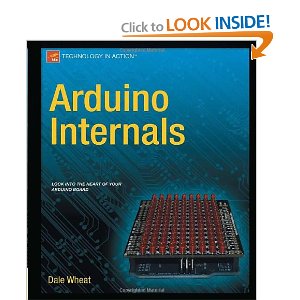 Apress, 16-Nov-2011 – 392 pages
Arduino Internals guides you to the heart of the Arduino board. Author Dale Wheat shares his intimate knowledge of the Arduino board—its secrets, its strengths and possible alternatives to its constituent parts are laid open to scrutiny in this book. You’ll learn to build new, improved Arduino boards and peripherals, while conforming to the Arduino reference design.
Arduino Internals begins by reviewing the current Arduino hardware and software landscape. In particular, it offers a clear analysis of how the ATmega8 board works and when and where to use its derivatives. The chapter on the “hardware heart” is vital for the rest of the book and should be studied in some detail.
Furthermore, Arduino Internals offers important information about the CPU running the Arduino board, the memory contained within it and the peripherals mounted on it. To be able to write software that runs optimally on what is a fairly small embedded board, one must understand how the different parts interact. Later in the book, you’ll learn how to replace certain parts with more powerful alternatives and how to design Arduino peripherals and shields.
Since Arduino Internals addresses both sides of the Arduino hardware-software boundary, the author analyzes the compiler toolchain and again provides suggestions on how to replace it with something more suitable for your own purposes. You’ll also learn about how libraries enable you to change the way Arduino and software interact, and how to write your own library implementing algorithms you’ve devised yourself. Arduino Internals also suggests alternative programming environments, since many Arduino hackers have a background language other than C or Java.
Of course, it is possible to optimize the way in which hardware and software interact—an entire chapter is dedicated to this field.
Arduino Internals doesn’t just focus on the different parts of Arduino architecture, but also on the ways in which example projects can take advantage of the new and improved Arduino board. Wheat employs example projects to exemplify the hacks and algorithms taught throughout the book.
Arduino projects straddling the hardware-software boundary often require collaboration between people of different talents and skills which cannot be taken for granted. For this reason, Arduino Internals contains a whole chapter dedicated to collaboration and open source cooperation to make those tools and skills explicit.
Contents
| Hardware |
1 |
| Software |
25 |
| Atmel AVR |
39 |
| Supporting Hardware |
71 |
| Arduino Software |
89 |
| Optimizations |
99 |
| Hardware Plus Software |
133 |
| Example Projects |
165 |
| Project Management |
213 |
| Hardware Design |
231 |
| Software Design |
255 |
| Networking |
281 |
| More Example Projects |
305 |
| Index |
359 |
| Cover |
ii |
| Copyright |
Bibliographic information
| Title | Arduino Internals Apressus Series SpringerLink : Bücher Technology in action |
| Author | Dale Wheat |
| Edition | illustrated |
| Publisher | Apress, 2011 |
| ISBN | 1430238828, 9781430238829 |
| Length | 392 pages |
| Subjects |
› › |
To download book & more info visit: Arduino Internals – AVR E-Book
Purchase the book: Arduino Internals – AVR E-Book
- What does the book cover regarding the ATmega8 board?
The book offers a clear analysis of how the ATmega8 board works and when and where to use its derivatives. - Can you replace certain parts with more powerful alternatives?
Yes, the book teaches how to replace certain parts with more powerful alternatives and how to design Arduino peripherals and shields. - How do libraries enable interaction changes?
Libraries enable you to change the way Arduino and software interact, and you can write your own library implementing algorithms. - Does the book address alternative programming environments?
Yes, it suggests alternative programming environments for hackers with backgrounds in languages other than C or Java. - Is there a chapter dedicated to optimization?
Yes, an entire chapter is dedicated to optimizing the way in which hardware and software interact. - Why is collaboration important for Arduino projects?
Projects straddling the hardware-software boundary often require collaboration between people of different talents and skills. - How are example projects utilized in the book?
Wheat employs example projects to exemplify the hacks and algorithms taught throughout the book. - What specific hardware components are analyzed in detail?
The book analyzes the CPU running the Arduino board, the memory contained within it, and the peripherals mounted on it.
