
Summary of Atmega8 Pinout Diagram
ATmega8 is an 8-bit AVR RISC microcontroller from Atmel with 8KB flash, 1KB SRAM, 512B EEPROM, a 6/8-channel 10-bit ADC, and 16 MIPS performance at 16 MHz, operating from 2.7–5.5 V. The article describes pin functions and ports: Port B (PB7..PB0), Port C (PC5..PC0) with PC6/RESET special behavior, Port D (PD7..PD0), VCC, GND, XTAL1/XTAL2/TOSC1/TOSC2, and RESET, and notes alternate functions, oscillator roles, pull-ups, and tri-state on reset.
Parts used in the ATmega8 project:
- ATmega8 microcontroller
- VCC (power supply connection)
- GND (ground connection)
- XTAL1/XTAL2 (crystal oscillator pins)
- TOSC1/TOSC2 (timer oscillator pins)
- Port B pins PB0..PB7
- Port C pins PC0..PC6
- Port D pins PD0..PD7
- RESET pin
ATmega8 is an atmel’s low-power 8-bit AVR RISC-based microcontroller combines 8KB of programmable flash memory, 1KB of SRAM, 512K EEPROM, and a 6 or 8 channel 10-bit A/D converter. The device supports throughput of 16 MIPS at 16 MHz and operates between 2.7-5.5 volts.
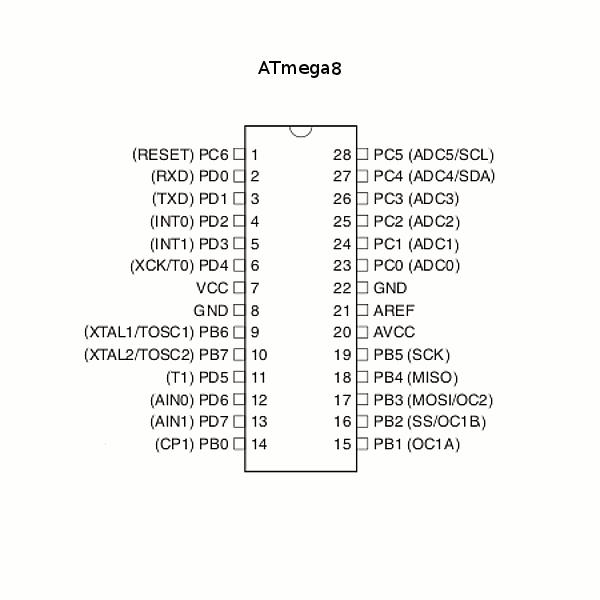
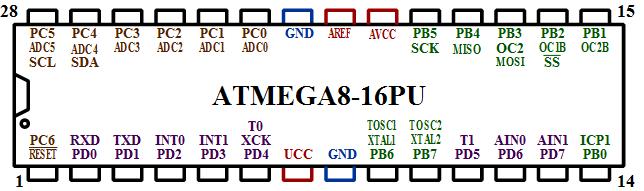
To find out its complete Specs, here is the link to ATmega8 datasheet , Under given is another view for its pin diagram.
Pin Descriptions
VCC Digital supply voltage.
GND Ground.
Port B (PB7..PB0)
XTAL1/XTAL2/TOSC1/
TOSC2
Port B is an 8-bit bi-directional I/O port with internal pull-up resistors (selected for each bit). The
Port B output buffers have symmetrical drive characteristics with both high sink and source
capability. As inputs, Port B pins that are externally pulled low will source current if the pull-up
resistors are activated. The Port B pins are tri-stated when a reset condition becomes active,
even if the clock is not running.
Depending on the clock selection fuse settings, PB6 can be used as input to the inverting Oscillator
amplifier and input to the internal clock operating circuit.
Depending on the clock selection fuse settings, PB7 can be used as output from the inverting
Oscillator amplifier.
If the Internal Calibrated RC Oscillator is used as chip clock source, PB7..6 is used as TOSC2..1
input for the Asynchronous Timer/Counter2 if the AS2 bit in ASSR is set.
The various special features of Port B are elaborated in “Alternate Functions of Port B” on page
58 and “System Clock and Clock Options” on page 25.
Port C (PC5..PC0) Port C is an 7-bit bi-directional I/O port with internal pull-up resistors (selected for each bit). The
Port C output buffers have symmetrical drive characteristics with both high sink and source
capability. As inputs, Port C pins that are externally pulled low will source current if the pull-up
resistors are activated. The Port C pins are tri-stated when a reset condition becomes active,
even if the clock is not running.
PC6/RESET If the RSTDISBL Fuse is programmed, PC6 is used as an I/O pin. Note that the electrical characteristics
of PC6 differ from those of the other pins of Port C.
If the RSTDISBL Fuse is unprogrammed, PC6 is used as a Reset input. A low level on this pin
for longer than the minimum pulse length will generate a Reset, even if the clock is not running.
The minimum pulse length is given in Table 15 on page 38. Shorter pulses are not guaranteed to
generate a Reset.
The various special features of Port C are elaborated on page 61.
Port D (PD7..PD0) Port D is an 8-bit bi-directional I/O port with internal pull-up resistors (selected for each bit). The
Port D output buffers have symmetrical drive characteristics with both high sink and source
capability. As inputs, Port D pins that are externally pulled low will source current if the pull-up
resistors are activated. The Port D pins are tri-stated when a reset condition becomes active,
even if the clock is not running.
Port D also serves the functions of various special features of the ATmega8 as listed on page
63.
RESET Reset input. A low level on this pin for longer than the minimum pulse length will generate a
reset, even if the clock is not running. The minimum pulse length is given in Table 15 on page
38. Shorter pulses are not guaranteed to generate a reset.
- What memory does the ATmega8 include?
It includes 8KB of flash, 1KB of SRAM, and 512 bytes of EEPROM. - What is the operating voltage range of the ATmega8?
It operates between 2.7 and 5.5 volts. - What clock speed and throughput can the ATmega8 achieve?
It supports 16 MIPS throughput at 16 MHz. - How many ADC channels and resolution does the ATmega8 provide?
It provides a 6 or 8 channel 10-bit analog-to-digital converter. - What happens to port pins during reset?
Port pins are tri-stated when a reset condition becomes active, even if the clock is not running. - Can PB6 and PB7 be used for oscillator functions?
Yes; depending on clock fuse settings, PB6 can be the oscillator input and PB7 can be the oscillator output; if using the internal RC, PB7 and PB6 serve as TOSC2 and TOSC1 for Timer/Counter2 when AS2 is set. - What is special about PC6 pin?
If the RSTDISBL fuse is programmed, PC6 is an I/O pin; if unprogrammed, PC6 is the Reset input. - How are internal pull-ups handled on ports?
Ports B, C, and D have internal pull-up resistors that can be selected for each bit; when inputs are externally pulled low they will source current if pull-ups are activated.
