
Summary of How HDMI Works
HDMI transmits digital video using TMDS encoding to minimize bit transitions and preserve signal integrity over cable by sending differential pairs (signal plus inverse) and decoding the differential at the receiver. HDMI also supports HDCP, an authentication and encryption handshake using keys stored on EDID chips; devices verify each other, generate a shared key, encrypt/decrypt the stream, and periodically recheck keys to prevent unauthorized interception. Content providers may choose whether to enable HDCP; device support is required and US regulations involve the FCC.
Parts used in theHDMI Signals:
- HDMI cable (twisted pair conductors)
- Sending device (e.g., HD-DVD or Blu-ray player)
- Receiving device (e.g., HDTV)
- TMDS encoder (in sending device)
- TMDS decoder (in receiving device)
- Inverse signal conductor (paired with signal conductor)
- EDID chip (stores identification and encryption data)
- HDCP authentication module (in devices)
HDMI Signals
One of the common misperceptions about HDMI is that the digital signal is innately superior to an analog signal. In some people’s minds, the lack of analog-to-digital conversion means that the signal is in a pure, undamaged state when it reaches the HDTV set. It’s easy to imagine a high-definition, digital signal traveling straight from an HD-DVD player to an HDTV. But signal transmission via HDTV does require an encoding step.
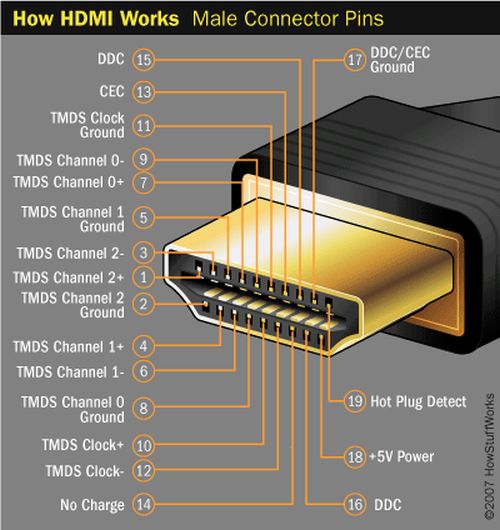
HDMI uses transition minimized differential signaling (TMDS) to move information from one place to another. TMDS is a way of encoding the signal to protect it from degrading as it travels down the length of the cable. Here’s what happens:
- The sending device, such as an HD-DVD player, encodes the signal to reduce the number of transitions between one (on) and zero (off). Think of each transition as a sharp drop-off — as the signal travels, this drop-off can begin to wear away, degrading the signal. The encoding step helps protect signal quality by reducing the number of chances for the signal to degrade.
- One of the cables in the twisted pair carries the signal itself. The other carries an inverse copy of the signal.
- The receiving device, such as an HDTV, decodes the signal. It measures the differential, or the difference between the signal and its inverse. It uses this information to compensate for any loss of signal along the way.
HDMI also has the ability to protect data from piracy. It uses high-bandwidth digital copy protection (HDCP) to accomplish this. HDCP is an authentication protocol. Basically, each home-theater device has identification data and encryption data stored on its extended display identification data (EDID) chip. The source device, such as a Blu-ray player, checks the authentication key of the receiving device, such as an HDTV. If both keys check out, the sending device moves on to the next step. It generates a new key and shares it with the receiving device. In other words, it creates a shared secret. Ideally, this whole process, known as a handshake, takes place almost instantaneously.
The source device encodes its information using the key it generated it. The receiving device decodes it using the same information. If an unauthorized device tries to intercept the data, the source device stops transmitting. It also makes sure that the key hasn’t changed and that the system is still secure every few minutes. All HDMI-compatible devices are required to support HDCP, but the companies that manufacture and distribute high-definition content aren’t required to enable it. In the United States, this content-protection ability is mandated by the Federal Communications Commission (FCC).
For more detail: How HDMI Works
- Does HDMI use encoding before transmission?
Yes. HDMI uses transition minimized differential signaling (TMDS) to encode the signal and reduce transitions before transmission. - How does TMDS protect the HDMI signal?
TMDS reduces the number of transitions between ones and zeros and sends a differential pair (signal and inverse) so the receiver can measure the difference and compensate for loss. - What does the receiving device do with the inverse signal?
The receiving device measures the differential between the signal and its inverse and decodes the signal, compensating for any loss along the cable. - Does HDMI include content protection?
Yes. HDMI supports high-bandwidth digital copy protection (HDCP) as an authentication and encryption protocol. - How do devices authenticate under HDCP?
Each device stores identification and encryption data on its EDID chip; the source checks the receiver's authentication key, and if valid they generate a shared key during the handshake. - What happens if an unauthorized device tries to intercept HDMI data?
The source device stops transmitting if an unauthorized device attempts interception or if authentication fails. - Are all HDMI devices required to support HDCP?
All HDMI-compatible devices are required to support HDCP, though content providers are not required to enable it. - Who mandates content-protection ability in the United States?
The Federal Communications Commission (FCC) is involved in mandating content-protection ability in the United States.
