
Summary of How does the ball return work on a coin-operated pool table?
Coin-operated pool tables return the cue ball using chutes that direct pocketed balls to a storage chamber. To separate the cue ball from numbered balls, manufacturers use either oversized balls (approx. 2 3/8 inches) detected by radius gauges or magnetic cue balls with internal magnets triggered by magnetic detectors. These mechanisms divert the cue ball through a specific chute to an exit opening, preventing it from entering the locked storage compartment while allowing standard balls to remain stored until coins are inserted.
Parts used in the Coin-Operated Pool Table Ball Return System:
- Six pockets
- System of chutes
- Collection chamber
- Plexiglas viewing panel
- Radius gauging device
- Magnetic detector
- Deflecting device
- Oversized cue ball
- Magnetic cue ball with metallic core
If you have ever played one of those coin-operated pool tables in a place like a restaurant or an arcade, then you know that the obvious question is, “how the heck does this thing return the cue ball to me???” If you look inside the table, there is a system of chutes that connect to the six pockets on the table. Each chute sends a pocketed ball from the pocket to a collection chamber, where the numbered balls are lined up single file. These numbered balls remain locked in the chamber, which you can see behind a piece of Plexiglas, until someone wants to play a game and inserts some coins. Of course the cue ball can’t get stuck in this chamber — If a player accidentally pockets the cue ball (a scratch), the cue ball needs to come back out.
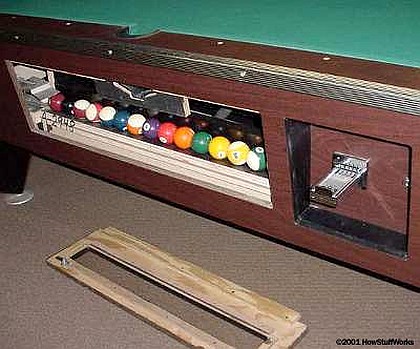
Table manufacturers needed a way to allow the cue ball to be returned to play, while keeping the pocketed numbered balls locked in the storage compartment. Many solutions have been proposed to solve this problem, including:
- Light sensors that sense the light reflected from the cue ball
- A metallic core ball that would trigger a separating mechanism when it passed through an electromagnetic field
- A balance mechanism that would separate a heavier cue ball from lighter numbered balls
And so on. For the most part, though, coin-operated tables use two types of cue balls that can be easily separated:
- An oversized ball that is separated by a radius gauging device.
- A magnetic cue ball that triggers a magnetic detector.
The oversized ball is approximately 2 3/8 inches (6 cm) in diameter, which is about one-eighth (2 mm) of an inch larger than a normal ball. This slight difference in size allows the cue ball to be separated before it gets to the storage compartment. The smaller numbered balls are able to pass through a gauging mechanism, while the larger cue ball is directed through a second chute, where it falls out into an opening on the side of the table.
For players who dislike using the slightly larger cue ball, there are also coin-operated machines that can use a magnetic ball, in which a magnet is built into the core of the cue ball. Magnetic cue balls that go into a pocket are separated from numbered balls by a magnetic detector. As the magnetic ball passes this detector, the magnet triggers a deflecting device that separates the cue ball and, again, sends it into the opening on the side of the table.
For more Detail: How does the ball return work on a coin-operated pool table?
- How does the system prevent the cue ball from getting stuck in storage?
The system uses separation mechanisms like radius gauges or magnetic detectors to divert the cue ball into a side exit before it reaches the locked storage chamber. - What is the size difference between a cue ball and numbered balls?
An oversized cue ball is approximately 2 3/8 inches in diameter, which is about one-eighth of an inch larger than normal numbered balls. - Can players choose not to use the slightly larger cue ball?
Yes, machines can utilize magnetic cue balls instead of oversized ones for players who dislike the size difference. - How do magnetic cue balls get separated from numbered balls?
A magnet built into the core of the cue ball triggers a magnetic detector, which activates a deflecting device to send the ball to the exit. - Where does the cue ball go after being separated?
After separation, the cue ball is directed through a second chute and falls out into an opening on the side of the table. - What happens to the numbered balls after they are pocketed?
Numbered balls pass through the gauging mechanism and enter the collection chamber where they are lined up single file behind Plexiglas. - How are the numbered balls released for play?
The numbered balls remain locked in the storage compartment until a player inserts coins to start a game. - What mechanism separates the oversized cue ball?
A radius gauging device allows smaller numbered balls to pass through while directing the larger cue ball to a separate chute.
