
Summary of ALCHITRY – FPGA DEVELOPMENT BOARDS FOR HOBBYISTS
Digital design creates circuits implemented traditionally as expensive ASICs; FPGAs let you design and reconfigure digital circuits without manufacturing. The article describes two Alchitry FPGA boards: Alchitry Au (Artix 7 XC7A35T-1C, 33,280 logic cells, 256MB DDR3, 102 IO pins, USB-C power/configure, 8 LEDs, 1 button, 100 MHz clock, USB-serial up to 12Mbaud, 65×45 mm) and Alchitry Cu. The Au is the higher-capacity board, avoids Xilinx ISE, and suits hobbyist FPGA projects.
Parts used in the Alchitry Au:
- Artix 7 XC7A35T-1C FPGA (33,280 logic cells)
- 256MB DDR3 RAM
- 102 IO pins (3.3V logic level, 20 switchable to 1.8V for LVDS)
- 9 differential analog inputs (1 dedicated, 8 mixed with digital IO)
- USB C port for configuration and power
- 8 general purpose LEDs
- 1 button (typically used as reset)
- 100 MHz on-board clock
- USB to serial interface (up to 12 Mbaud)
- Board PCB sized 65mm x 45mm
Digital design refers to creating digital circuits. Digital circuits are in basically everything today and range from something as simple as a circuit that turns an LED on when a button is pressed to the complex processor in the device you are reading this on. Traditionally, these circuits are built by making ASICs (Application Specific Integrated Circuits) out of silicon wafers. This process is incredibly expensive and complex.
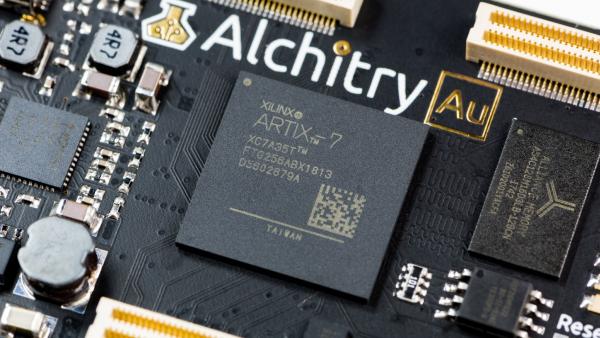
FPGAs, or Field Programmable Gate Arrays, are a way to create digital circuits without these barriers. FPGAs are part of a class of devices known as programmable hardware. This means that you can design a digital circuit and program the FPGA to become that circuit. You can reconfigure the FPGA as many times as you want allowing you to create circuit after circuit without having to physically change a thing!
This time around, there are two FPGA boards! These are the Alchity Au (gold) and the Alchitry Cu (copper).
Specifications
- Artix 7 XC7A35T-1C – 33,280 logic cells (approx. 4x the capacity of the Mojo)
- 256MB DDR3 RAM
- 102 IO pins (3.3V logic level, 20 of then can be switched to 1.8V for LVDS)
- 9 differential analog inputs (1 dedicated, 8 mixed with digital IO)
- USB C to configure and power the board
- 8 general purpose LEDs
- 1 button (typically used as a reset)
- 100 MHz on-board clock (can be multiplied internally by the FPGA)
- Powered with 5V through USB C port, 0.1″ holes, or headers
- USB to serial interface for data transfer (up to 12Mbaud)
- Dimensions of 65mm x 45mm
The Alchitry Au is the workhorse of the two boards. It features an Artix 7 FPGA which means no more dealing with Xilinx’s antiquated ISE tool. This board also has 256MB of DDR3 RAM while still having 102 IO pins available for your projects!
Read more: ALCHITRY – FPGA DEVELOPMENT BOARDS FOR HOBBYISTS
- What is an FPGA?
An FPGA is programmable hardware that you can design and program to become different digital circuits and reconfigure as many times as you want. - What FPGA does the Alchitry Au use?
The Alchitry Au uses an Artix 7 XC7A35T-1C FPGA with 33,280 logic cells. - How much RAM does the Alchitry Au have?
The Alchitry Au includes 256MB of DDR3 RAM. - How many IO pins are available on the Alchitry Au?
The board provides 102 IO pins, with 20 of them switchable to 1.8V for LVDS. - Can the Alchitry Au be powered via USB C?
Yes, the board is powered with 5V through a USB C port. - Does the Alchitry Au include analog inputs?
Yes, it has 9 differential analog inputs: 1 dedicated and 8 mixed with digital IO. - What clock does the board use?
The board includes a 100 MHz on-board clock which can be multiplied internally by the FPGA. - Is there a USB to serial interface on the Alchitry Au?
Yes, it includes a USB to serial interface for data transfer up to 12 Mbaud. - What are the physical dimensions of the Alchitry Au?
The board measures 65 mm by 45 mm.
