
Summary of Arietta G25 – Tiny, cheap and easy ARM9@400Mhz Linux Embedded module
The Arietta G25 is a compact, Italy-designed ARM9 embedded module featuring an AT91SAM9G25 SoC running at 400MHz with 128MB or 256MB DDR2 RAM. It supports Linux via microSD, offers extensive I/O including USB, UART, SPI, and I2C, and operates on 5VDC or 3.3VDC power. Designed for industrial use with low EMI and RoHS compliance, it lacks direct video output but can drive small displays via SPI.
Parts used in the Arietta G25:
- CPU Atmel AT91SAM9G25 SoC (ARM9 @ 400Mhz)
- DDR2 Ram 128 or 256 MByte
- microUSB connector
- J4 Placement for a 20x2 pins connector pitch 2.54mm
- DP placements for a 6 pin male strip pitch 2.54
- IIEE802.11 b/g/n Wi-Fi module WiFi USB adapter
- Push-push type holder for bootable microSD
- User configurable led on board
- User configurable push button on board
Main features
- CPU Atmel AT91SAM9G25 SoC (ARM9 @ 400Mhz)
- DDR2 Ram 128 or 256 MByte
- Power supply: 5VDC via microUSB or 3.3VDC using the PCB pads
- Line levels: TTL 3.3V (NOT 5V tolerant)
- Operative temperature range:
- ARIETTA-G25 (128MByte RAM): -20 +70 °C
- ARIETTA-G25-256 (256MByte RAM): -0 +70 °C
- Size: 53x25mm
- PCB layers: 8
- RoHS and REACH compliant. Low EMI
- Availability: > 5 years
- Designed and Made in Italy
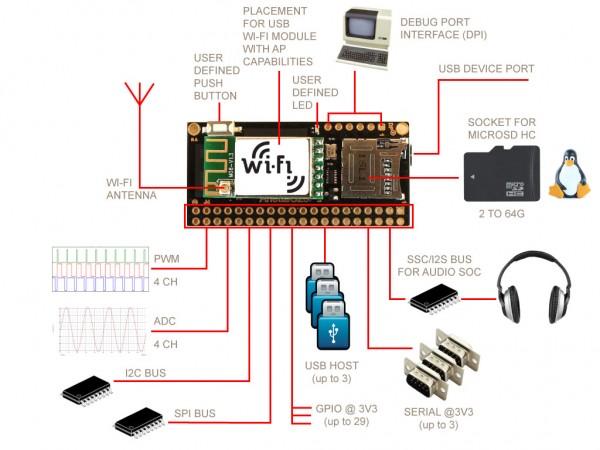
Exposed signals and external devices
- J4 Placement for a 20×2 pins connector pitch 2.54mm (100 mils) (pinout):
- 1 full-speed usb host
- 1 hi-speed host/device (same port lines used for the microUSB port)
- 1 hi-speed host (same lines used for the WiFi adpter)
- UART lines: 3 ports
- I2C bus lines: 2 bus
- SPI bus lines: 1 bus with up to 3 chip select (5 to 50 MHz)
- PWM lines: 4 lines
- A/D converters lines: 4 channels@10 bit
- SSC/I2S interface for audio soc
- No video or TFT output but the SPI bus can be used for small TFT display and I2C bus for small alphanumeric LCD
- No direct LAN interface but the USB ports can be used with USB to LAN adapter
- DP placements for a 6 pin male strip pitch 2.54 (100 mils) with the Debug Port Interface lines
- Placement for IEE802.11 b/g/n Wi-Fi module WiFi USB adapter
- Push-push type holder for bootable microSD (up to 64GB) with Linux pre-installed
- microUSB connector to plug the Arietta to your PC and access to the internal Linux with and emulated LAN port over USB (USB gadget)
- User configurable led on board
- User configurable push button on board
For more detail: Arietta G25 – Tiny, cheap and easy ARM9@400Mhz Linux Embedded module
-
What CPU does the Arietta G25 use?
The module uses an Atmel AT91SAM9G25 SoC with an ARM9 processor running at 400Mhz. -
How much RAM is available in this project?
The device comes with either 128 MByte or 256 MByte of DDR2 Ram depending on the model. -
Can I connect a TFT display directly to the module?
No, there is no direct video or TFT output, but the SPI bus can be used for small TFT displays. -
Does the module support a LAN interface?
There is no direct LAN interface, but USB ports can be used with a USB to LAN adapter. -
What are the power supply options for the Arietta G25?
You can provide power via 5VDC through microUSB or 3.3VDC using the PCB pads. -
How do I access the internal Linux system?
You can plug the Arietta into your PC via microUSB to access internal Linux with an emulated LAN port over USB. -
Is the module compatible with high voltage logic levels?
No, the line levels are TTL 3.3V and they are NOT 5V tolerant. -
What is the maximum size of the microSD card supported?
The push-push type holder supports bootable microSD cards up to 64GB.
