
Summary of ATMega328 Board
The ATMega328 board is a microcontroller platform based on the ATmega328 chip, requiring 5VDC power via USB, AC-to-DC adapter, or battery. It features 20 digital I/O pins (6 PWM, 6 analog), a 16 MHz oscillator, RS232 connectivity, and supports programming through ICSP, serial, parallel, or USB programmers.
Parts used in the ATMega328 Board:
- ATMega328 microcontroller
- 20 digital input/output pins
- 16 MHz crystal oscillator
- RS232 connection
- Power jack
- ICSP header
- Reset button
- USB cable
- AC-to-DC adapter
- Battery
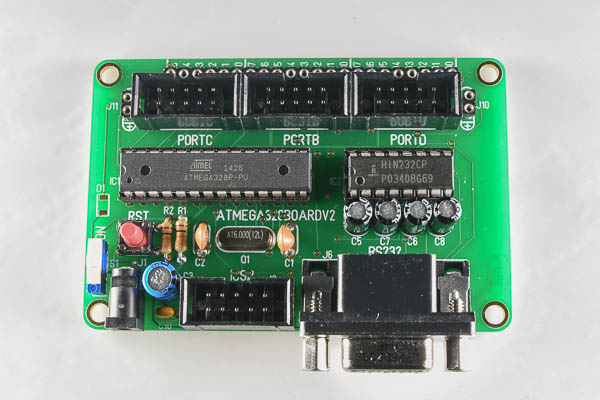
The ATMega328 board is a microcontroller board based on the ATmega328, The board contains everything needed to support the microcontroller. The board need 5VDC to power it. Simply connect the power connector to a computer with a USB cable or power it with a AC-to-DC adapter or battery to get started. You can program it with the ICSP connection. The ATMega microcontroller boards can be programmed with a serial port programmer, parallel port programmer or USB port programmer.
Technical Details:
- 20 digital input/output pins (of which 6 can be used as PWM outputs and 6 as analog inputs)
- 16 MHz crystal oscillator,
- RS232 connection for communication with your PC,
- power jack,
- ICSP header,
- reset button.
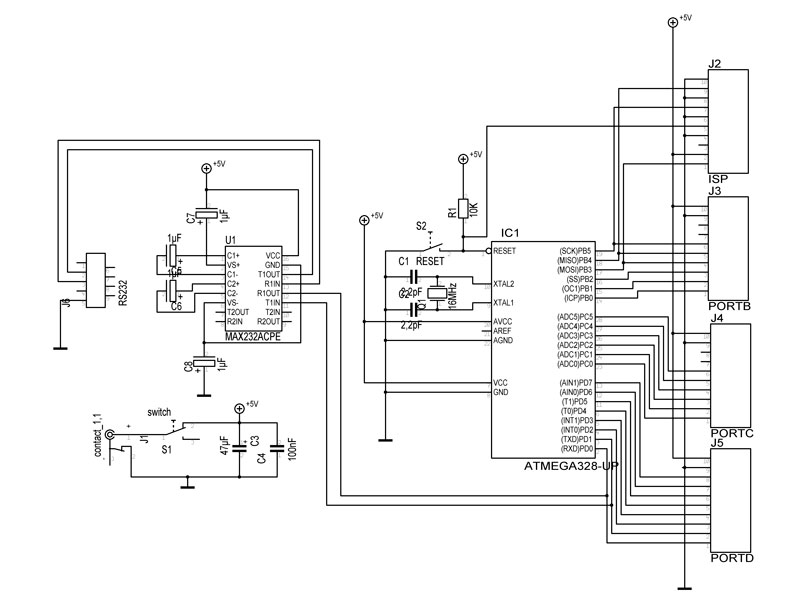
for more detail: ATMega328 Board
- What voltage does the ATMega328 board require?
The board needs 5VDC to power it. - How can the ATMega328 board be powered?
You can connect it via a USB cable to a computer, use an AC-to-DC adapter, or use a battery. - Can the ATMega328 board be programmed with a serial port programmer?
Yes, the boards can be programmed with a serial port programmer. - What communication interface connects the board to a PC?
An RS232 connection is provided for communication with your PC. - How many digital input/output pins are available?
There are 20 digital input/output pins available. - Which pins can be used as PWM outputs?
Six of the digital pins can be used as PWM outputs. - Does the board include a reset mechanism?
Yes, the board includes a reset button. - What type of oscillator is used on the board?
The board uses a 16 MHz crystal oscillator.
