
Summary of Build Your Own Cheap Antenna Analyser
This article outlines a DIY project to build a cost-effective HF antenna analyzer for under $50 using an Arduino, replacing expensive commercial units. The system utilizes an AD9850 DDS module for frequency synthesis and a VSWR bridge for measurement, controlled by a microcontroller.
Parts used in the DIY HF Antenna Analyzer:
- Microcontroller (Arduino)
- AD9850 DDS module
- VSWR Bridge
Ham radio is the use of radio frequency spectrum for purposes of non-commercial exchange of messages, wireless experimentation, self-training, etc. Developing a ham radio project may requires using an antenna analyser, a device that is used for measuring input frequency and impedance.
There are many types of antenna analysers such as Anritsu VNA Master, RigExpert, MiniVNA, and others. But these analysers are very expensive to buy. They starts from $500 up to thousands of dollars and they are also hard to hack. This guide shows how to construct and use a DIY HF antenna analyzer using Arduino for less than $50.
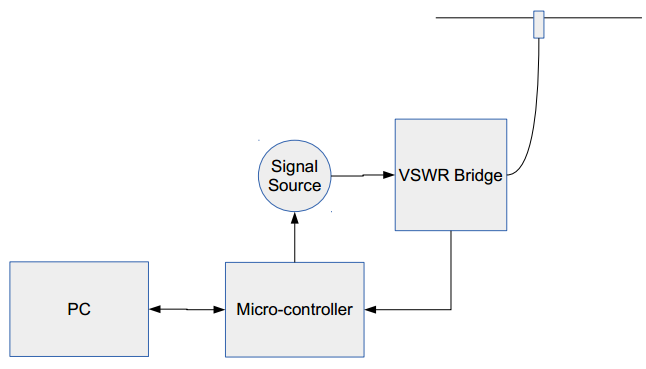
The project consists of three parts; a Microcontroller, AD9850 DDS module, and a VSWR Bridge.
The AD9850 is a CMOS highly integrated device that uses advanced Direct Digital Synthesis (DDS) technology coupled with an internal high speed, high performance, D/A converter and comparator, to form a complete digitally programmable frequency synthesizer and clock generator function.
AD9850 module is a $9 stable, low drift VFO (Variable Frequency Oscillator) fed by a 125 MHz crystal clock. The module covers from 0 to 40 MHz, which are all the HAM HF(High Frequency) frequencies. There are 4 output pins on the device, 2 for Sine Waves (only one Frequency at a time) and two Square wave outputs. The blue pot on the board adjusts the duty cycle of the Square Wave Outputs but has no effect on the Sine Wave Outputs.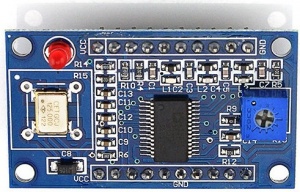
AD9850 features:
- Signal Frequency output range: 0-40MHz
- 4 Signal outputs; 2 sine wave outputs and 2 square wave outputs
- DAC SFDR > 50 dB @ 40 MHz AOUT
- 32-Bit Frequency Tuning Word
- Simplified Control Interface: Parallel Byte or Serial Loading Format
- Phase Modulation Capability
- +3.3 V or +5 V Single Supply Operation
- Low Power: 380 mW @ 125 MHz (+5 V)
- Low Power: 155 mW @ 110 MHz (+3.3 V)
- Power-Down Function
- What is the primary purpose of this project?
To construct and use a DIY HF antenna analyzer for less than $50. - How much do commercial antenna analysers typically cost?
They start from $500 up to thousands of dollars. - What technology does the AD9850 module use?
It uses advanced Direct Digital Synthesis (DDS) technology. - What frequency range does the AD9850 module cover?
The module covers frequencies from 0 to 40 MHz. - How many signal outputs does the AD9850 device have?
The device has 4 signal outputs consisting of 2 sine waves and 2 square waves. - Does the blue pot on the board affect sine wave outputs?
No, the blue pot adjusts the duty cycle of square wave outputs but has no effect on sine wave outputs. - What clock source feeds the AD9850 module?
The module is fed by a 125 MHz crystal clock. - What are the three main parts of this project?
The project consists of a Microcontroller, AD9850 DDS module, and a VSWR Bridge.
