
Summary of Audio Spectrum Monitor using S1D15200 microcontroller
This article describes a project using an SG12232C graphic LCD module to create a real-time audio waveform display and FFT spectrum analyzer. The author utilized the module, originally purchased for 1500 Yens, to demonstrate its capabilities with a cheap microcontroller, achieving performance suitable for radio frequency band applications.
Parts used in the Audio Spectrum Monitor:
- SG12232C graphic LCD module
- Epson S1D15200 LCD controller (two units)
- Microcontroller
- 2 kHz square wave generator
This is an evaluation use of a small graphics LCD module. Last summer, SG12232C graphic LCD module has been sold sold for 1500 Yens from Akizuki Denshi and I bought it. However I could not find good application for the LCD module and it was going to go to junk box 🙂 so that I tried to use the LCD module temporary.
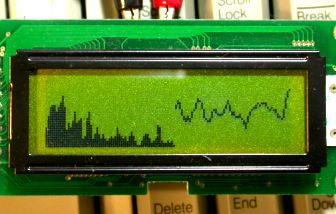
Only displaying any still image is not cool, first I tried to display an audio wave form in real-time like a digital oscilloscope, and then an FFT spectrum analysis too. The spectrum monitor seems to achived nice performance, in view of it is realized with a cheap microcontroller.
This can also be applied to radio frequency band.
Hardware
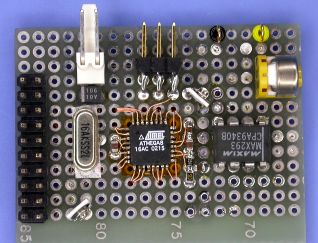
SG12232C is a full graphics type LCD module in resolution of 122(H) x 32(V) dots. It has two Epson S1D15200 LCD controller on a board. The S1D15200 can display up to 61(H) x 32(V) dots and they drive half of the LCD panel each. SG12232C requires a 2 kHz square wave as LCD drive clock and it must be supplied during power is on or the LCD panel may be damaged due to static bias. The bus interface can select 8080 based or 6800 based. There is no 4-bit mode like HD447880, only 8-bit mode is available and it requires 14 I/O lines at least.
For more detail: Audio Spectrum Monitor using S1D15200 microcontroller
- What is the resolution of the SG12232C module?
The module has a resolution of 122(H) x 32(V) dots. - How many LCD controllers are on the board?
There are two Epson S1D15200 LCD controllers on the board. - Does the SG12232C support 4-bit mode?
No, only 8-bit mode is available. - What clock signal does the module require?
The module requires a 2 kHz square wave as the LCD drive clock. - Can this setup be applied to radio frequency bands?
Yes, this application can also be applied to radio frequency bands. - How many I/O lines are required at minimum?
The interface requires at least 14 I/O lines. - Why must the drive clock be supplied during power on?
The clock must be supplied continuously or the LCD panel may be damaged due to static bias. - What bus interfaces can the module select?
The bus interface can select 8080 based or 6800 based modes.
