
Summary of AVR based monochrome signal generation for a PAL TV using atmega16 micrcontroller
Summary: I refreshed TV basics and implemented a monochrome PAL TV signal generator using an AVR microcontroller (ATmega16). The initial goal was to display simple patterns; the first practical output is a vertical line, which requires only horizontal synchronization. The article explains the necessity of horizontal and vertical sync pulses to lock the image on the TV and mentions analog video levels (~0.3 to 1 V) and sync levels (0 to 0.3 V).
Parts used in the Monochrome PAL TV Signal Generator:
- ATmega16 AVR microcontroller
- USBASP programmer
- avr-gcc compiler (software)
- TV with PAL input
- Video output circuitry (to generate 0.3 to 1 V picture levels and 0 to 0.3 V sync levels)
- Power supply for microcontroller and video circuitry
- Connecting cables (to TV and programmer)
Introduction:
I have learned some thing about TV in one of my B.tech semester but I forgot most of them. Now I refreshed a few basics and tried to implement a monochrome PAL TV signal generator using an AVR micrcontroller. I was using PIC earlier but later I jumped to AVR because I loves the USBASP programmer, the free avr-gcc compiler and the user friendly architecture of AVR microcontroller .Also at any time, if I feel little bit lazy, they I can try arduino also.
At first, my aim was to display few A B C D letters on my tv screen. But it is not possible for a beginner to do it directly(at least in my case) without doing any hello world stuff on TV. The first and the basic hello world pattern which one could display very easily on his tv is a vertical line of desired thickness and position. This is very easy because we don’t need to provide any vertical synchronization to lock the picture scrolling on vertical axis, what we need to provide is a horizontal synchronization only.
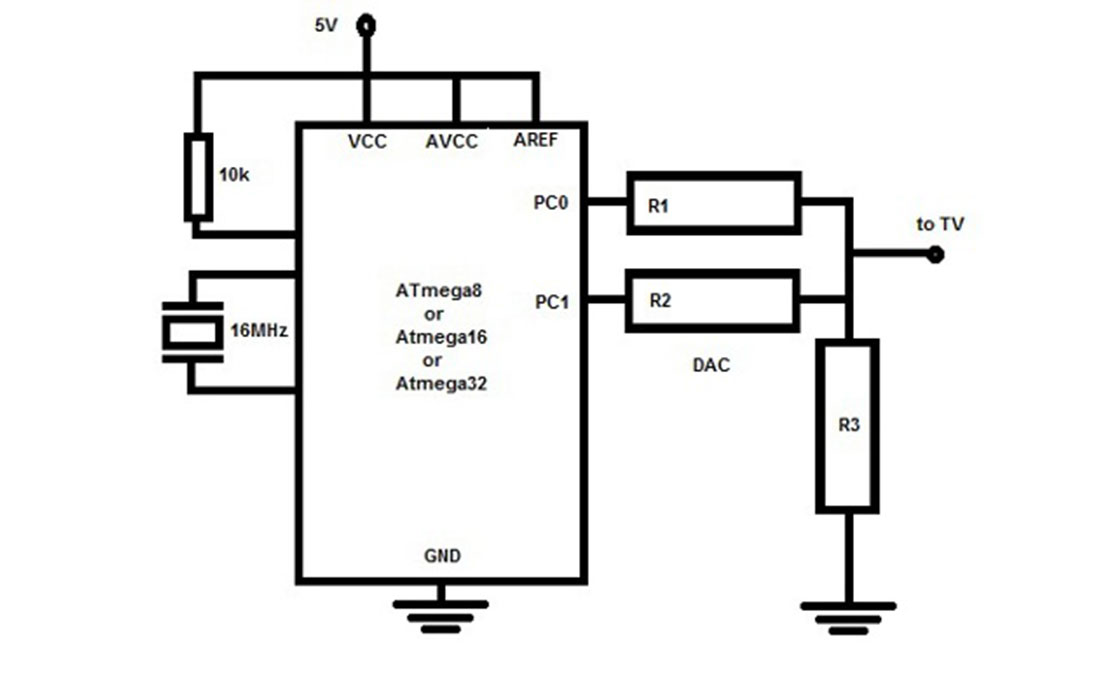
- What was the initial display goal on the TV?
To display a few letters (A B C D), but the first practical output implemented was a vertical line. - Why is a vertical line an ideal hello world for TV signal generation?
Because it requires only horizontal synchronization and no vertical synchronization to lock vertical position. - Which microcontroller was used for the project?
An ATmega16 AVR microcontroller was used. - Why did the author prefer AVR over PIC?
Because of the USBASP programmer, the free avr-gcc compiler, and the user-friendly AVR architecture. - What voltage ranges are mentioned for picture and sync levels?
Picture (analog) levels are about 0.3 to 1 V, and sync levels are 0 to 0.3 V. - What do horizontal and vertical synchronization pulses do?
Horizontal sync locks scanning horizontally; vertical sync (a stream of pulses) locks the picture vertically so it starts from the top of each field. - Is vertical synchronization longer or shorter than horizontal synchronization?
Vertical synchronization is longer compared to horizontal synchronization. - Can Arduino be used instead of direct AVR development?
Yes, the author mentions Arduino as an alternative if feeling lazy.
