
Summary of BOXER-8521AI: POWER AI EDGE COMPUTING WITH GOOGLE® EDGE™ TPU
The BOXER-8521AI is a rugged, fanless AI Edge Computing system that won the 2021 Taiwan Excellence Award. It integrates Google's Edge TPU with NXP i.MX 8M SoC for efficient processing up to 4 TOPS. Key features include PoE PD connectivity for simplified installation and redundant power support via DC input. The system supports AutoML Vision Edge and TensorFlow Lite, operating reliably in temperatures from -5°C to 50°C with extensive I/O options like HDMI, USB, and COM ports.
Parts used in the BOXER-8521AI:
- Google Edge TPU System-on-Module (SoM)
- NXP i.MX 8M SoC
- Google Edge TPU coprocessor
- PoE PD port
- DC-input power connector
- Rugged fanless chassis
- HDMI port
- USB3.2 Gen 1 ports
- USB2.0 ports
- COM port
- 40-pin multi-I/O port
mass-market scale. Winner of the 2021 Taiwan Excellence Award, the BOXER-8521AI combines the flexibility of PoE PD deployment with the Google® Edge™ TPU in a rugged, fanless system designed to bring AI Edge Computing to where it’s needed.
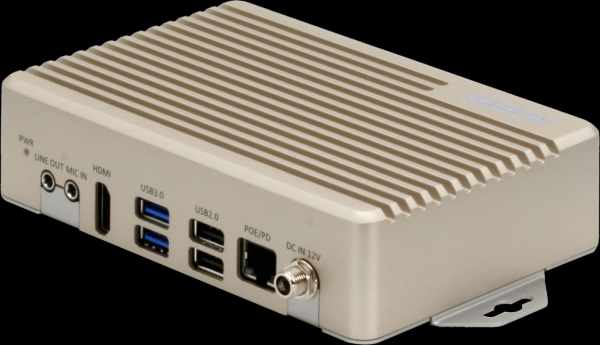
Recently awarded the Taiwan Excellence Award for 2021, the BOXER-8521AI is focused on providing flexibility in deployment and connectivity. The BOXER-8521AI features a PoE PD port, allowing the system to be deployed further away from its power source, as well as enable internet connection and remote monitoring of the system over the same single cable, reducing the complexity of installation. Additionally, by utilizing both the PoE PD port and DC-input, the system can continue operating even if one power supply is cut off.
The BOXER-8521AI powers AI Edge Computing thanks to the Google Edge TPU System-on-Module (SoM) with a rugged chassis and flexible I/O loadout. The Google Edge TPU combines the NXP i.MX 8M SoC (quad Cortex-A53, Cortex-M4F) with the Google Edge TPU coprocessor to deliver speeds up to 4 TOPS at an energy-efficient 2 TOPS per Watt.
Thanks to the Google Edge TPU, developers and users who deploy the BOXER-8521AI have access to Google’s suite of training software, AutoML Vision Edge. This innovative software helps developers quickly develop and train AI models utilizing Google’s vast cloud services, and then export the model to the BOXER-8521AI and Google Edge TPU. The system supports TensorFlow Lite, a framework that allows for more efficient models, better system performance and processing speeds.
The BOXER-8521AI is built rugged, with fanless construction to keep dust and contaminants out, providing longer-lasting, reliable operations. Additionally, the system can operate in temperatures from -5°C to 50°C without loss in performance. The BOXER-8521AI is equipped with a flexible I/O loadout that includes COM, HDMI, two USB3.2 Gen 1 and two USB2.0 ports. It also features a 40-pin multi-I/O port to connect to more sensors and controllers, such as cameras, temperature sensors, and others.
Read more: BOXER-8521AI: POWER AI EDGE COMPUTING WITH GOOGLE® EDGE™ TPU
-
What award did the BOXER-8521AI win?
It was the winner of the 2021 Taiwan Excellence Award. -
How does the PoE PD port benefit deployment?
It allows the system to be deployed further from its power source while enabling internet connection and remote monitoring over a single cable. -
Can the system operate if one power supply fails?
Yes, utilizing both the PoE PD port and DC-input ensures continuous operation even if one power supply is cut off. -
What processing speed does the Google Edge TPU provide?
The system delivers speeds up to 4 TOPS at an energy-efficient 2 TOPS per Watt. -
Which software tools are supported by the BOXER-8521AI?
It supports Google's AutoML Vision Edge training software and the TensorFlow Lite framework. -
What is the operating temperature range of the system?
The system can operate in temperatures from -5°C to 50°C without loss in performance. -
Does the BOXER-8521AI have active cooling fans?
No, it features a rugged fanless construction to keep dust and contaminants out. -
What types of sensors can connect via the 40-pin port?
The port connects to sensors and controllers such as cameras and temperature sensors.
