
Summary of BQ25619 I2C-CONTROLLED 1.5 A SINGLE-CELL BUCK BATTERY CHARGER
Texas Instruments' BQ25619 is a highly integrated 1.5 A switch-mode battery charger and power-path management device designed for Li-Ion and Li-polymer batteries in wearables. It combines charging, boost conversion, and voltage protection to support USB, high-voltage adapters, and wireless power inputs. Key features include ultra-low termination current, ship-mode leakage of 6 µA, and a single-inductor buck-boost architecture that optimizes efficiency and extends battery life while maintaining system operation even with depleted batteries.
Parts used in the BQ25619 Project:
- BQ25619 single-chip solution
- Input reverse-blocking FET (RBFET, Q1)
- High-side switching FET (HSFET, Q2)
- Low-side switching FET (LSFET, Q3)
- Battery FET (BATFET, Q4)
- Bootstrap diode
- I2C serial interface
- Single inductor
- External PMOS FET
- USB PHY detection circuit
Texas Instruments’ power-path management solution features 20 mA termination and 1 A boost operation
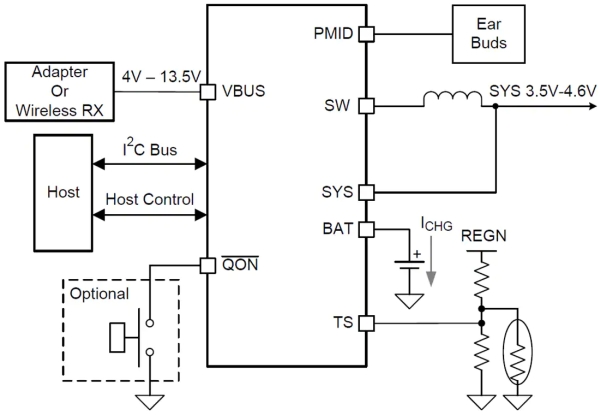
Texas Instruments’ BQ25619 integrates charge, a boost converter, and voltage protection in a single device. It offers ultra-low termination current for switching chargers to charge wearable devices by full-battery capacity. The BQ25619 low quiescent current reduces battery leakage to 6 µA in ship-mode, which conserves battery energy to double the device’s shelf life. The device is a highly integrated 1.5 A switch-mode battery charge management and system power-path management device for Li-Ion and Li-polymer batteries. It features fast charging with high input voltage support for a wide range of applications including wearables and earphone charging cases. The low impedance power-path optimizes switch-mode operation efficiency, reduces battery charging time, and extends battery run-time during the discharging phase. The input voltage and current regulation, low termination current, and battery remote sensing deliver maximum charging power to the battery. The solution is highly integrated with input reverse-blocking FET (RBFET, Q1), high-side switching FET (HSFET, Q2), low-side switching FET (LSFET, Q3), and battery FET (BATFET, Q4) between the system and battery. A bootstrap diode is integrated for the high-side gate drive to simplify the system design. The I2C serial interface with charging and system settings makes the device a truly flexible solution.
The BQ25619 supports a wide range of input sources, including a standard USB host port, USB charging port, USB-compliant high voltage adapter, and wireless power. The charger is compliant with USB 2.0 and USB 3.0 power specs with input current and voltage regulation. The device takes the result from a detection circuit in the system, such as a USB PHY device. The BQ25619 integrates a buck charger and boost regulator into one solution with a single inductor. The boost-mode supplies 5 V (adjustable 4.6 V / 4.75 V / 5 V / 5.15 V) on the PMID-pin and is used to save BOM and charge another battery by the control of PMID_GOOD. The PMID_GOOD pin is used to drive the external PMOS FET to disconnect boost output PMID from the attached accessories. The power-path management regulates the system slightly above battery voltage but does not drop below the 3.5 V minimum system voltage (programmable) with the adapter applied. With this feature, the system maintains operation when the battery is completely depleted or removed. When the input current limit or voltage limit is reached, the power path management automatically reduces the charge current. As the system load continues to increase, the battery starts to discharge the battery until the system power requirement is met. This supplement-mode prevents overloading the input source.
Features
- Single-chip solution to charge wearable accessories from an adapter or battery
- High-efficiency, 1.5 MHz, synchronous switch-mode buck charger
- Boost-mode with output of 4.6 V to 5.15 V
- Single input supports USB, high-voltage adapter, or wireless power
- Narrow VDC (NVDC) power-path management
- Flexible I2C configuration and autonomous charging for optimal system performance
- High integration includes MOSFETs, current-sensing, and loop compensation
- Low RDS(ON) 19.5 mΩ BATFET minimizes charging loss and extends battery run-time
- Low battery leakage current in ship-mode (7 µA), system standby (9.5 µA)
- High accuracy battery charging profile
Applications
- Consumer wearables, smartwatches
- Personal care and fitness
- Headsets/headphones
- Earbuds (true wireless or TWS) charging cases
- Hearing aids charging cases
Read more: BQ25619 I2C-CONTROLLED 1.5 A SINGLE-CELL BUCK BATTERY CHARGER
- What components are integrated inside the BQ25619?
The device integrates charge, a boost converter, voltage protection, RBFET, HSFET, LSFET, BATFET, and a bootstrap diode. - How does the BQ25619 conserve battery energy in ship-mode?
It reduces battery leakage to 6 µA in ship-mode to double the device's shelf life. - Can the BQ25619 support multiple input sources?
Yes, it supports standard USB host ports, USB charging ports, high-voltage adapters, and wireless power. - Does the device maintain system operation when the battery is removed?
Yes, power-path management keeps the system voltage above 3.5 V so it operates even if the battery is depleted or removed. - What is the output voltage range of the boost mode?
The boost mode supplies an adjustable output between 4.6 V and 5.15 V on the PMID pin. - How is the boost output disconnected from accessories?
The PMID_GOOD pin drives an external PMOS FET to disconnect the boost output from attached accessories. - What happens when the input current limit is reached?
The power path management automatically reduces the charge current to prevent overloading the input source. - Which applications are best suited for this solution?
It is ideal for consumer wearables, smartwatches, headsets, TWS earbuds cases, and hearing aid cases.
