
Summary of Controlling a BLDC Motor with an ESC
Brushless DC motors place permanent magnets on the rotor and electromagnets on the stator, yielding higher efficiency, precision, less electrical noise, no brush wear, and better cooling than brushed motors. They require an Electronic Speed Controller (ESC) to interpret speed commands, typically delivered as 50 Hz (20 ms) PWM signals from a microcontroller like the AtMega16. Pulse widths around 1 ms give minimum or zero speed and 2 ms gives full speed, with intermediate values controlling speed proportionally. ESC choice and initial cost are the main trade-offs.
Parts used in the BLDC Control Project:
- AtMega16 microcontroller
- Brushless DC motor (BLDC)
- Electronic Speed Controller (ESC)
- LiPo battery (power source for the motor)
REQUIREMENTS:
1. Microcontroller (AtMega 16)
2. A Brushless DC motor (BLDC)
3. An Electronic Speed Controller (ESC)
4. Power source to drive the motor (LiPo battery)
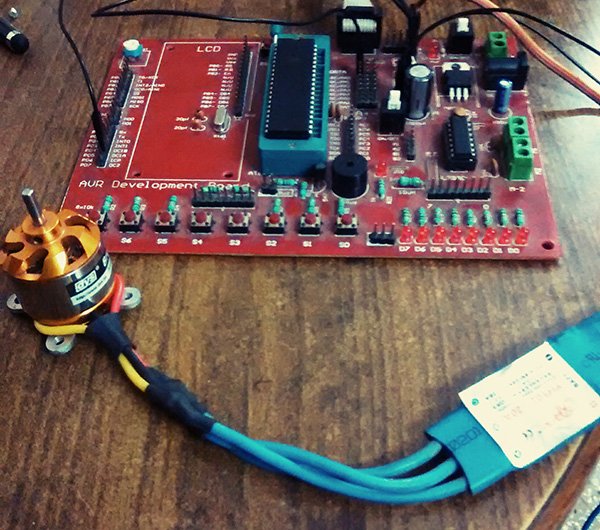
DESCRIPTION:
 For more detail: Controlling a BLDC Motor with an ESC
Brushless motors have much more satisfying results as compared to brushed motors. The basic difference between them is that in a brushless motor, the rotor itself contains the permanent magnets and the electromagnets move to the stator which is quite opposite as seen in a brushed motors. It’s more precise and can also factor the speed of the motor into the equation. This makes brushless motors more efficient as there is no sparking, less electrical noise and no brushes to wear out. With the electromagnets on the stator, they are very easy to cool. You can have a lot of electromagnets on the stator for more precise control. The only disadvantage of a brushless motor is its higher initial cost, but you can often recover that cost through the greater efficiency over the life of the motor.
Now when we talk about controlling these motors I would like to introduce a new term, i.e. ESC which stands for Electronic Speed Controllers. As the name suggests, they control the speed of brushless DC motors using some electronic protocol. These ESCs need a command to work further. In this project I’m sending these commands using a microcontroller, AtMega 16. You might be thinking what these command could be? Don’t worry, if you have ever dealt with servo motors before, you’ll be able to control these BLDC motors very easily. Most of the ESCs need a 50Hz frequency i.e. a 20 ms cycle and the speed depends upon the duty cycle you provide. 1ms will reduce its speed to minimum or even stop it (it depend upon the ESC model) while a 2ms pulse will run the motor on its full speed. The values between them give you a variation in speed.
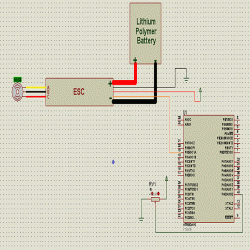
Schematic
 For more detail: Controlling a BLDC Motor with an ESC
- How does a brushless motor differ from a brushed motor?
In a brushless motor the rotor has permanent magnets and the electromagnets are on the stator, opposite of brushed motors. - What component controls the speed of a BLDC motor?
An Electronic Speed Controller (ESC) controls the speed of a BLDC motor. - Which microcontroller is used to send commands to the ESC in this project?
The AtMega16 microcontroller is used to send commands to the ESC. - What signal frequency do most ESCs expect?
Most ESCs expect a 50 Hz signal, corresponding to a 20 ms cycle. - What pulse width corresponds to minimum or zero speed?
A pulse width around 1 ms corresponds to minimum speed or stop, depending on the ESC model. - What pulse width corresponds to full speed?
A 2 ms pulse typically runs the motor at full speed. - Can speed be varied between minimum and full speed?
Yes, values between 1 ms and 2 ms pulse width provide varying speeds. - Why are brushless motors more efficient?
They have no sparking, produce less electrical noise, have no brushes to wear out, and allow easier cooling of stator electromagnets.
