
Summary of Curious C-Beeper
The Curious C-Beeper is a compact, battery-powered probe designed to detect capacitor capacity, test temperature stability, and locate wires. It utilizes three transistors to generate a frequency-dependent beep when capacitance changes, allowing users to match components or trace circuits without direct contact. Powered by two CR2032 cells in a TicTac box, it consumes minimal power (10 uA) when idle, eliminating the need for a power switch. The device effectively handles capacitors under 0.1 uF, using the user's body as a conductor to complete the circuit.
Parts used in the Curious C-Beeper:
- Three transistors
- Two CR2032 lithium cells
- TicTac box
- Beeper metal case
- Probe tip
Curious C-Beeper is a fun to build little probe that can be used to quickly detect the capacity of capacitors in pF nF range, test their stability with temperature changes, find broken wires, locate wires, trace wires on PCBs, and to locate live wires behind the walls without touching them. The circuit uses three transistors to make a most unusual capacitance beeper probe. When a capacitor is touched to the probe, the probe beeps at a frequency that varies with capacitance. The frequency change is so steep with capacitance that tiny capacitors may be precisely matched or an exact fixed value may be selected to replace a trimmer in a prototype. If the user has reasonably moist skin, simply holding one lead of the capacitor to be tested while touching the other lead to the probe is all that is necessary. The user’s body forms the other connection through the beeper’s metal case. When the beeper is properly adjusted it draws only 10 uA with nothing touching the probe – no power switch is required. This design is optimized for capacitors less than about 0.1 uF (100 nF). Large capacitors give a low frequency “clicking” sound and small capacitors sound a tone that increases as the capacitance decreases. Many decades of frequency change occur over the beeper’s range giving even the more tone-deaf among us sufficient change to discern slight differences in capacitance. The entire device is powered by two CR2032 lithium cells that fit into TicTac box. The use of power switch is unnecessary since the circuit consumes almost no power when not being used.
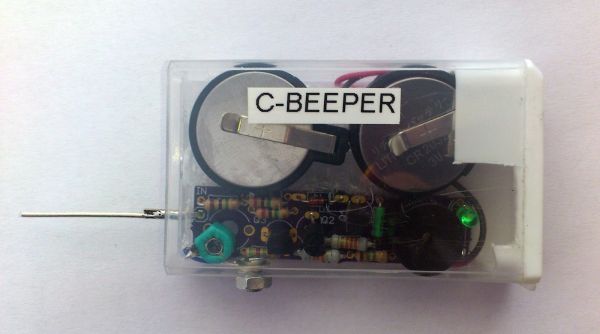
The Curious C-Beeper will become indispensable in virtually no time and has many uses such as:
Quickly match capacitors and trimmers. Forget the capacitance meter when matching parts from the parts bin or selecting a fixed value to replace a trimmer – the “fingers as conductors” feature makes the C-Beeper super-fast when searching for that perfect value.
Easily detect tiny variations when a capacitor is heated or cooled to quickly discriminate between NPOs and “Stable” dielectrics. General purpose and temperature compensating dielectric are quite easy to spot.
The C-Beeper makes an excellent cable fault locator – the end with the open will have less capacitance and beep at a much higher pitch or not at all. A break along an unshielded bundle can be spotted by grabbing the bundle at various points while listening for the capacitance change.
Identify which wire is which at the end of a bundle without stripping back the insulation. Touch the bare wire at one end with the C-beeper probe and pinch the still-insulated wires at the opposite end. The right wire will drop the pitch.
For more detail: Curious C-Beeper
- How does the Curious C-Beeper work?
The circuit uses three transistors to create a beeper that sounds at a frequency varying with the capacitance of the component being tested. - Can I use the C-Beeper without a power switch?
Yes, the design draws only 10 uA when not touching the probe, making a power switch unnecessary. - What range of capacitors can this device test?
The design is optimized for capacitors less than about 0.1 uF or 100 nF. - How do I test a capacitor using my body?
If you have reasonably moist skin, hold one lead while touching the other to the probe, allowing your body to form the connection through the beeper's metal case. - Does the pitch change based on capacitance size?
Yes, small capacitors produce a tone that increases as capacitance decreases, while large capacitors give a low-frequency clicking sound. - How can I identify broken wires with this tool?
The end with an open break will have less capacitance and beep at a much higher pitch or not at all. - Can I trace wires inside a bundle without stripping insulation?
Touch the bare wire at one end with the probe and pinch insulated wires at the opposite end; the correct wire will drop the pitch. - What type of batteries power this project?
The entire device is powered by two CR2032 lithium cells that fit into a TicTac box.
