
Summary of DC Motor Control with Joystick & AVR Microcontroller
This article demonstrates controlling DC motor direction using an AVR microcontroller and a potentiometer acting as a joystick. Suitable for robotics, industrial machinery, and RC toys, the circuit utilizes an ATMega32 to process input from the potentiometer and an L293D H-bridge driver to manage motor rotation. Three LEDs provide visual feedback on motor status, indicating forward motion, reverse motion, or a stop state.
Parts used in the DC Motor Control with Joystick:
- AVR microcontroller ATMega32
- H-bridge driver L293D
- Potentiometer (used as joystick)
- Three LEDs of different colors
In many of the applications it is required to alter the direction of DC motor instantly. Like in washing machine, mixer, drilling machine winding – rewinding machine etc. Changing the direction of DC motor using joystick is most suitable and handy method.
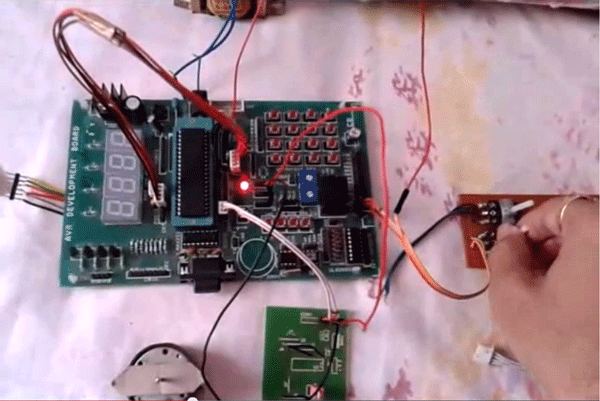
Joystick Control for DC motor is mostly used in different Robotic applications like
· Moving robotic hand up and down
· Rotating robotic arm clockwise or anticlockwise
· Moving robotic vehicle forward or reverse
· Rotating robotic eye (camera) complete 360o
Also in industries the joystick control is most preferable way to control machinery that is operated with DC motor. The best example is 3 axis or 2 axis DC motor operated crane. In this, 3 (or 2) DC motors moves crane up or down, rotate it left or right using 3 (or 2) joysticks.
And the biggest application of joystick control for DC motor is in RC (remote control) toys. RC cars, RC helicopters, RC motor boats, RC planes etc all uses wireless joystick control to control DC motor and to rotate it forward and reverse.
So this project illustrates how to change direction of DC motor using simple potentiometer as joystick. Here i have used potentiometer in place of joystick but any standard resistive joystick can be used. It is readily available in market. This is just a demonstration but one can also make real time industrial application with few modifications. Some of the ideas for advancements are discussed at the end of this project.
 stick, avr
Schematic diagram: –
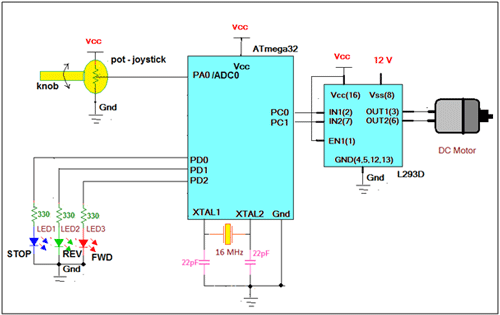
As shown in circuit diagram tab, the application is made using only two ICs, potentiometer and LEDs. AVR microcontroller ATMega32 used as motor controller and H-bridge driver L293D is used as motor driver chip. Potentiometer is used as joystick. It can be replaced by readily available joysticks in which resistance changes as joystick is moved upward or downward (here only difference is resistances changes as pot is rotated clockwise or counter clockwise). Three LEDs of different colours are used to indicate motor is rotating forward, reverse or its stop.
For more detail: DC Motor Control with Joystick & AVR Microcontroller
- How is the direction of a DC motor altered instantly?
Changing the direction is achieved using a joystick or a potentiometer connected to an AVR microcontroller. - What are common robotic applications for this control method?
It is used for moving robotic hands up and down, rotating arms clockwise or anticlockwise, moving vehicles forward or reverse, and rotating cameras 360 degrees. - Can standard joysticks replace the potentiometer in this project?
Yes, any standard resistive joystick can be used where resistance changes as the stick is moved. - Which ICs are required to build this specific application?
The application uses only two ICs: the ATMega32 microcontroller and the L293D motor driver chip. - How does the system indicate the current motor state?
Three LEDs of different colors indicate if the motor is rotating forward, rotating reverse, or stopped. - What is the primary function of the L293D component?
The L293D serves as the H-bridge driver chip responsible for driving the DC motor. - Are there industrial examples of this technology mentioned?
Yes, it is used in 2-axis or 3-axis DC motor operated cranes that move up, down, left, or right. - Does this project support real-time industrial applications?
While this is a demonstration, the text states one can make real-time industrial applications with a few modifications.
