
Summary of DIY Solder Paste Dispenser
This article outlines a budget-friendly DIY solder paste dispenser project, emphasizing the use of readily available components to avoid expensive commercial tools. The build utilizes a low-cost oilless air compressor and solenoid valves to replicate commercial vacuum mechanisms. Control is achieved via a relay board with an ATmega microcontroller, paired with syringes and needles for dispensing.
Parts used in the DIY Solder Paste Dispenser:
- Low cost oilless air compressor (specifically a Blue Hawk model)
- Solenoid valves (Stainless Steel or ABS models like 2S025-1/4H or 2P025 1/4S)
- Syringes and needles front end kit
- Relay board with an ATmega controller acting as an Arduino
- MOSFET and heatsink (recommended for 12VDC valve control)
- Motor driver (suggested as an alternative controller option)
This DIY Solder Paste dispenser is an easy project to build, so I thought I would share the details a bit with everyone! When possible I like to build my own tools, it makes sense especially when you have most of the parts on hand. There are a lot of tools that are just yak shaving experience, but fortunately this isn’t one of them!
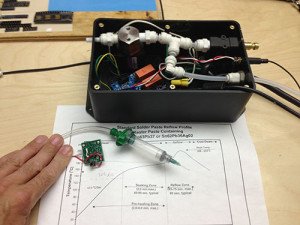
What parts do I need
for the DIY solder paste dispenser not much!
The heart behind this and any commercial unit is the compressor, so I thought I would go ahead and include it but it should be factored in when comparing prices to a commercial ebay solder paste dispenser. In this case I went to the local big box store and got the cheapest, oilless air compressor I could get in the sub $100 dollar range. this turned out to be a lowes Blue Hawk cheapy compressor.
The other key piece to these machines are the solenoid valves which control the airflow. Commercial units use dual process valves with venturi to create a vacuum on the syringe, but I will use 2 valve to mimic this action and come in under the price to boot! I use a lot of these valves in my Aeroponics projects and I really like STCValve as a reliable source! I really recommend the Stainless Steel ones, over the abs ones they are simply bulletproof. Although the ABS ones are a good price, but will require some more maintenance and can’t handle as much pressure! I recommend model numbers (SS) 2S025-1/4H and (ABS) 2P025 1/4S both models come with a choice of power options for the actual Solenoid part. Type 1 is the 12VDC, 2 are 24VDC, 3 110VAC and 4 is 220VAC the best choice for a tool like this I think are the 12VDC they require more amperage but nothing a mosfet and heatsink cant handle. In this example I used the 110VAC version as I had a couple on hand at the time of the build!
After that you need a front end kit of syringes and needles I like this one its a great deal for the price! and something to control the valves with, In the example it is a relay board with an atmega on it that acts like an Arduino. This could be an analog for just about any old arduino and controller board for the solenoids (I think a motor driver could work each valve is a stepper pole 
For more detail: DIY Solder Paste Dispenser
-
Why build this DIY solder paste dispenser instead of buying one?
Building your own makes sense if you have most parts on hand and avoids the yak shaving experience associated with many other tools. -
What type of air compressor is recommended for this project?
The author used a cheap, oilless air compressor from a big box store, specifically a Blue Hawk model under $100. -
Which solenoid valve materials are best for reliability?
Stainless steel valves are recommended over ABS ones because they are bulletproof and can handle more pressure with less maintenance. -
What power options are available for the solenoid valves?
The valves come with four power options: 12VDC, 24VDC, 110VAC, and 220VAC. -
What is the best voltage choice for controlling these valves?
12VDC is considered the best choice, though it requires more amperage that can be handled by a MOSFET and heatsink. -
How does the user plan to control the solenoid valves?
A relay board with an ATmega acts like an Arduino, though any old Arduino or controller board could work. -
Can a motor driver be used to control the valves?
Yes, the author suggests that a motor driver could work since each valve acts like a stepper pole.
