
Summary of Dummy electrical Load
The author built a variable dummy load to test a 0-15V, 2A power supply. Unlike the standard design, this version uses an MCP6002 rail-to-rail opamp powered by 5V, enabling precise current control from 1mA to 1A and beyond. The LM358 was tested as a pin-compatible alternative but failed to reach maximum current due to input/output limitations.
Parts used in Variable Dummy Load:
- MCP6002 rail-to-rail opamp
- LM358 opamp (tested alternative)
- Power supply (0~15V, 2A max)
- Dummy load circuit components
- Resistors
- Socket for opamp replacement
Recently, I purchased a power supply that claimed a max current of 2A and 0~15V. So I wanted to test it. I had a 36 watts bulb (used in motor cycles), but that was too much. Then, I thought of the dummy load that is explained by Dave in his video blog.
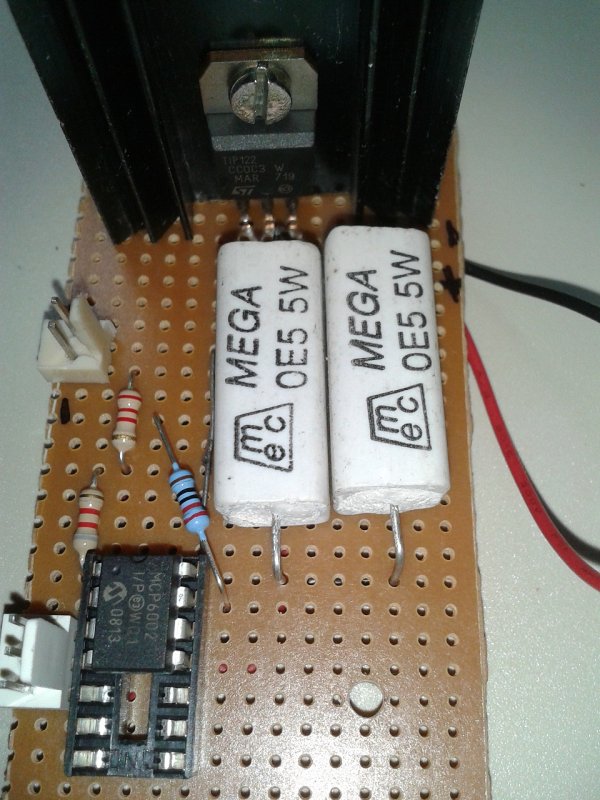
My version is similar, but I changed certain components to my liking (and what ever was already available with me).
Following are changes: –
1. I used MCP6002 — rail-to-rail opamp (both input and output). Supply voltage = 5V. Using rail-to-rail opamp simplifies the hardware design a lot and using this opamp, I was able to control current all the way from 1mA to 1A (and more). I also tried using LM358 (pin compatible, so remove MCP6002 from socket and insert LM358). But then, my max current was limited. That is either due to the lower limits of inputs/ outputs for this opamp. I could tweak the resistor to make the circuit work, but then, I had a bunch of MCP6002 lying with me as well, so better use them.
For more detail: Dummy electrical Load
-
What is the purpose of this project?
The project tests a power supply with a claimed max current of 2A and 0~15V output. -
Can I use the LM358 instead of the MCP6002?
Yes, it is pin-compatible, but the maximum current will be limited compared to the MCP6002. -
Why did the author choose the MCP6002 opamp?
It is a rail-to-rail opamp that simplifies hardware design and allows current control from 1mA to 1A and more. -
What voltage supplies the opamp in this circuit?
The opamp is supplied with 5V. -
What happened when the LM358 was used in the circuit?
The max current was limited likely due to lower limits of inputs or outputs for this specific opamp. -
Is it possible to tweak resistors to make the LM358 work better?
The author noted that tweaking resistors could make the circuit work, but preferred using the available MCP6002 chips.
