
Summary of Easy Pulse kit: A DIY pulse sensor based on photoplethysmography
The Easy Pulse sensor demonstrates photoplethysmography (PPG) for non-invasive heart rate detection. Version 1.1 improves upon the original design by utilizing a robust HRM-2511E transmission-mode sensor with flexible silicone rubber to minimize motion artifacts. This version outputs both analog PPG waveforms and digital pulse signals, offering greater accuracy and versatility compared to the previous TCRT1000 reflectance-based model.
Parts used in the Easy Pulse Version 1.1:
- HRM-2511E IR sensor
- Flexible Silicone rubber material
- IR LED
- Photodetector diode
- TCRT1000 reflective optical sensor (Original Version)
- Tindie board (Purchase option)
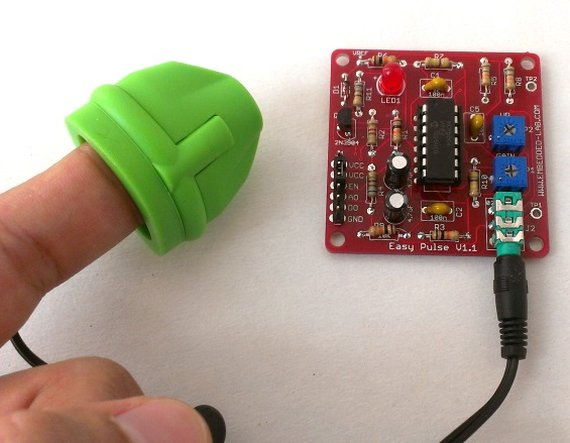
The Easy Pulse sensor is designed for hobby and educational applications to illustrate the principle of photoplethysmography (PPG) as a non-invasive optical technique for detecting cardio-vascular pulse wave from a fingertip. It uses an infrared light source to illuminate the finger on one side, and a photodetector placed on the other side measures the small variations in the transmitted light intensity. The variations in the photodetector signal are related to changes in blood volume inside the tissue. The signal is filtered and amplified to obtain a nice and clean PPG waveform, which is synchronous with the heart beat. The original version of Easy Pulse uses the TCRT1000 reflective optical sensor to sense the blood variation in the finger tissue and outputs a digital pulse which is synchronous with the heart beat. Today, we are pleased to announce the release of Easy Pulse Version 1.1, which has some improvements over the original design. The new version provides both analog PPG waveform as well as digital pulse signal as separate outputs. Easy Pulse Version 1.1 board is also available for purchase on Tindie.
Quick overview of Easy Pulse
The Easy Pulse sensor is based on the principle of photoplethysmography (PPG) which is a non-invasive method of measuring the variation in blood volume in tissues using a light source and a detector. Since the change in blood volume is synchronous to the heart beat, this technique can be used to calculate the heart rate. Transmittance and reflectance are two basic types of photoplethysmography. For the transmittance PPG, a light source is emitted in to the tissue and a light detector is placed in the opposite side of the tissue to measure the resultant light. Because of the limited penetration depth of the light through organ tissue, the transmittance PPG is applicable to a restricted body part, such as the finger or the ear lobe. However, in the reflectance PPG, the light source and the light detector are both placed on the same side of a body part. The light is emitted into the tissue and the reflected light is measured by the detector. As the light doesn’t have to penetrate the body, the reflectance PPG can be applied to any parts of human body. In either case, the detected light reflected from or transmitted through the body part will fluctuate according to the pulsatile blood flow caused by the beating of the heart.
The original Easy Pulse design was based on the reflectance approach and used TCRT1000 IR device as sensor. It could detect the pulse signal when an user places his/her fingertip on the top of the sensor. While this sensor performed well, it was susceptible to a very small movement of the finger. So, the user should keep the finger very steady to obtain the accurate pulse signal. Easy Pulse Version 1.1 uses a more robust sensor (HRM-2155E) that operates in transmission mode and fits tight around the fingertip, thereby it is less prone to motion.
The HRM-2511E sensor is manufactured by Kyoto Electronic Co., China, and operates in transmission mode. The sensor body is built with flexible Silicone rubber material that helps to keep the sensor tightly hold to the finger. Inside the sensor case, an IR LED and a photodetector are placed on two opposite sides and are facing each other. When a fingertip is plugged into the sensor, it is illuminated by the IR light coming from the LED. The photodetector diode receives the transmitted light through the tissue on other side. More or less light is transmitted depending on the tissue blood volume. Consequently, the transmitted light intensity varies with the pulsing of the blood with heart beat. A plot for this variation against time is referred to be a photoplethysmographic or PPG signal. The following picture shows a basic transmittance PPG probe setup to extract the pulse signal from the fingertip.
The PPG signal consists of a large DC component, which is attributed to the total blood volume of the examined tissue, and a pulsatile (AC) component, which is synchronous to the pumping action of the heart. The AC component, which carries vital information including the heart rate, is much smaller in magnitude than the DC component. A typical PPG waveform is shown in the figure below (not to scale).
For more detail: Easy Pulse kit: A DIY pulse sensor based on photoplethysmography
- How does the Easy Pulse sensor detect heart rate?
It uses an infrared light source and a photodetector to measure variations in blood volume inside tissue caused by the heartbeat. - What is the main improvement in Easy Pulse Version 1.1 over the original?
The new version uses a more robust HRM-2511E sensor in transmission mode that fits tightly around the fingertip, making it less prone to motion errors. - Does the Easy Pulse Version 1.1 provide analog output?
Yes, it provides both analog PPG waveform and digital pulse signal as separate outputs. - Why was the TCRT1000 replaced in the new design?
The original TCRT1000 sensor was susceptible to very small finger movements, requiring the user to keep their finger very steady. - What material is used to make the HRM-2511E sensor fit tight?
The sensor body is built with flexible Silicone rubber material to help keep the sensor tightly holding the finger. - Where can I purchase the Easy Pulse Version 1.1 board?
The board is available for purchase on Tindie. - What are the two basic types of photoplethysmography mentioned?
The article identifies transmittance and reflectance as the two basic types of photoplethysmography. - Which component carries vital information like heart rate in the PPG signal?
The pulsatile AC component of the PPG signal carries vital information including the heart rate.
