
Summary of Fake TV Security Light
This article describes a DIY "Fake TV" project designed to deter burglars by simulating the changing light patterns of a television using neopixel RGB LEDs and a microcontroller. The build aims to consume significantly less power (under 5W) than a real TV while creating a convincing visual effect. Although commercial clones exist, this guide offers a cost-effective, low-power alternative for home security.
Parts used in the Fake TV:
- Neopixel RGB LED's (WS2812B)
- Microcontroller (Digispark)
- Prototyping board (prototype PCB)
- Resistor
- Capacitor
- LDR (Light Dependent Resistor)
- Power supply
- Black irrigation tube
The Idea
Update: Looks like somebody had this idea before me and made a product out of it. Just Google Fake TV. In fact, you can also buy a clone of this from AliExpress – again, just search for ‘fake tv’ in AliExpress. The Chinese versions can be had for about $12 in your hand and that includes a power supply (no doubt of somewhat dubious quality and safety standards). So what follows is a fun project, but it’s easier and possibly cheaper to buy direct from China.
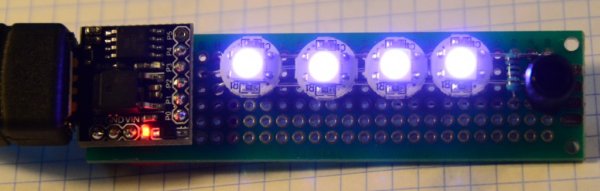
The idea of leaving a light on at home while you’re out is to give the burglar an uneasy feeling that somebody’s at home and it might be worth trying the next house along instead. A TV on at night plays a constantly-changing light-show against your window which really does say I’m at home and I’m awake. Of course, you could leave a real TV on but that’s an eco-disaster since TV’s consume 50W at best and hundreds at worst. Plus you might not want to be burning your TV in for days on end if you’re not at home.
Why not use some of these neopixel RGB LED’s and a microcontroller to simulate the same effect? With just a few eurodollars, an hour of build time and a power budget of 5W absolute maximum, it sounds like a winner
Building
I built using some of my favourite prototyping board. It’s not stripboard (Veroboard) so you have to solder your own wires but it’s cheap, pre-cut to commonly-used sizes. I get mine from eBay – search for ‘prototype PCB’. I had to file down the end of the board so as to not foul the USB connector on the Digispark.
The resistor and capacitor for the neopixel WS2812B LEDs part of the circuit are on the back of the board.
I turned the little black tube for the LDR of plastic on the lathe. It occurred to me while I was making it that I probably had several tens of metres of spare black irrigation tube from which I could have snipped off a centimetre in a heartbeat. There we are, it works.
For more detail: Fake TV Security Light
- What is the main purpose of this project?
To simulate a constantly-changing light-show against a window to make it appear that someone is awake at home. - How much power does this project consume compared to a real TV?
The project has a power budget of 5W absolute maximum, whereas a real TV consumes 50W at best and hundreds at worst. - Can I buy a ready-made version of this device?
Yes, you can buy a product called Fake TV or a clone from AliExpress for about $12 including a power supply. - What type of prototyping board did the author use?
The author used a cheap prototype PCB which is pre-cut to commonly-used sizes but requires soldering your own wires. - Why was the end of the prototyping board filed down?
The end was filed down so as not to foul the USB connector on the Digispark. - Where are the resistor and capacitor located in the circuit?
The resistor and capacitor for the neopixel WS2812B LEDs part of the circuit are on the back of the board. - What material was used to create the tube for the LDR?
The black tube for the LDR was turned from plastic on a lathe, though spare black irrigation tube could have been used instead. - Is building this project cheaper than buying one?
Building it costs just a few eurodollars and takes an hour, making it potentially cheaper than buying a Chinese version for $12. - Does leaving a real TV on count as an eco-friendly solution?
No, leaving a real TV on is described as an eco-disaster due to high energy consumption.
