
Summary of Final Project EKG Monitoring System
Summary (under 100 words): The project builds an EKG monitoring instrument using an Atmel Mega103 microcontroller to measure cardiac electrical activity. It employs a custom instrumentation amplifier, a 0.2 Hz high-pass filter to remove DC drift, and a low-pass anti-aliasing filter. Data sampling occurs at 720 Hz via the microcontroller ADC and is stored in external SRAM. User input on PinD0 starts acquisition; stored data can be transmitted over Hyperterminal to Matlab for analysis such as RR and QT interval studies.
Parts used in the EKG Monitoring Instrument:
- Atmel Mega103 microcontroller
- Instrumentation amplifier (custom design for bio-electrical signals)
- High-pass active filter (cut-off 0.2 Hz)
- Low-pass active filter (anti-aliasing)
- Analog-to-digital converter (ADC) on the microcontroller
- External SRAM for data storage
- User input interface on PinD0
- Serial interface for Hyperterminal communication
- Electrodes and lead wiring for EKG signal acquisition
- Power supply components (implied for operation)
Introduction
Unexpected cardiac death, also known as sudden death is a frequently fatal form of arrhythmia which kills more than a quarter of a million people each year in the United States. Confronted with the devastating effects of unexpected cardiac death and with the pursuit of advance understanding of cardiac diseases, my partner and I Young Ho Cho and Jeff S. Lee – plan to design and build a heart monitoring instrument which measures the electrical activity of the heart, also known as an electrocardiogram (ECG / EKG).
Unexpected cardiac death can be further classified as ventricular fibrillation – irregular twitching of the ventricles replacing normal contractions – in which more than half of those victims die within an hour of the onset of symptoms and before any medical assistance. According to the American Heart Association’s 1999 Heart and Stroke Statistical Update, coronary heart disease caused 476,124 deaths in the United States in 1996 and since, it has been identified as the single largest killer of both men and women in this country and the world.
High level design
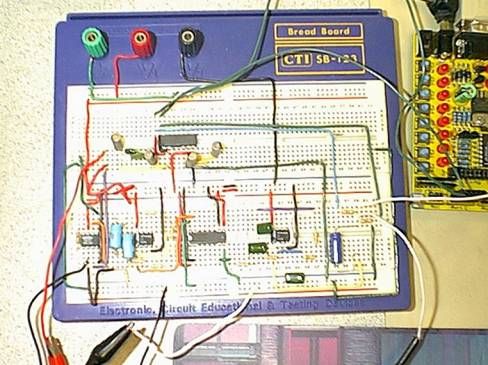
Our EKG monitoring instrument uses the Atmel Mega103 microcontroller to control and store the data acquired via EKG monitoring systems involved. Our primary objective is to accurately measure the electrical activity of heart with EKG monitoring instrument. This is achieved by building an instrumentation amplifier which is specifically designed for bio-electrical signal measurement. In addition, two active filters one high pass and one low pass were employed to eliminate measurement errors. The high pass filter was used to remove any dc drift with cut-off frequency of 0.2Hz, while the low pass filter was used to eliminate anti-aliasing effects. More detailed hardware designs are described below.
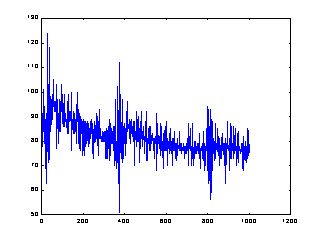
User input from the PinD0 initiates the data acquisition process. Once initiated, the signal acquired via EKG monitoring instrument goes through the Analog to Digital Converter of the microcontroller at sampling frequency of 720Hz and this data is stored in external SRAM. Upon completion of data acquisition process, the user can initiate transmission of the stored data via the Hyperterminal to be interfaced with Matlab. Data can be further analyzed with Matlab software for future studies, such as RR interval analysis, QT interval analysis.
For more detail:Final Project EKG Monitoring System
- What microcontroller is used in the project?
The project uses the Atmel Mega103 microcontroller. - How is the bio-electrical EKG signal amplified?
The signal is amplified using a custom instrumentation amplifier designed for bio-electrical measurements. - Does the design include filtering to remove drift?
Yes, a high-pass active filter with a 0.2 Hz cut-off is used to remove DC drift. - What filter is used to prevent aliasing?
A low-pass active filter is employed as an anti-aliasing filter. - At what sampling frequency is the EKG signal digitized?
The ADC samples the signal at 720 Hz. - Where is the sampled data stored?
Sampled data is stored in external SRAM. - How does a user start data acquisition?
User input on PinD0 initiates the data acquisition process. - How can stored data be transmitted for analysis?
Stored data can be transmitted via Hyperterminal to interface with Matlab. - What analyses are suggested for the recorded data?
Matlab can be used for RR interval analysis and QT interval analysis.
