
Summary of FIREFLY DUAL-LENS AI CAMERA MODULE SUPPORTS COMPUTER VISION AT EDGE
Firefly launched two dual-lens AI camera modules, CAM-C1109S2U and CAM-C1126S2U, featuring Rockchip processors (RV1109 and RV1126) with integrated NPUs up to 2 TOPS. These modules support edge computer vision, FastBoot, TrustZone, and multiple crypto engines. They include RGB and IR cameras with 1080p resolution, H.264/H.265 encoding, and 3F-HDR for low-latency video in various lighting conditions.
Parts used in the Firefly Dual-Lens AI Camera Modules:
- Rockchip RV1109 SoC
- Rockchip RV1126 SoC
- Arm Cortex-A7 CPU (dual-core or quad-core)
- RISC-V processor
- NPU (Neural Processing Unit)
- VPU (Vision Processing Unit)
- GC2093 image sensor
- GC2053 image sensor
- DDR4 RAM
- eMMC 4.51 flash storage
- 30-pin FPC header
- USB Type-C port
- Aluminum alloy housing
Firefly has launched two dual-lens AI camera modules with a built-in NPU (Neural Processing Unit) accelerator supporting up to 2 TOPS of performance. The modules feature Rockchip’s AI vision processors, RV1109 for CAM-C1109S2U module and RV1126 for CAM-C1126S2U module. The processor also supports FastBoot, TrustZone technology, and multiple crypto engines.
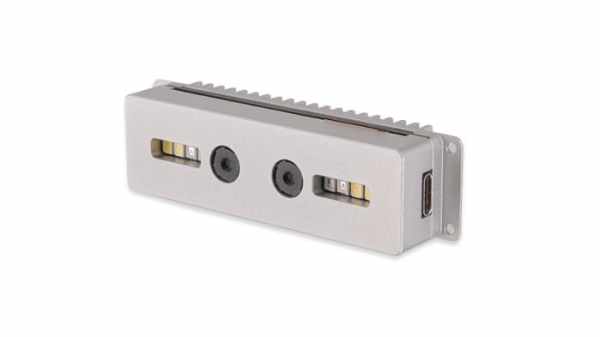
CAM-C1109S2U module’s RV1109 SoC comes with a 1.5GHz dual-core Arm Cortex-A7 CPU and a 400MHz RISC-V processor. It is also equipped with a 2D-capable graphics processor, and a VPU (Vision Processing Unit) compatible with H.264/H.265 encoding at 30 fps, and an NPU performing up to 1.2 TOPS.
CAM-C1126S2U module comes with a more powerful Rockchip RV1126 which has a quad-core Arm Cortex-A7 instead of the dual-core Arm Cortex-A7 in the CAM-C1109S2U module. Hence, this enhances the capacity of VPU encoding and decoding to allow up to 4K from the visible-light camera module and increases the NPU performance up to 2 TOPS.
Both the firefly camera modules have almost similar specifications, apart from the processors.
Technical Specifications Of Firefly Camera Modules
- 1 or 2GB DDR4 RAM constitutes the system memory
- Storage of 8 or 16 GB eMMC 4.51 flash
- RGB camera features 1920×1080 resolution GC2093 image sensor with 650nm filter and 80cm focus distance
- IR camera features 1920×1080 resolution GC2053 image sensor with 850nm filter and 80cm focus distance
- 30-pin FPC header to connect MIPI display (TBC) for video output
- Working temperature ranges from 10 to 60°C
- Power Supply of 5V through USB Type-C port
- 84 x 22.45 x 19.35 mm dimensions with aluminum alloy housing.
The on-board video CODEC of the firefly camera modules supports 2K H.254/H.265 at 30FPS and multi-channel video encoding and decoding. Hence, it fulfills the requirement of low bit rate and low-latency encoding. Thus, making the video tenure smaller. The built-in 3F-HDR ISP and 3F-HDR feature multi-level noise reductions. It also comes with a dual-lens 2M (RGB+IR) WDR camera for working in strong light, backlight, and darkness.
Read more: FIREFLY DUAL-LENS AI CAMERA MODULE SUPPORTS COMPUTER VISION AT EDGE
- What processors power the Firefly CAM-C1109S2U module?
The CAM-C1109S2U module uses the Rockchip RV1109 SoC with a dual-core Arm Cortex-A7 CPU. - How does the NPU performance differ between the two modules?
The CAM-C1109S2U has an NPU performing up to 1.2 TOPS, while the CAM-C1126S2U reaches up to 2 TOPS. - Can these modules support 4K video encoding?
Yes, the CAM-C1126S2U module supports up to 4K encoding due to its quad-core processor. - What image sensors are used in the dual-lens setup?
The RGB camera uses a GC2093 sensor and the IR camera uses a GC2053 sensor, both at 1080p resolution. - Does the system memory vary between the modules?
No, both modules feature 1GB or 2GB of DDR4 RAM as system memory. - What video codecs are supported by the on-board video CODEC?
The modules support H.264 and H.265 codecs at 30FPS for multi-channel encoding. - How do the modules handle low-light or strong backlight environments?
They utilize a dual-lens 2M WDR camera and 3F-HDR features for noise reduction in varied lighting. - What is the maximum working temperature for these modules?
The modules operate within a temperature range of 10 to 60°C.
