
Summary of AT89LP2052 / AT89LP4052 Parallel Port Programmer
The article describes a parallel port programmer for the AT89LP2052 and AT89LP4052 microcontrollers. It highlights that while these chips support SPI programming, this specific design utilizes the parallel mode to enable ISP fuses or disable XTAL Oscillator Bypass fuses. The hardware uses a 74HC574 latch for data, an HC273 for control signals (CS, Vcc, Vpp), and requires an external 16V power supply to generate the necessary 12V programming voltage. No external oscillator is needed, though data polling is omitted to minimize components.
Parts used in the AT89LP2052/AT89LP4052 Parallel Port Programmer:
- Parallel Port
- 74HC574 Latch with 3 State outputs
- HC273 device
- LEDs for Vcc and Vpp status
- External Power Supply (16V)
Programming the AT89 LP2052/LP4052 Flash Memory, Lock Bits and User Fuses
The AT 89LP2052 / 89LP4052 microcontroller provide two interfaces with same command format for device programming. The serial ISP Programming interface of the new 2052/4052 microcontroller needs one additional SS Signal for device programming. This SPI signal will be added in the near future to the existing AT89ISP cable and Software (driver) for IDE. You can find more details in the Atmel specifications.
This 2052 / 4052 programmer design uses the parallel programming mode via Parallel Port. Only parallel programming can re-enable the ISP Fuse. This programmer is also usefull if you need to write the user fuses to disable the XTAL Osc Bypass fuse – e.g. to test the LP2052 in existing 2051 hardware designs.
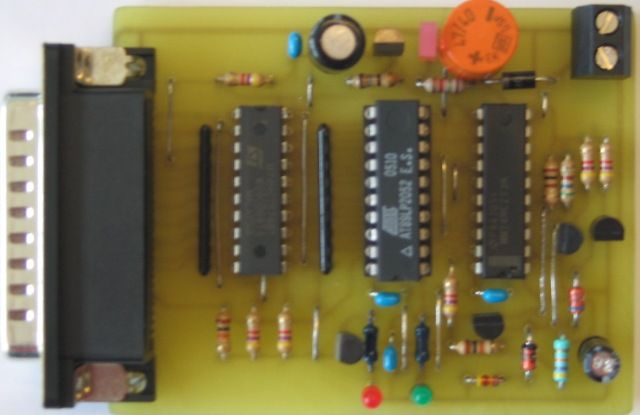
Programmer Hardware
The Dataport is connected via a 574 latch with 3 State outputs. The strobe signal of the Parallel Port is used to latch the datas. The CS/ Signal and Powersupply signals Vcc/Vpp of the micro are controlled through the HC273 device. The Init signal of the parallel Port is used to control these lines with the host software. The status of Vcc and Vpp are displayed with two LEDs on the programmer board. An external Oscillator is not required. The Atmel microcontroller is pulsed with the Select_In signal from the parallel port.
An external power supply (16V= ) is needed to generate the 12V programming voltage.
Visit www.atmel.com to find an application note how to use the Parallel Port for existing Atmel AT89 C/LV 51/52 devices.
Data polling is currently not supported to reduce the number of components on the board. To verify the datas we still have to test the SPI interface via parallel Port.
To minimize the influence of undefined states it is necessary to start the host software (to disable Vcc and Vpp !) before a 2052 / 4052 LP device is put into the socket.
For more detail: AT89LP2052 / AT89LP4052 Parallel Port Programmer
- How can you re-enable the ISP Fuse?
Only parallel programming can re-enable the ISP Fuse. - What is the purpose of using this programmer with existing 2051 hardware designs?
This programmer allows writing user fuses to disable the XTAL Osc Bypass fuse. - Which component latches the data from the Parallel Port?
The Dataport is connected via a 74HC574 latch with 3 State outputs. - What signal controls the CS, Powersupply, Vcc, and Vpp lines?
The HC273 device controls the CS signal and Powersupply signals Vcc/Vpp. - Does this programmer require an external oscillator?
An external oscillator is not required for this design. - What external power supply is needed for the 12V programming voltage?
An external power supply of 16V DC is needed to generate the 12V programming voltage. - Can you verify data using data polling on this board?
Data polling is currently not supported to reduce the number of components on the board. - When should you start the host software relative to inserting the chip?
You must start the host software to disable Vcc and Vpp before putting the device into the socket.
