
Summary of Broadband RF Field Strength Probe using Atmel AT90S1200A AVR controller
This article describes a battery-powered broadband RF field strength probe using an Atmel AT90S1200A microcontroller. It features automatic zeroing, low current drain, and auto-shutdown to extend battery life. The device detects RF energy via a small antenna and outputs millivolt signals for DVM input. It effectively covers frequencies from 4 MHz up to microwave levels, though response flatness is not guaranteed.
Parts used in the Broadband RF Field Strength Probe:
- Small antenna (approx. 15 cm insulated wire)
- Digital Volt Meter (DVM)
- Two AA batteries
- Power switch
- Atmel AT90S1200A microcontroller
- Detector transistor
- 10k potentiometer
- Reset/recal button
- LED indicator
- Punched fiberglass board
Download
auto-zero assembly code
This broadband probe has a small antenna (about a 15 cm length of insulated wire). Radio Frequency energy coupled to the antenna is detected and made available to drive millivolt level signals to the input of a DVM (Digital Volt Meter). Its battery powered for convenience with very low current drain and automatic shutdown for long battery life.
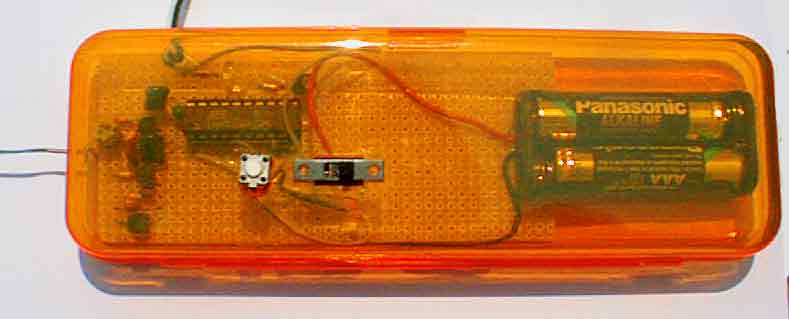
I’ve used the circuit shown below to check the output of transmitters at 4 MHz, 35 MHz, 55 MHz, 100 MHz, 900 MHz, a cell phone, and a microwave oven. It really is broad band, though I don’t make any claims for the flatness of response. Since the collectors and emitters of the detector transistor are both at RF ground, choice of transistors isn’t all that critical. A low base-collector capacitance will enhance the VHF and UHF sensitivity. All transistors should be of the same type to minimize thermal drift. The DC gain of the detector is about 50X (estimated by multiplying the voltage drop across the collector load by 38)Assembly is not critical and mine was built on punched fiberglass board without a ground plane. The 10k pot is a rough offset adjustment. Set it for about a +50 mV offset (assuming that the one you build doesn’t experience an offset drift of more than 50 mV). Push the reset/recal button (after power is applied, of course) and the auto zero circuit will bring the offset down of a millivolt or two and turn out the LED. The meter will continue to operate for 10 to 20 minutes (depending upon actual battery voltage) before shutting itself off.
An Atmel AT90S1200A micro controller is used to take advantage of its ability to operate with the internal clock rather than needing an external crystal. The advantages of using the internal clock over the crystal are a lower parts count, less radiated RF from the controller, and low cost. Note that the low frequency operation of several hundred kilohertz results in low power supply current demands from the controller.
The circuit is battery powered. I used two AA cells and put a power switch in series with them. The switch is only a comfort factor since the circuit has a timer that automatically shuts everything off after about 15 minutes (depends on battery voltage). When shut down, current drain drops to a few tens of micro amps. The auto-shut off feature has been well tested. In the first year since I built this, I have left with the power switch in the on position in my desk drawer while I was out of town twice, for a period of two months each time. Everything still works fine when the reset/recal button is pressed even though its still using the original pair of batteries.
For more detail: Broadband RF Field Strength Probe using Atmel AT90S1200A AVR controller
- How does the probe detect radio frequency energy?
Radio Frequency energy coupled to the small antenna is detected and converted into millivolt level signals for the DVM input. - What frequency range can this probe measure?
The probe operates broadly from 4 MHz up to microwave oven frequencies like 900 MHz. - Does the circuit require an external crystal oscillator?
No, the Atmel AT90S1200A microcontroller uses its internal clock, eliminating the need for an external crystal. - How long does the battery last before automatic shutdown?
The meter operates for 10 to 20 minutes depending on battery voltage before shutting itself off automatically. - What is the purpose of the reset/recal button?
Pressing this button activates the auto-zero circuit to reduce offset drift to a millivolt or two and turn off the LED. - Is the assembly process critical?
Assembly is not critical; the author built it on a punched fiberglass board without a ground plane. - Can I leave the power switch on for extended periods?
Yes, the auto-shut off feature allows the device to remain on for months without draining the batteries significantly. - What type of transistors should be used?
All transistors should be of the same type to minimize thermal drift, with low base-collector capacitance preferred for UHF sensitivity.
