
Summary of Make an Op-Amp High-Voltage Output Circuit
This article describes a technique to convert standard voltage op-amps into high-voltage output circuits capable of handling up to +/- 120V. The method utilizes shunt regulators to power the chip and incorporates current limiting transistor circuitry for the output stage, enabling higher voltage performance without specialized components.
Parts used in the Op-Amp High-Voltage Output Circuit:
- Standard voltage op-amp
- Shunt regulators
- Current limiting transistor circuitry
Have you ever wanted to take a standard voltage op-amp and turn it into a high voltage output circuit?
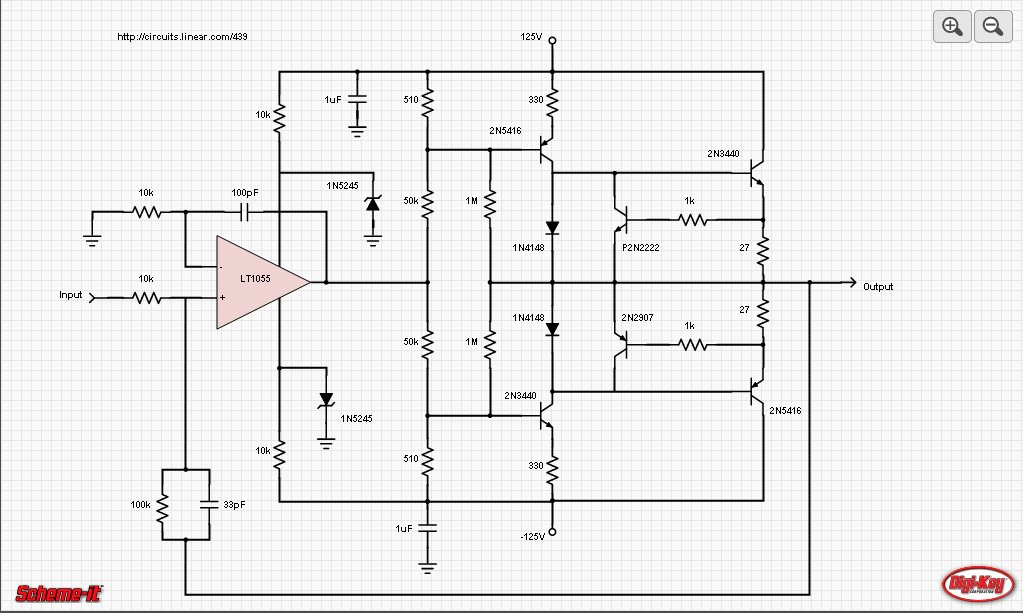
Here is a technique that requires some shunt regulators to power the chip and some current limiting transistor circuitry for the output. This example should work upto +/- 120V.
For more detail: Make an Op-Amp High-Voltage Output Circuit
- How can a standard voltage op-amp be converted to a high voltage output?
By using shunt regulators to power the chip and adding current limiting transistor circuitry. - What is the maximum voltage this circuit works up to?
The example circuit should work up to plus or minus 120 volts. - What components are required to power the chip in this design?
Shunt regulators are used to power the chip. - Does this circuit use special high voltage op-amps?
No, it uses a standard voltage op-amp with added circuitry. - What is the purpose of the transistor circuitry in this project?
The transistor circuitry provides current limiting for the output. - Can this technique achieve dual polarity high voltage outputs?
Yes, the example works up to plus or minus 120 volts. - What is the main advantage of this specific technique?
It allows turning a standard op-amp into a high voltage output circuit.
