
Summary of Frequency Counter
This project describes a compact, economical frequency counter designed to verify function generators. Built around a bare-bones Arduino clone, it measures frequencies up to 8 MHz using a single digital pin. The device supports sine and triangle waves with suitable amplitudes and displays results on an LCD screen. While constructed as a standalone unit, the circuit is easily adaptable for integration into other projects like function generators.
Parts used in Frequency Counter:
- Bare-bones Arduino clone
- LCD display
I am in the process of designing a function generator and I needed a frequency counter to check it against. This project uses a minimal number of components for a very economical and compact design. A bare-bones Arduino clone is at the heart of this project and the measured frequency is shown on an LCD display.
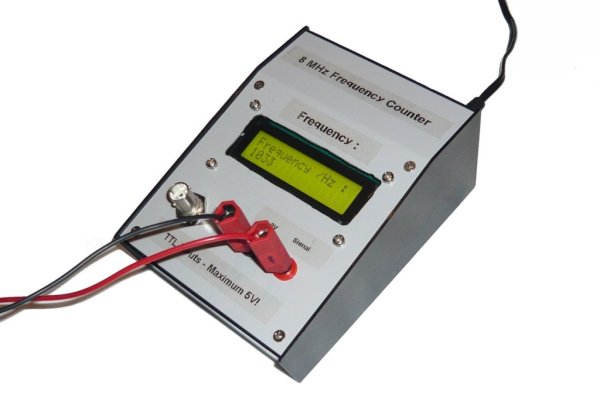
The maximum frequency that this can measure is about 8 MHz (at a 50% duty cycle). Despite the fact that this counts the frequency on one of the digital pins, I have found that it will quite happily measure sine and triangle waves providing that they have a suitable amplitude.
Although the version that I built is a standalone unit, this circuitry could be easily incorporated into another project such as a function generator.
For more detail: Frequency Counter
- What is the maximum frequency this device can measure?
The maximum measurable frequency is about 8 MHz at a 50% duty cycle. - Can this counter measure sine and triangle waves?
Yes, it can measure these waveforms provided they have a suitable amplitude. - How does the device display the measured frequency?
The measured frequency is shown on an LCD display. - Is this project designed to be a standalone unit?
Although the built version is standalone, the circuitry is easily incorporated into other projects. - Which pin is used to count the frequency?
The circuit counts the frequency on one of the digital pins. - What is the primary purpose of this project?
The project serves as a frequency counter to check a function generator against. - Does this design require many components?
No, the project uses a minimal number of components for an economical and compact design. - Can this circuit be used inside a function generator?
Yes, the circuitry could be easily incorporated into another project such as a function generator.
