
Summary of From TMA to Z: Visiopharm and Integrated Systems Engineering Announce Collaboration on a Platform for Data Management and Efficient Workflow in TMA Based Research
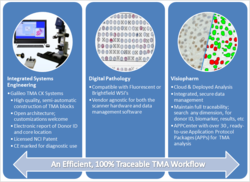
Visiopharm and ISENET have formed a non-exclusive collaboration to promote a joint solution for Tissue Microarray (TMA) research. This partnership focuses on data management, efficient workflows, and image analysis. TMA technology combines tens to hundreds of paraffin-embedded tissue specimens into a single block, allowing simultaneous histological analysis of hundreds of samples on unique slides. The system offers significant time and money-saving benefits for researchers.
Parts used in the Joint Solution:
- Galileo TMA system
- Tissue Microarray (TMA) technology
- Paraffin-embedded tissue specimens
- Unique slide
- Data management software
- Image analysis tools
Hoersholm, Denmark (PRWEB) March 13, 2012
Visiopharm, a leader in Quantitative Digital Pathology, and Integrated Systems Engineering (ISENET) the manufacturer of the innovative Galileo TMA system, announce today a non-exclusive collaboration to promote a joint solution for data management, efficient workflows, and image analysis for Tissue Microarray based research.
Tissue Microarray (TMA) technology is a technical procedure that combines tens to hundreds of paraffin-embedded tissue specimens into a single paraffin block. The use of relatively small tissue cores, positioned onto a unique slide, allows simultaneous histological analysis of hundreds of samples. TMAs provide time and money saving benefits including:
- Who announced the collaboration?
Visiopharm and Integrated Systems Engineering (ISENET) announced the collaboration. - What is the main goal of this partnership?
The goal is to promote a joint solution for data management, efficient workflows, and image analysis for Tissue Microarray based research. - How does TMA technology combine tissue specimens?
TMA technology combines tens to hundreds of paraffin-embedded tissue specimens into a single paraffin block. - What benefit does using small tissue cores provide?
It allows simultaneous histological analysis of hundreds of samples. - Does the collaboration cover exclusive rights?
No, it is a non-exclusive collaboration. - What are the primary benefits of TMA mentioned?
The technology provides time and money saving benefits. - Can hundreds of samples be analyzed at once?
Yes, TMAs allow simultaneous histological analysis of hundreds of samples. - What type of block is used in TMA?
A single paraffin block is used to hold the combined specimens.
