
Summary of Hacking a Blood Pressure Monitor
This article details a DIY project to modify a Panasonic EW3106 blood pressure monitor into a wireless IoT device. By integrating an ESP8266 WiFi module, the author enables automatic data transmission to the cloud, allowing users to track health trends and correlate blood pressure with other metrics like sleep and activity levels. The process involves intercepting I²C bus data when measurements are saved. A strong safety disclaimer warns that modifying medical devices may compromise accuracy and reliability, advising against using the modified unit for actual medical purposes.
Parts used in the Hacked Blood Pressure Monitor:
- Panasonic EW3106 blood pressure monitor
- ESP8266 WiFi module
- I²C memory chip (internal to the monitor)
- Arduino environment software
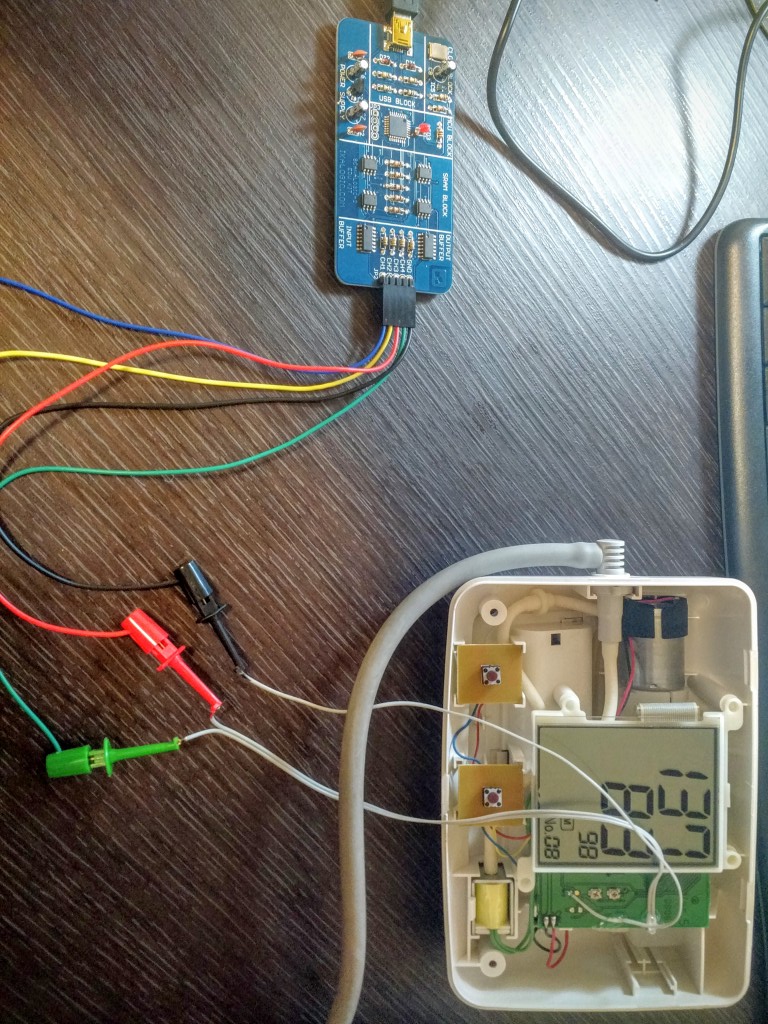
I’ve been meaning to hack my blood pressure monitor for a while, and I finally got around to doing it! So, the idea is to mod a regular electronic blood pressure monitor to make it wireless and connected to the Internet, much like iHealth BP5 or Withings’. That makes detecting trends in your blood pressure much easier, since you can chart the data and even correlate it with other health data, such as how much sleep you’ve been getting, your weight or your level of activity. The model I have is the EW3106 from Panasonic. It’s quite old but from what I’ve seen the design hasn’t changed much throughout the years.The other part of the solution is the ESP8266. It’s an awesome little WiFi module. It has a TCP stack and only uses about 20% of it’s CPU resources, which means you can run your own software on it, with no need for an external MCU. Some cool guys have added support to the Arduino environment, which makes it really easy to use. And when you consider it costs little more than $4 it’s really a no-brainer.Since the unit has a feature to store measurements (the blue M/R button), I figured it would probably have a memory chip connected to an I²C bus. My idea was to, whenever the user decided to save a new measurement, retrieve the data stored by the MCU, make sense of it and push it to the cloud.
Disclaimer
Should you choose to attempt this project on your own, keep in mind you’re modifying a medical device and that CAN interfere with it’s accuracy and reliability. Remember that a WiFi device emits RF which can affect other devices. If you choose to modify it, don’t use it as a medical device anymore. Use this information and code at your own risk. I cannot be held liable if, knock on wood, your house burns down or your your dog dies!
For more detail: Hacking a Blood Pressure Monitor
-
What is the main goal of this project?
To modify a regular electronic blood pressure monitor to make it wireless and connected to the Internet. -
Which specific model of blood pressure monitor was used?
The Panasonic EW3106 model was used for this modification. -
How does the ESP8266 benefit this project?
The ESP8266 is a low-cost WiFi module with a built-in TCP stack that requires no external MCU and uses only about 20% of its CPU resources. -
How is the data retrieved from the monitor?
Data is retrieved by detecting when the user saves a measurement via the M/R button and accessing the internal memory chip connected to the I²C bus. -
Can you use your own software on the ESP8266?
Yes, the ESP8266 allows you to run your own software without needing an external microcontroller unit. -
Does modifying the device affect its safety?
Modifying a medical device can interfere with its accuracy and reliability, and the WiFi emission may affect other devices. -
Is it recommended to use the modified monitor for medical purposes?
No, the author advises not to use the modified device as a medical device anymore.
