
Summary of HAILO-8 POWERED M.2 ACCELERATOR CARDS CLAIM TO BEAT THE COMPETITION
Hailo launched new M.2 and mini-PCIe Linux accelerator cards featuring the Hailo-8 NPU, delivering up to 26 TOPS. These modules outperform competitors like Google Coral and Intel Movidius in performance per watt, supporting real-time AI tasks such as semantic segmentation and object detection for smart cities, autonomous vehicles, and industrial security.
Parts used in the Hailo-8 Accelerator Project:
- Hailo-8 NPU chip
- M.2 M-key 2242 form-factor module
- mini-PCIe format module
- PCIe Gen3 x4 interface (M.2)
- PCIe Gen3 x1 interface (mini-PCIe)
- Linux-based system support
Hailo has introduced a new line of M.2 and mini-PCIe cards for Linux systems. These new modules are equipped with up to 26-TOPS Hailo-8 NPUs. These Neural processing unit (NPU) are a specially designed chip that implements all the necessary control and arithmetic logic necessary to execute machine learning algorithms, typically by operating on predictive models such as artificial neural networks (ANNs) or random forests (RFs). According to Hailo, the new M.2 M-key is a 2242 form-factor accelerator which is powered by Halio-8, for the first time in a mini-PCIe format. They claim it to be the world’s highest-performing AI M.2 module, winning by a large margin against Google Coral M.2 or AAEON AI Core cards.
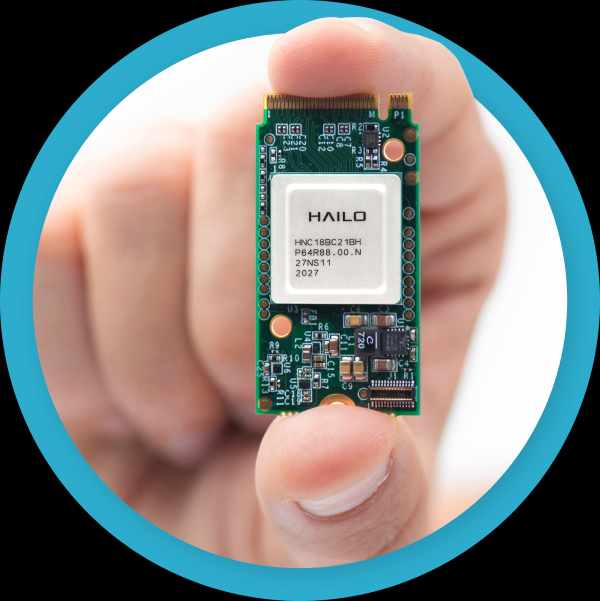
The Hailo-8 M.2 AI Acceleration Module implements PCIe Gen3 x4. On the other hand, the mini-PCIe accelerator will offer the same NPU, but with PCIe Gen3 x1. The acceleration cards can run on any Linux-based system adding support for Windows in the near future. Hailo claims its 17 x 17mm Hailo-8 chip greatly outperforms Google’s Edge TPU and Intel’s Movidius Myriad X on a TOPS per watt basis. The new Hailo-8 can run better and faster AI semantic segmentation and object detection applications.
Potential applications for these modules can be found in a smart city, self-driving car, home, and industrial security. Especially in those where multiple cameras and sensors are needed to be processed and analyzed on the go. The company has published some benchmarks to show its Hailo-8 M.2 module achieving 26 times higher frames per second AI performance than Myriad-X and 13 times higher than Edge TPU.
Read more: HAILO-8 POWERED M.2 ACCELERATOR CARDS CLAIM TO BEAT THE COMPETITION
- What is the primary function of the Hailo-8 NPU?
The Hailo-8 NPU is a specially designed chip that executes machine learning algorithms by operating on predictive models such as artificial neural networks or random forests. - Can these acceleration cards run on Windows systems currently?
No, the cards can run on any Linux-based system now, with support for Windows planned for the near future. - How does the M.2 version differ from the mini-PCIe version regarding connectivity?
The M.2 version implements PCIe Gen3 x4, while the mini-PCIe accelerator offers the same NPU but with PCIe Gen3 x1. - Does the Hailo-8 chip offer better power efficiency than its competitors?
Yes, Hailo claims the 17 x 17mm Hailo-8 chip greatly outperforms Google's Edge TPU and Intel's Movidius Myriad X on a TOPS per watt basis. - What specific AI applications do the new modules support?
The modules are designed to run better and faster AI semantic segmentation and object detection applications. - How much faster is the Hailo-8 M.2 module compared to Myriad-X?
Benchmarks show the Hailo-8 M.2 module achieves 26 times higher frames per second AI performance than Myriad-X. - Which industries are potential applications for these modules found?
Potential applications include smart cities, self-driving cars, home environments, and industrial security where multiple cameras and sensors need processing.
