
Summary of HiFive1, An Open-Source RISC-V Development Kit
SiFive introduces the HiFive1, an open-source Arduino-compatible development board featuring the Freedom E310 SoC. Based on the 32-bit RV32IMAC E31 CPU core, this board targets embedded and IoT applications with high performance at 320+ MHz. It supports programming via Arduino IDE or Freedom E SDK and offers flexible voltage options for diverse hardware integration.
Parts used in the HiFive1:
- SiFive Freedom E310 (FE310) Microcontroller
- SiFive E31 CPU Core
- 16 KB Instruction Cache
- 16 KB Data Scratchpad
- 128 Mbit Off-Chip Flash Memory (ISSI SPI Flash)
- 19 Digital I/O Pins
- 9 PWM Pins
- SPI Controller with 3 Hardware Chip Select Pins
- microUSB Host Interface
- On-chip Oscillators and PLLs
By bringing the power of open-source and agile hardware design to the semiconductor industry, SiFive aims to increase the performance and efficiency of customized silicon chips with lower cost.
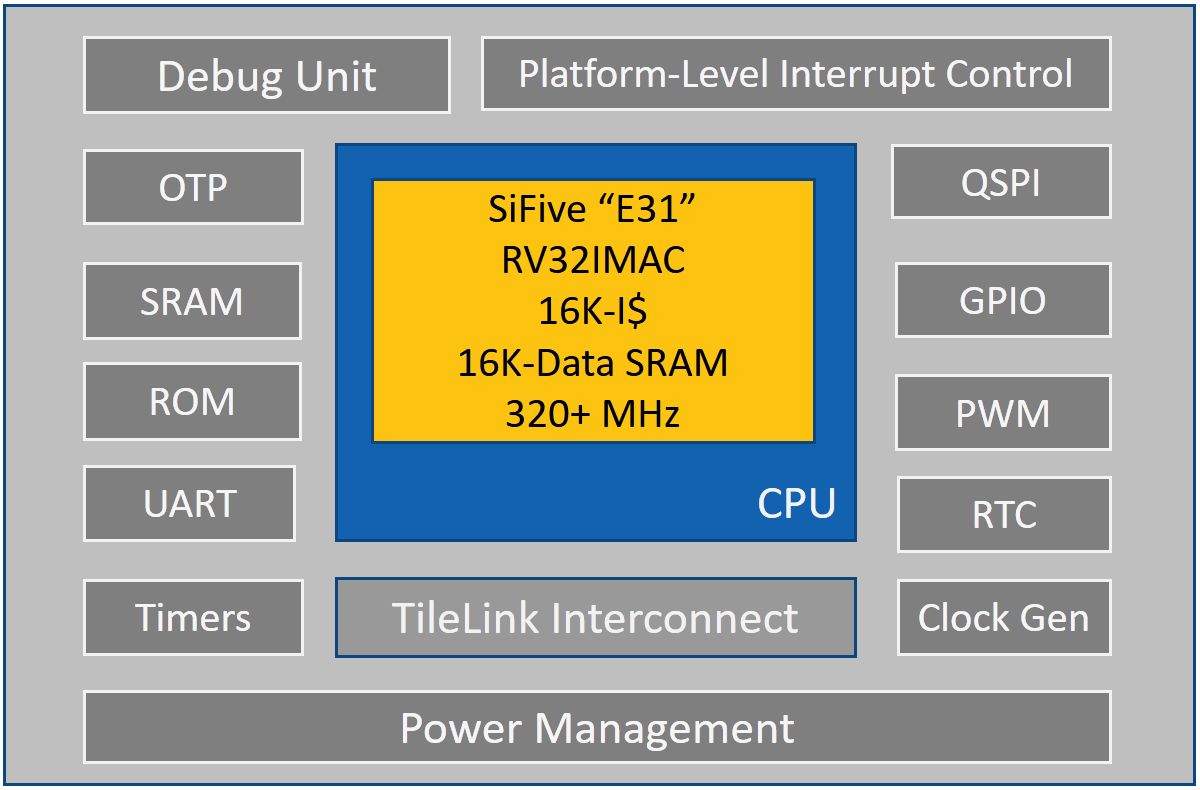
The Freedom E310 (FE310) is the first member of the Freedom Everywhere SoCs family, a series of customizable microcontroller SoC platforms, designed based on SiFive’s E31 CPU Coreplex CPU for microcontroller, embedded, IoT, and wearable applications. The SiFive’s E31 CPU Coreplex is a high-performance, 32-bit RV32IMAC core. Running at 320+ MHz.
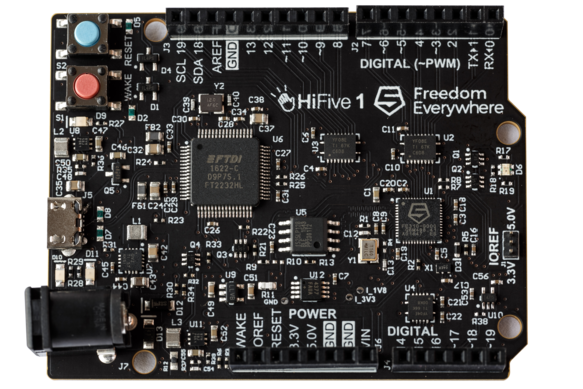
SiFive recently announced the ‘HiFive1’, an open-source Arduino-compatible RISC-V development board that features the FE310 SoC. It is a 68 x 51 mm board consists of 19 Digital I/O pins, 9 PWM pins, and 128 Mbit Off-Chip flash memory. HiFive1 operates at 3.3V and 1.8V and is fed with 5V via USB or with 7-12V DC jack. The board can be programed using Arduino IDE or Freedom E SDK.
HiFive1’s Specifications:
- Microcontroller: SiFive Freedom E310 (FE310)
- CPU: SiFive E31 CPU
- Architecture: 32-bit RV32IMAC
- Speed: 320+ MHz
- Performance: 1.61 DMIPs/MHz, 2.73 Coremark/MHz
- Memory: 16 KB Instruction Cache, 16 KB Data Scratchpad
- Other Features: Hardware Multiply/Divide, Debug Module, Flexible Clock Generation with on-chip oscillators and PLLs
- Operating Voltage: 3.3 V and 1.8 V
- Input Voltage: 5 V USB or 7-12 VDC Jack
- IO Voltages: Both 3.3 V or 5 V supported
- Digital I/O Pins: 19
- PWM Pins: 9
- SPI Controllers/HW CS Pins: 1/3
- External Interrupt Pins: 19
- External Wakeup Pins: 1
- Flash Memory: 128 Mbit Off-Chip (ISSI SPI Flash)
- Host Interface (microUSB): Program, Debug, and Serial Communication
- Dimensions: 68 mm x 51 mm
- Weight: 22 g
RISC-V is an open source instruction set architecture (ISA) that became a standard open architecture for industry implementations under the governance of the RISC-V Foundation. The RISC-V ISA was originally designed and developed in the Computer Science Division at the University of California to support computer architecture researches and education.
For more detail: HiFive1, An Open-Source RISC-V Development Kit
- What is the HiFive1?
It is an open-source Arduino-compatible RISC-V development board featuring the FE310 SoC. - How fast does the SiFive E31 CPU run?
The CPU runs at speeds over 320 MHz. - Can I program the HiFive1 using the Arduino IDE?
Yes, the board can be programmed using the Arduino IDE or the Freedom E SDK. - What are the input voltage options for the board?
The board accepts 5 V via USB or 7-12 V DC jack. - Does the HiFive1 support 5V logic levels?
Yes, it supports both 3.3 V and 5 V IO voltages. - What type of flash memory is included?
It includes 128 Mbit Off-Chip ISSI SPI Flash memory. - How many digital I/O pins are available?
The board consists of 19 Digital I/O pins. - What architecture does the CPU use?
The CPU uses a 32-bit RV32IMAC architecture.
