
Summary of High Voltage, Low Noise Zero-Drift Operational Amplifier
The LTC2057 is a high-voltage, low-noise zero-drift operational amplifier designed for precision DC applications. It offers an ultra-low offset voltage of 4μV and excellent noise performance with 200nVP-P input noise from DC to 10Hz. Featuring self-calibrating circuitry, it maintains minimal drift over temperature and time. With rail-to-rail output, wide supply voltage options (up to 60V for the HV version), and superior PSRR/CMRR, it is ideal for data acquisition, test equipment, strain gauges, and automotive monitoring systems.
Parts used in the LTC2057 Operational Amplifier:
- LTC2057 High Voltage Zero-Drift Op Amp
- LTC2057HV High Voltage Zero-Drift Op Amp
- Self-Calibrating Circuitry
- Rail-to-Rail Output Stage
- Shutdown Mode Control
Description
The LTC®2057 is a high voltage, low noise, zero-drift operational amplifier that offers precision DC performance over a wide supply range of 4.75V to 36V or 4.75V to 60V for the LTC2057HV. Offset voltage and 1/f noise are suppressed, allowing this amplifier to achieve a maximum offset voltage of 4μV and a DC to 10Hz input noise voltage of 200nVP-P (typ). The LTC2057’s self-calibrating circuitry results in low offset voltage drift with temperature, 0.015μV/°C (max), and zero-drift over time.
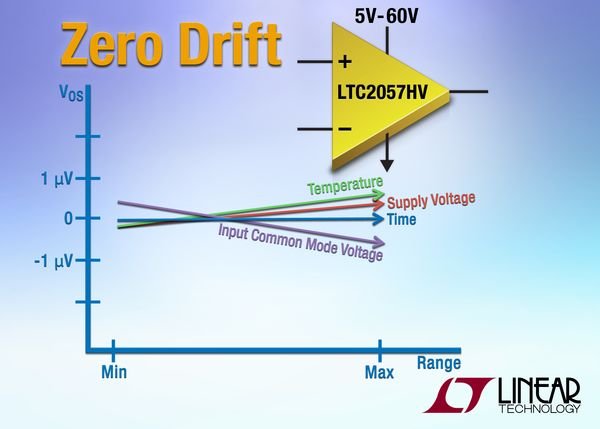
The amplifier also features an excellent power supply rejection ratio (PSRR) of 160dB and a common mode rejection ratio (CMRR) of 150dB (typ).
The LTC2057 provides rail-to-rail output swing and an input common mode range that includes the V– rail (V– – 0.1V to V+ – 1.5V). In addition to low offset and noise, this amplifier features a 1.5MHz (typ) gain-bandwidth product and a 0.45V/μs (typ) slew rate.
Wide supply range, combined with low noise, low offset, and excellent PSRR and CMRR make the LTC2057 and LTC2057HV well suited for high dynamic-range test, measurement, and instrumentation systems.
Applications
- High Resolution Data Acquisition
- Reference Buffering
- Test and Measurement
- Electronic Scales
- Thermocouple Amplifiers
- Strain Gauges
- Low-Side Current Sense
- Automotive Monitors and Control
Features
- Supply Voltage Range
4.75V to 36V (LTC2057)
4.75V to 60V (LTC2057HV) - Offset Voltage: 4μV (Maximum)
- Offset Voltage Drift: 0.015μV/°C (Maximum, –40°C to 125°C)
- Input Noise Voltage
200nVP-P, DC to 10Hz (Typ)
11nV/√Hz, 1kHz (Typ) - Input Common Mode Range: V– – 0.1V to V+ – 1.5V
- Rail-to-Rail Output
- Unity Gain Stable
- Gain Bandwidth Product: 1.5MHz (Typ)
- Slew Rate: 0.45V/μs (Typ)
- AVOL: 150dB (Typ)
- PSRR: 160dB (Typ)
- CMRR: 150dB (Typ)
- Shutdown Mode
For more detail: High Voltage, Low Noise Zero-Drift Operational Amplifier
- What is the maximum offset voltage of the LTC2057?
The maximum offset voltage is 4μV. - How does the LTC2057 handle offset voltage drift over temperature?
It achieves a maximum offset voltage drift of 0.015μV/°C due to self-calibrating circuitry. - Can the LTC2057 operate with a supply voltage up to 60V?
Yes, the LTC2057HV variant supports a supply range of 4.75V to 60V. - What is the typical gain-bandwidth product of this amplifier?
The typical gain-bandwidth product is 1.5MHz. - Does the LTC2057 include a shutdown mode?
Yes, the device features a shutdown mode. - What are the typical values for PSRR and CMRR?
The typical Power Supply Rejection Ratio is 160dB and the Common Mode Rejection Ratio is 150dB. - Is the LTC2057 suitable for thermocouple amplifiers?
Yes, it is well suited for thermocouple amplifiers among other applications. - What is the input common mode range of the amplifier?
The input common mode range includes V– – 0.1V to V+ – 1.5V.
