
Summary of How Bone-conducting Headphones Work
This article explains bone conduction, a hearing method where sound vibrations travel through skull bones directly to the cochlea, bypassing the eardrum. It traces the technology's history from Beethoven's piano rod to modern devices like communication helmets and sports headphones, highlighting inventors who patented these innovations for safety and accessibility in loud environments.
Parts used in Bone Conduction Devices:
- Outer ear (pinna)
- Air-filled middle ear
- Auditory canal
- Eardrum
- Ossicles (three small bones)
- Cochlea
- Auditory nerve
- Headband receiver
- Belt-mounted music player
- Tiny speakers attached to clothing
- Mastoid bones of the skull
How Bone Conduction Works
To understand how bone conduction works, you first have to understand how we hear sounds, which we do in two ways:
Sound travels in waves through the air. Normally, sound waves travel through several structures in the ear, before being translated and transmitted through our nervous systems to our brains. First, the waves enter the outer ear, or pinna, which is the big flappy piece of cartilage that helps to focus the sound. From there, the sound goes into the air-filled middle ear, which includes the auditory canal and the eardrum, a flap of skin that vibrates when exposed to the energy from sound waves. On the other side of the eardrum, there are three small bones, the ossicles, which are attached to it. They transmit the vibration to the cochlea, a fluid-filled structure that takes those vibrations and converts them to electrical impulses that are sent along the auditory nerve to the brain [source: Hass].
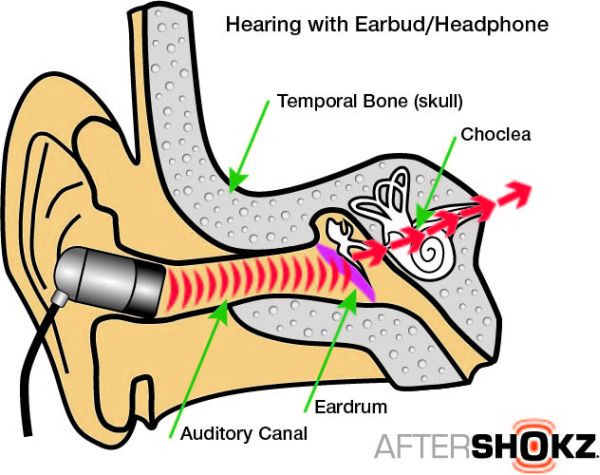
But that’s not the only way our body can process sound. Sound waves can also be transmitted through the bones in your head. When the bones vibrate, the sound reaches the cochlea, just as it would by going through the middle ear and eardrum, and results in the same sort of nerve impulses being transmitted to your brain. This method of sound transmission is called bone conduction [source: Walker and Stanley].
The great 18th- and early-19th-century composer Ludwig Van Beethoven, who suffered hearing loss apparently caused by thickening of the structures in his middle ear, may have been one of the first people to develop a bone-conducting device help him hear music. He attached a rod to his piano and then connected it to his head, so that it transmitted the vibration of his playing directly to his cochlea [source: Mai]. Bone-conducting headphones are built around this same concept.
Bone-conducting Technology
Once the 20th century age of electrically amplified sound hit, inventors started developing bone conduction hearing devices to aid people with hearing loss, or who had to work in loud environments. In 1935, for example, inventor Edgar Hand was granted a patent for a special telephone equipped with a headband that attached the receiver to a user’s head, so that it could transmit the vibration of a caller’s voice through the bones [source: Hand]. In the 1940s and 1950s, numerous inventors patented hearing aids that utilized bone conduction. In 1957, Clairdon Cunningham, an engineer for defense contractor General Dynamics, even used the principle of bone conduction to develop an ingenious communication helmet that could be worn by pilots who had to converse over the roar of jet engines [source: Cunningham].
In the early 1980s, an inventor named James P. Liautaud was granted a patent for a device that enabled people to listen to the radio or taped music while skiing, running, bicycling or doing other active sports, without wearing headphones that might interfere with their safety. He patented a music player that a user wore in a belt around his or her waist. Wires from the device were connected to tiny speakers, which were attached to clothing over the user’s collarbone. While the music actually could be heard through the ears, bone conduction was involved as well [source: Liautaud]. In 1994, another inventor, H. Werner Bottesch, took the concept a bit further and received a patent for a set of stereo music headphones designed for bone conduction. His device attached just behind the user’s outer ears, so that it transmitted sound through the mastoid bones of the user’s skull. Bottesch also came up with the idea of selectively amplifying certain frequencies of sound that don’t transmit through bone as well as others [source: Bottesch].
Since then, bonephones have become even more sophisticated. But are they a safer alternative than ear buds to protect your precious ears?
For more detail: How Bone-conducting Headphones Work
- How does normal hearing work?
Sound waves enter the outer ear, travel through the auditory canal to vibrate the eardrum, move the ossicles, and stimulate the cochlea to send impulses via the auditory nerve. - Can sound be transmitted through bones?
Yes, when skull bones vibrate, the sound reaches the cochlea just as it would through the middle ear, creating similar nerve impulses. - Did Ludwig Van Beethoven use bone conduction?
Yes, he attached a rod to his piano and connected it to his head to transmit vibrations directly to his cochlea. - When were early bone conduction telephone patents granted?
Inventor Edgar Hand received a patent in 1935 for a telephone with a headband that transmitted voice vibrations through the bones. - Who developed a bone conduction helmet for pilots?
Clairdon Cunningham, an engineer for General Dynamics, developed this device in 1957 for pilots to converse over jet engine noise. - What was James P. Liautaud's 1980s invention?
He created a belt-worn music player with wires connecting tiny speakers to clothing over the collarbone for active sports users. - How did H. Werner Bottesch improve bone conduction in 1994?
He designed stereo headphones attaching behind the ears to transmit sound through mastoid bones and selectively amplified specific frequencies. - Are bone phones considered safer than ear buds?
The text raises this question but notes they are built on the same concept as earlier devices without explicitly confirming their safety superiority.
