
Summary of How Cordless Telephones Work
This article explains the functionality and evolution of cordless telephones. It details how these devices use a base station and handset to convert electrical signals into FM radio waves for communication. The text traces their history from 1980 analog models with poor security to modern digital systems operating at higher frequencies like 2.4 GHz, which offer better range, clarity, and protection against eavesdropping.
Parts used in Cordless Telephones:
- Base
- Handset
- Phone jack
- Standard phone wire connection
- FM radio transmitter
- FM radio receiver
- Speaker
- Digital spread spectrum technology
Cordless phones have many of the same features as standard telephones, and there are many models available. In this article, we will examine how these cordless telephones work and see why there are so many different types on the market today.
The Basics
A cordless telephone is basically a combination telephone and radio transmitter/receiver (see How Telephones Work and How Radio Works for details on these two technologies). A cordless phone has two major parts: base and handset.
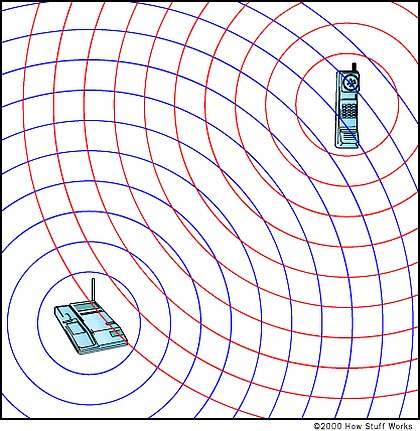
- The base is attached to the phone jack through a standard phone wire connection, and as far as the phone system is concerned it looks just like a normal phone. The base receives the incoming call (as an electrical signal) through the phone line, converts it to an FM radio signal and then broadcasts that signal.
- The handset receives the radio signal from the base, converts it to an electrical signal and sends that signal to the speaker, where it is converted into the sound you hear. When you talk, the handset broadcasts your voice through a second FM radio signal back to the base. The base receives your voice signal, converts it to an electrical signal and sends that signal through the phone line to the other party.
The base and handset operate on a frequency pair that allows you to talk and listen at the same time, called duplex frequency.
A Brief History
Cordless phones first appeared around 1980. The earliest cordless phones operated at a frequency of 27 MHz. They had the following problems:
- limited range
- poor sound quality – noisy and ridden with static because walls and appliances interfered with the signals
- poor security – people could easily intercept signals from another cordless phone because of the limited number of channels
In 1986, the Federal Communications Commission (FCC) granted the frequency range of 47-49 MHz for cordless phones, which improved their interference problem and reduced the power needed to run them. However, the phones still had a limited range and poor sound quality.
Because the 43-50 MHz cordless phone frequency was becoming increasingly crowded, the FCC granted the frequency range of 900 MHz in 1990. This higher frequency allowed cordless phones to be clearer, broadcast a longer distance and choose from more channels. However, cordless phones were still quite expensive, about $400.
In 1994, digital cordless phones in the 900 MHz frequency range were introduced. Digital signals allowed the phones to be more secure and decreased eavesdropping — it was pretty easy to eavesdrop on analog cordless phone conversations. In 1995, digital spread spectrum (DSS) was introduced for cordless phones. This technology enabled the digital information to spread in pieces over several frequencies between the receiver and the base, thereby making it almost impossible to eavesdrop on the cordless conversations.
In 1998, the FCC opened up the 2.4 GHz range for cordless phone use. This frequency has increased the distance over which a cordless phone can operate, and brought it out of the frequency range of most radio scanners, thereby further increasing security.
For more Detail: How Cordless Telephones Work
-
How does a cordless telephone transmit voice?
The handset broadcasts your voice through an FM radio signal back to the base, which converts it to an electrical signal for the phone line. -
What major parts make up a cordless phone?
A cordless phone consists of two major parts: the base and the handset. -
Why did early cordless phones have poor sound quality?
Early models suffered from static because walls and appliances interfered with the signals. -
When was the 2.4 GHz frequency range opened for cordless phones?
The FCC opened the 2.4 GHz range for cordless phone use in 1998. -
What technology made cordless conversations almost impossible to eavesdrop on?
Digital spread spectrum (DSS) introduced in 1995 enabled information to spread over several frequencies, making eavesdropping nearly impossible. -
Does the base connect directly to the phone system?
Yes, the base is attached to the phone jack through a standard phone wire connection. -
What allows users to talk and listen simultaneously?
The base and handset operate on a duplex frequency pair that allows simultaneous talking and listening.
