
Summary of Imec Presents Low-Power Chip for Intra-Cardiac Ventricular Fibrillation Detection
Imec and Olympus demonstrated a 20µW low-power intra-cardiac signal processing chip at ISSCC 2013 for detecting ventricular fibrillation. This integrated circuit supports Cardiac Resynchronization Therapy by monitoring heart rates across three ECG channels, analyzing motion via an accelerometer, and measuring thoracic impedance with high accuracy to assess intra-thoracic fluid.
Parts used in the Intra-Cardiac Signal Processing Chip:
- Three power-efficient intra-cardiac signal readout channels (ECG channels)
- Precision ECG signal readout circuit
- Analog signal processor for feature extraction
- Low-power accelerometer readout channel
- 16-level digital sinusoidal current generator
- Bio-impedance measurement system
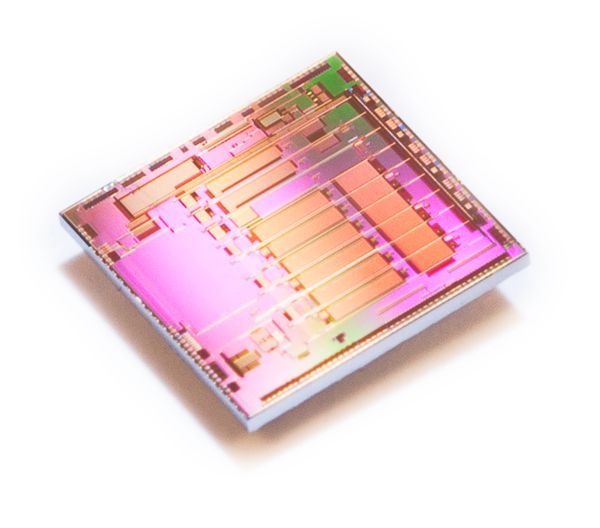
San Francisco, USA – February 19, 2013 – Imec demonstrated a low-power (20µW), intra-cardiac signal processing chip for the detection of ventricular fibrillation at this week’s International Solid State Circuits Conference (ISSCC 2013) in San Francisco with Olympus. An important step toward next-generation Cardiac Resynchronization Therapy solutions, the new chip delivers innovative signal processing functionalities and consumes only 20µW when all channels are active, enabling the miniaturization of implantable devices.
Robust and accurate Heart Rate (HR) monitoring of the right and left ventricles and right atrium is essential for implantable devices for Cardiac Resynchronization Therapy. And accurate motion sensor and thoracic impedance measurements to analyze intra-thoracic fluid are critical for improving clinical research and analysis of the intra-cardiac rhythm. Moreover, extreme low-power consumption is required to further reduce the size of cardiac implants and improve the patient’s quality of life.
Imec’s low-power integrated circuit features three power-efficient, intra-cardiac signal readout channels (or in short: ECG channels). Each of the three ECG channels is equipped with a precision ECG signal readout circuit with very low-power consumption and an analog signal processor to extract the features of the ECG signal for detection of ventricular fibrillation. The feature extractor achieves only 2ms latency to facilitate responsive Cardiac Resynchronization Therapy.
Additionally, the chip includes unique features that improve the functionality of Cardiac Resynchronization Therapy devices. First, the low-power accelerometer readout channel enables rate adaptive pacing. Secondly, to handle intra-thoracic fluid analysis, the chip includes a 16-level digital sinusoidal current generator and provides 82db wide dynamic range bio-impedance measurement, in the range of 0.1Ω-4.4kΩ with 35mΩ resolution, and achieves best-in-class accuracy (>97%).
For more detail: Imec Presents Low-Power Chip for Intra-Cardiac Ventricular Fibrillation Detection
- What is the primary function of the new chip?
The chip detects ventricular fibrillation using low-power intra-cardiac signal processing. - How much power does the chip consume when all channels are active?
The chip consumes only 20µW when all channels are active. - Can this chip improve the size of cardiac implants?
Yes, its extreme low-power consumption enables the miniaturization of implantable devices. - Does the chip monitor multiple heart chambers?
Yes, it provides robust Heart Rate monitoring of the right and left ventricles and the right atrium. - How fast is the feature extractor for ventricular fibrillation detection?
The feature extractor achieves only 2ms latency to facilitate responsive therapy. - What unique features help with rate adaptive pacing?
The chip includes a low-power accelerometer readout channel that enables rate adaptive pacing. - How accurate is the bio-impedance measurement for fluid analysis?
The chip achieves best-in-class accuracy greater than 97% for intra-thoracic fluid analysis. - What dynamic range does the bio-impedance measurement support?
It provides an 82db wide dynamic range in the range of 0.1Ω to 4.4kΩ.
