
Summary of Integrating Wiznet W5100, WIZ811MJ network module with Atmel AVR Microcontroller
This article details building an embedded system for home automation and network synchronization using the AVR ATMega328 microcontroller. It explains integrating Ethernet protocols via the Wiznet W5100 chip to enable remote monitoring, control, and NTP time syncing through a web server on personal gadgets.
Parts used in the Home Automation Embedded System:
- Resistors: 10K Ohm (1), 1K Ohm (1), and 470 Ohm (2)
- Capacitors: 10uF/16v (2) and 0.1uF (2)
- LEDs: 3 mm Blue LED (2)
- Transistor: 2N3904 (1)
- Voltage Regulator IC: LM1086 – 3.3 Volt
- One momentary push button
- One 30×60 mm Prototype board
- Two 10 pins male double header and 5 pins male single header
- One 2 pins male single polarized header
- AVRJazz Mega328 board and JazzMate 5 Volt voltage regulator board from ermicro
- Wiznet WIZ811MJ Network Module
- Atmel AVR Studio version 4.17 IDE
- WinAVR AVR-GCC 4.3.2; avr-libc 1.6.6 (WinAVR 20090313)
- Reference Documents: W5100 Datasheet, WIZ811MJ Datasheet, W5100 Porting Guide, Atmel AVR ATMega328 Datasheet
The rapid penetration of the internet networks into many of today’s modern homes and personal gadgets (e.g. smart phone and smart pads) opening a tremendous useful and interesting embedded system application that could be integrated into our house or known as the intelligent house. For example by putting a small embedded system web server in our house, we could easily monitor such as alarm, temperature or even turn on/off the lamp or the garden’s water sprinkle; eventually from any remote location through the wireless personal gadget; Or perhaps you just want to impress your relative or friend with a very accurate digital clock which automatically synchronized the time through the Network Time Protocol (NTP) over the internet at your home or office.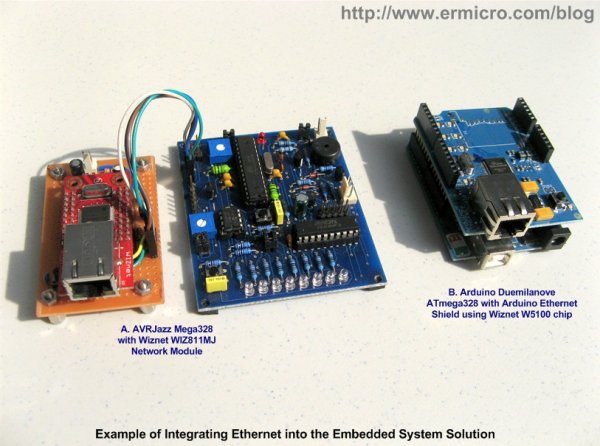 All of these interesting and challenging embedded system applications could be accomplished by integrating the Ethernet protocol which is formed the basic of the communication protocol used in the internet into the embedded system. Currently there are several approaches for this solution but basically they could be divided into two categories wired e.g. Wiznet W5100, W5300, Microchip ENC28J60 and wireless such as the Microchip ZG2100MC Wi-Fi module (recently is acquired by Microchip from the Zero-G Wireless on Jan 11, 2010).
Ok, now lets list down the necessary electronics components and supported software for this tutorial and make sure you have the AVR ATMega328 microcontroller datasheet near you:
- Resistors: 10K Ohm (1), 1K Ohm (1) and 470 Ohm (2)
- Capacitors: 10uF/16v (2) and 0.1uF (2)
- LEDS: 3 mm Blue LED (2)
- Transistor: 2N3904 (1)
- Voltage Regulator IC: LM1086 – 3.3 Volt
- One momentary push button
- One 30×60 mm Prototype board
- Two 10 pins male double header and 5 pins male single header
- One 2 pins male single polarized header
- AVRJazz Mega328 board and JazzMate 5 Volt voltage regulator board from ermicro
- Wiznet WIZ811MJ Network Module
- Atmel AVR Studio version 4.17 IDE
- WinAVR AVR-GCC 4.3.2; avr-libc 1.6.6 (WinAVR 20090313)
- Reference Document: W5100 Datasheet, WIZ811MJ Datasheet, W5100 Porting Guide, Atmel AVR ATMega328 Datasheet.
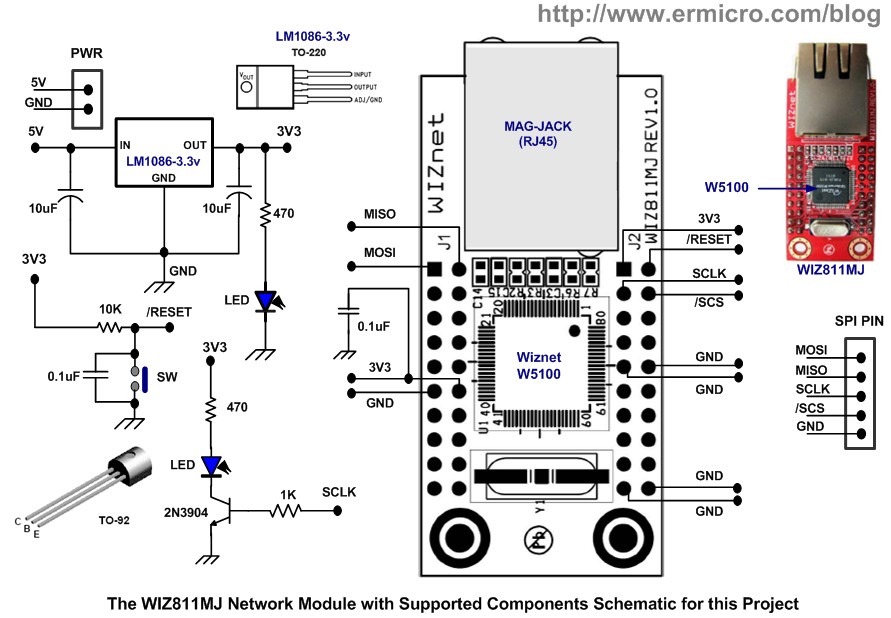
The Wiznet W5100 Hardwired TCP/IP Protocol Chip
Basically the Wiznet W5100 implements a full-featured of standard IEEE 802.3 (Ethernet physical and data link layer) and powerful TCP/IP stack inside the chip; this make the Wiznet W5100 chip is suitable choice for integrating the embedded system into the internet. Programming the Wiznet W5100 chip is also easier as we just need to write and read to and from the W5100 internal registers in order to use the build-in TCP/IP protocol features.
For more detail: Integrating Wiznet W5100, WIZ811MJ network module with Atmel AVR Microcontroller
- What is the primary function of the embedded system described?
The system allows users to monitor alarms, temperature, or turn on/off lamps and water sprinklers remotely, and sync time via NTP over the internet. - How can the system be accessed from a remote location?
Users can access the system through wireless personal gadgets like smartphones and smart pads using a small embedded system web server. - Which protocol forms the basic communication foundation for this project?
The Ethernet protocol forms the basic communication protocol used in the internet that is integrated into the embedded system. - What are the two main categories of solutions mentioned for this integration?
The solutions are divided into wired options like Wiznet W5100 and wireless options like the Microchip ZG2100MC Wi-Fi module. - Why is the Wiznet W5100 considered a suitable choice for this application?
It implements a full-featured standard IEEE 802.3 and a powerful TCP/IP stack inside the chip, making it suitable for internet integration. - How is the Wiznet W5100 chip programmed?
Programming involves writing and reading to and from the W5100 internal registers to use its built-in TCP/IP protocol features. - What specific software tools are required for this tutorial?
The tutorial requires Atmel AVR Studio version 4.17 IDE and WinAVR AVR-GCC 4.3.2 with avr-libc 1.6.6. - Can this system automatically synchronize time?
Yes, it can create a digital clock that automatically synchronizes the time through the Network Time Protocol over the internet.
