
Summary of How to Interface a GSM (SIM 300) Modem with ATmega32 to Send and Receive SMS
A GSM modem, specifically the SIMCOM SIM300 in this article, is a 2G Tri-band device that modulates and demodulates GSM/GPRS signals (900/1800/1900 MHz). It facilitates remote communication via SMS using AT commands over serial interfaces. The module acts as Data Circuit-terminating Equipment (DCE) to connect with PCs or microcontrollers, featuring TTL, RS232 (via MAX232), buzzer, antenna, and SIM slot components.
Parts used in the SIM300 GSM Modem Project:
- SIMCOM SIM300 Module
- MAX232 IC
- Buzzer
- Antenna
- SIM Slot
- TTL Interface
- RS232 Interface
- PC (Data Terminal Equipment)
What is a GSM Modem?
GSM stands for Global System for Mobile Communications.It is a standard set developed by the EuropeanTelecommunications Standards Institute (ETSI) to describe protocols for second generation (2G) digital cellular networks used by mobilephones.
A Modem is a device which modulates and demodulates signals as required to meet the communication requirements.It modulates an analog carrier signal to encode digital information, and also demodulates such a carrier signal to decode the transmitted information.
A GSM Modem is a device that modulates and demodulates the GSM signals and in this particular case 2G signals. The modem we are using is SIMCOM SIM300. It is a Tri-band GSM/GPRS Modem as it can detect and operate at three frequencies (EGSM 900 MHz, DCS 1800 MHz and PCS1900 Mhz). Default operating frequencies are EGSM 900MHz and DCS 1800MHz.
Sim300 is a widely used in many projects and hence many variants of development boards for this have been developed. These development boards are equipped with various features to make it easy to communicate with the SIM300 module. Some boards provide only TTL interface while some boards include an RS232 interface and some others include an USB interface. If your PC has a serial port(DB9) you can buy a GSM Modem that has both TTL and RS232 interfacings in economy.
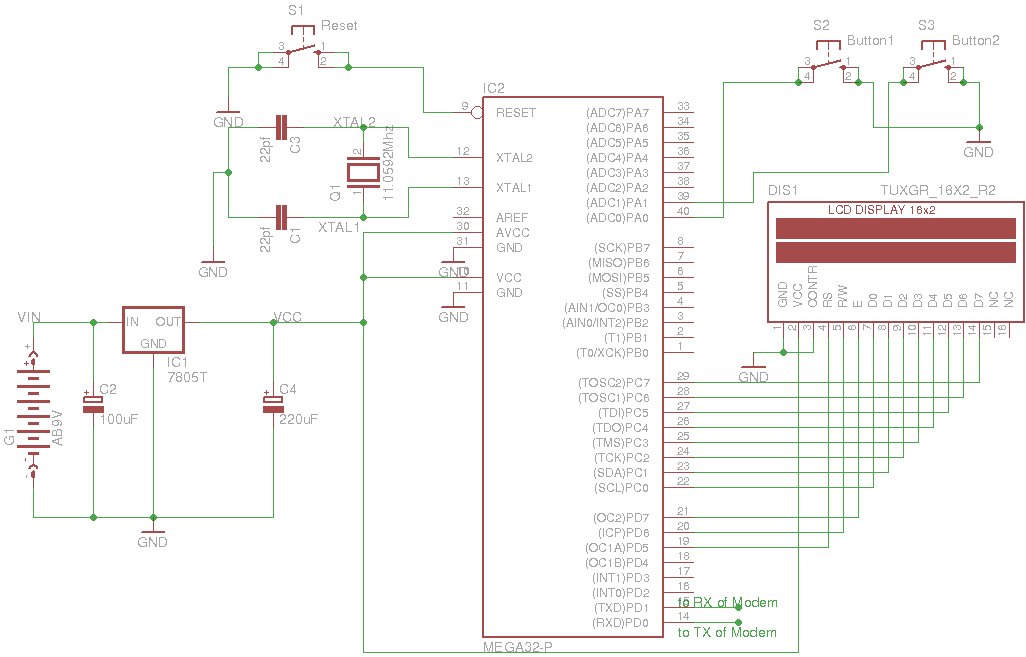
Sim300 GSM module used here, consists of a TTL interface and an RS232 interface. The TTL interface allows us to directly interface with a microcontroller while the RS232 interface includes a MAX232 IC to enable communication with the PC. It also consists of a buzzer, antenna and SIM slot. Sim300 in this application is used as a DCE (Data Circuit-terminating Equipment) and PC as a DTE (Data Terminal Equipment).
Why use a GSM Modem
GSM Technology has grown so much, that literally there isn’t a place on earth where there is no GSM signal. In such a scenario GSM provides us a wide scope in controlling things remotely from any place just with our finger tips. GSM also provides ease to easily communicate in a more robust way.
Some AT Commands
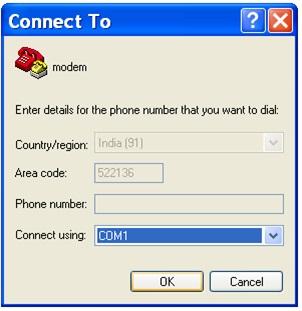
Sim300 GSM Module can be used to send and receive SMS connecting it to a PC when a SIM is inserted. The GSM Modem can be sent commands to send or receive SMS from the PC through a com port (serial port or an usb). These commands are called as AT commands. Through AT commands we can perform several actions like sending and receiving SMS, MMS, etc. Sim300 has an RS232 interface and this can be used to communicate with the PC. Sim300 usually operates at a baudrate of 9600, with 1 stopbits, No parity, No Hardware control and 8 databits. We shall see at some of the AT Commands necessary for sending and receiving SMS.
For more detail: How to Interface a GSM (SIM 300) Modem with ATmega32 to Send and Receive SMS
- What does GSM stand for?
GSM stands for Global System for Mobile Communications. - What frequencies does the SIM300 modem support?
It operates at EGSM 900 MHz, DCS 1800 MHz, and PCS 1900 MHz. - How can the SIM300 interface with a PC?
It uses an RS232 interface containing a MAX232 IC for PC communication. - What are AT commands used for in this project?
They allow sending and receiving SMS, MMS, and other actions via a com port. - What is the default baud rate for the Sim300 module?
The module usually operates at a baudrate of 9600. - Can the SIM300 interface directly with a microcontroller?
Yes, its TTL interface allows direct interfacing with a microcontroller. - What roles do the modem and PC play in this setup?
The Sim300 acts as DCE while the PC acts as DTE. - Why is a GSM modem useful for remote control?
GSM provides wide scope for controlling things remotely from any place with a signal.
